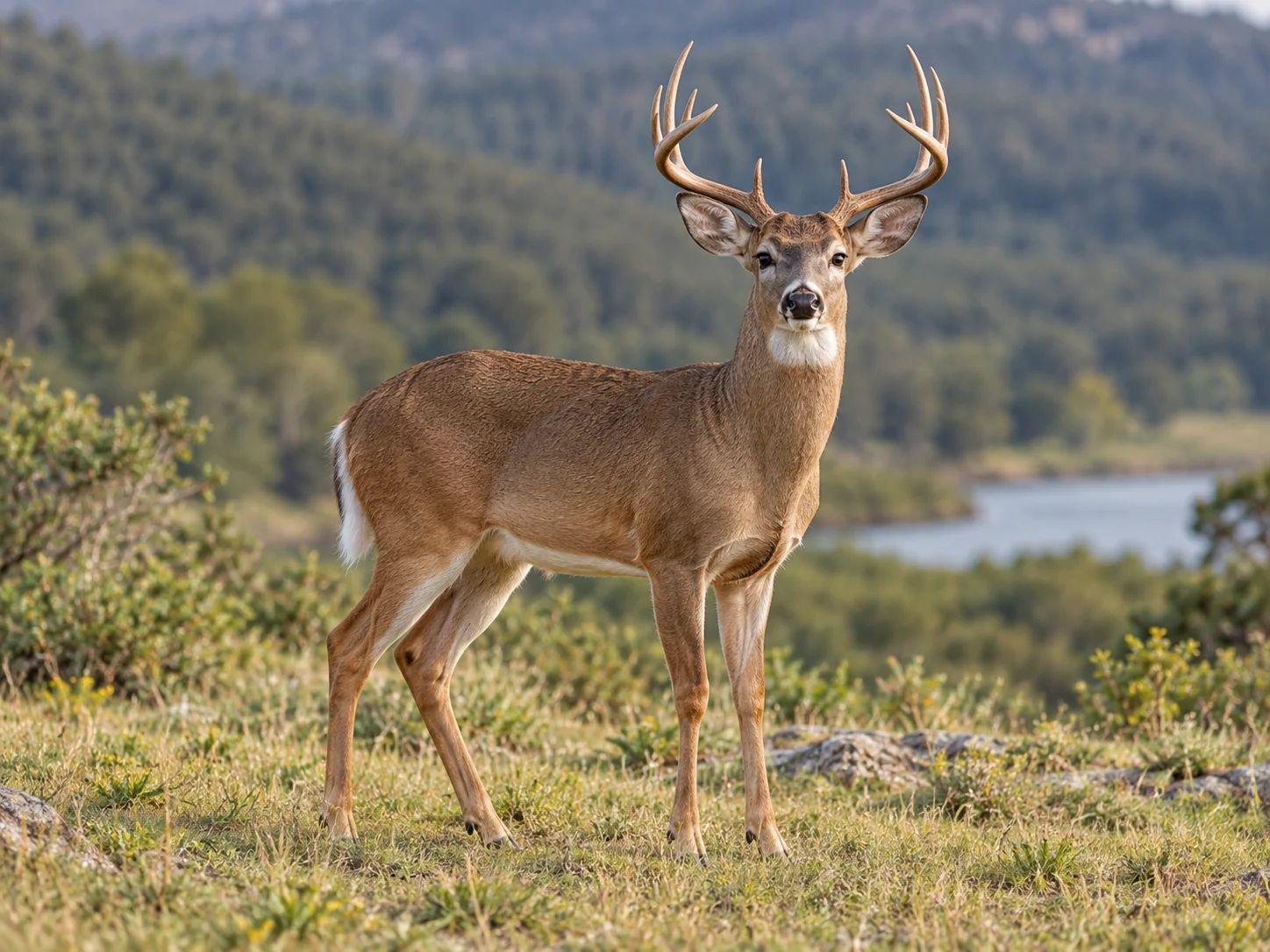
Meet the Deer
“Deer” is not one animal. It is a whole family of them, called Cervidae, and it holds around 50 species that range from the northern pudu, which is the size of a small dog, to the moose, which can stand taller than a horse.
What ties them together is on top of their heads. Deer grow antlers: solid bone, branched, and grown fresh every single year. No other family of animals on Earth does this.
Deer live wild on every continent except Australia and Antarctica, and people have carried them to plenty of places they never reached on their own. This page covers the family as a whole: what makes a deer a deer, how the species differ, and which animals get mistaken for them.
Scientific Name and Classification
Because deer are a family rather than a single species, they do not have one two-word scientific name the way a giraffe does. The family name is Cervidae, and each species inside it has a name of its own.
- Kingdom: Animalia
- Phylum: Chordata
- Class: Mammalia
- Order: Artiodactyla (even-toed hoofed animals)
- Family: Cervidae
Three things together make an animal a deer:
- Antlers. Grown from bone and shed every year. Every deer species has them except one, the Chinese water deer, which grows tusks instead.
- Even-toed hooves. Two large hooves carry the weight on each foot, with two small ones higher up at the back.
- A four-chambered stomach. Deer are ruminants. They swallow plant food quickly, then bring it back up later to chew it properly.
The family splits into two main branches: Cervinae, the Old World deer such as red deer and fallow deer, and Capreolinae, the New World deer such as white-tailed deer, moose and reindeer.
Counting deer species is harder than it sounds. Different authorities say 43, 47, 50 or 55, because experts disagree about where one species ends and the next begins. Around 50 is a fair answer.
Difference Between Antlers and Horns
This is the single most useful thing to know about deer, and almost everyone gets it wrong.
| Antlers (deer) | Horns (cattle, goats, antelope) |
|---|---|
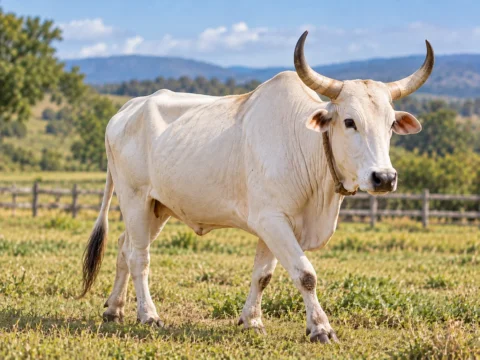
| Solid bone all the way through | A bony core wrapped in keratin, the stuff fingernails are made of |
| Grown fresh and shed every year | Kept for life and never shed |
| Branch into points called tines | Usually simple, curved or spiralled, not branched |
| Usually males only | Often both males and females |
| Covered in furry skin called velvet while growing | No velvet stage |
Growing antlers from scratch each year is enormously expensive. A big male can add several pounds of bone in a few months, which is some of the fastest tissue growth known in any mammal. He does it to compete for mates, then throws the whole lot away and starts again.
Two exceptions are worth remembering. In reindeer, also called caribou, females grow antlers too, the only deer where that is normal. And the Chinese water deer grows none at all, relying on long tusk-like canine teeth instead.
Types of Deer and Their Characteristics
A few of the species that show how much variety the family holds:
| Deer | Scientific name | Weight | Where it lives |
|---|---|---|---|
| Moose (elk in Europe) | Alces alces | 800-1,500 lb | Northern North America, Europe, Asia |
| Reindeer (caribou) | Rangifer tarandus | 200-400 lb | Arctic and sub-Arctic |
| Red deer | Cervus elaphus | 350-500 lb | Europe, western Asia, North Africa |
| White-tailed deer | Odocoileus virginianus | 100-300 lb | North, Central and South America |
| Fallow deer | Dama dama | 90-200 lb | Europe, introduced widely |
| Roe deer | Capreolus capreolus | 35-75 lb | Europe and Asia |
| Chinese water deer | Hydropotes inermis | 20-40 lb | China and Korea |
| Northern pudu | Pudu mephistophiles | 13-30 lb | Andes of South America |
Only one deer has ever been truly domesticated: the reindeer, herded across northern Europe and Asia for thousands of years.
Appearance and Anatomy
Across the family, weight runs from about 13 pounds to over 1,500, and shoulder height from roughly 14 inches to nearly 7 feet. Despite that spread, the basic build is consistent: a compact body, long slim legs, a short tail, and a head carried high.
Coats are usually brown, reddish or gray, often paler underneath, and many species change shade between summer and winter. Some, like the fallow deer and the young of many species, are spotted, which breaks up their outline in dappled woodland light.
The eyes sit on the sides of the head, giving a very wide field of view for spotting danger, and the ears swivel independently to track sound. Males of most species are noticeably larger than females, and carry the antlers.
Habitat and Range
Deer are native to the Americas, Europe, Asia and North Africa. They are absent in the wild from Australia and Antarctica, though people have introduced them to Australia, New Zealand and elsewhere, where they often become serious pests.
The family copes with an extraordinary range of conditions, from Arctic tundra to tropical rainforest, mountain slopes, grassland, swamp and farmland. Many species do best not deep inside forest but along its edges, where tree cover for hiding meets open ground for feeding.
Diet and Feeding
Deer are herbivores. They eat leaves, shoots, twigs, bark, grass, fruit, nuts, fungi and farm crops, and what is on the menu shifts with the seasons.
Being ruminants, they feed in bursts out in the open, filling the first stomach chamber quickly, then retreat to cover and bring the food back up to chew properly. That trick lets a deer spend as little time as possible standing exposed where a predator can see it.
Deer have no upper front teeth. They press leaves and grass against a hard pad on the roof of the mouth and tear, which is why browsed twigs look ragged rather than cleanly clipped.
Behavior and Lifestyle
Most deer are most active at dawn and dusk, which keeps them out of the heat and away from many hunters.
Social life varies enormously. Caribou gather in herds that can number tens of thousands and migrate hundreds of miles. Roe deer and pudus live alone or in twos. Many species split by sex outside the breeding season, with females and young in one group and males in another.
The breeding season is called the rut. Males roar, bellow or bark, thrash their antlers through vegetation, and lock antlers with rivals in shoving contests. Those fights settle who mates, and they are usually decided on size and stamina rather than injury.
Reproduction and Life Cycle
Most deer breed once a year, timed so the young arrive when food is plentiful. Pregnancy runs roughly six to nine months depending on the species.
One or two young is usual, occasionally three. A newborn deer, called a fawn or calf, is often spotted and nearly scentless. For the first weeks its mother leaves it lying still and hidden while she feeds nearby, returning only to nurse. A fawn alone in long grass has almost always not been abandoned.
Lifespan in the wild is commonly 10 to 20 years depending on species, though hunting, traffic and hard winters mean many deer never get close to that.
Predators and Threats
Deer are prey animals, and the list of things that hunt them is long: wolves, tigers, bears, lynx, cougars, leopards and wild dogs, with eagles and foxes taking young fawns.
Their defenses are speed, hearing, a very wide field of vision and the ability to freeze absolutely still. Many bound away with a stiff-legged gait that shows a predator it has been spotted and a chase is not worth starting.
Human pressures cut both ways. Habitat loss and hunting threaten some species badly. Elsewhere the opposite problem has appeared: with large predators gone, deer numbers in parts of North America and Europe have risen so high that they strip woodland of young trees and collide with vehicles in their millions.
Conservation Status
There is no single conservation status for deer, because the family holds around 50 species with very different fortunes.
Some are among the most abundant large mammals on Earth. White-tailed deer number in the tens of millions in North America, and red deer and roe deer are thriving across much of Europe.
Others are in real trouble. The Calamian deer, Bawean deer, hog deer and Persian fallow deer all appear on the IUCN Red List as threatened, usually because of hunting and the loss of the specific habitat they depend on. Pere David’s deer survives only because animals kept in European parks were used to rebuild the species after it died out in the wild in China.
So “are deer endangered?” has no single answer. It depends entirely on which deer.
Role in the Ecosystem
Deer are a central link in the food chain across the northern half of the world, turning plants into the prey that supports wolves, big cats and bears.
Their browsing shapes forests. By eating seedlings and stripping bark, deer decide which young trees survive, and in balanced numbers that keeps woodland varied. In excessive numbers it does the reverse, clearing out the understory and leaving forests that cannot replace themselves.
They also move plants around. Seeds catch in their coats and pass through their guts, and shed antlers are gnawed by mice, squirrels and porcupines for calcium, putting those minerals back into the soil.
Difference Between Deer and Antelope
Several animals look like deer without being deer at all.
- Antelope. Antelope belong to the cattle family, Bovidae, alongside cows, goats and sheep. The giveaway is on the head: antelope have permanent horns, not shed antlers.
- Musk deer. Despite the name, these belong to their own family, Moschidae. They have no antlers and the males have long tusks.
- Mouse deer, or chevrotains. Another separate family, Tragulidae. They are tiny, tusked and among the most primitive ruminants alive.
- Pronghorn. Often called the American antelope, it is neither deer nor antelope, but the last survivor of its own family. Its horns are shed, which no other horned animal does.
The quickest test in the field: if the headgear is branched and the animal is shedding it each year, it is a deer.