Meet the Eagle
An eagle can see a rabbit from two miles away. Its eyes are roughly the same size as a human adult’s, packed into a skull a fraction of ours, and it sees four to eight times more sharply than we do. Eagles are large hunting birds of the family Accipitridae, around 60 species of them, on every continent except Antarctica.
Those eyes are so large they cannot move much in their sockets, which is why an eagle turns its whole head to look at something.
There are about 60 species of eagle, on every continent except Antarctica, and they include the most powerful bird of prey alive.
Scientific Name and Classification
Eagles are not a single branch of the family tree, so they have no scientific name of their own. They are large birds of prey spread across several groups within the family Accipitridae.
- Kingdom: Animalia
- Phylum: Chordata
- Class: Aves
- Order: Accipitriformes
- Family: Accipitridae
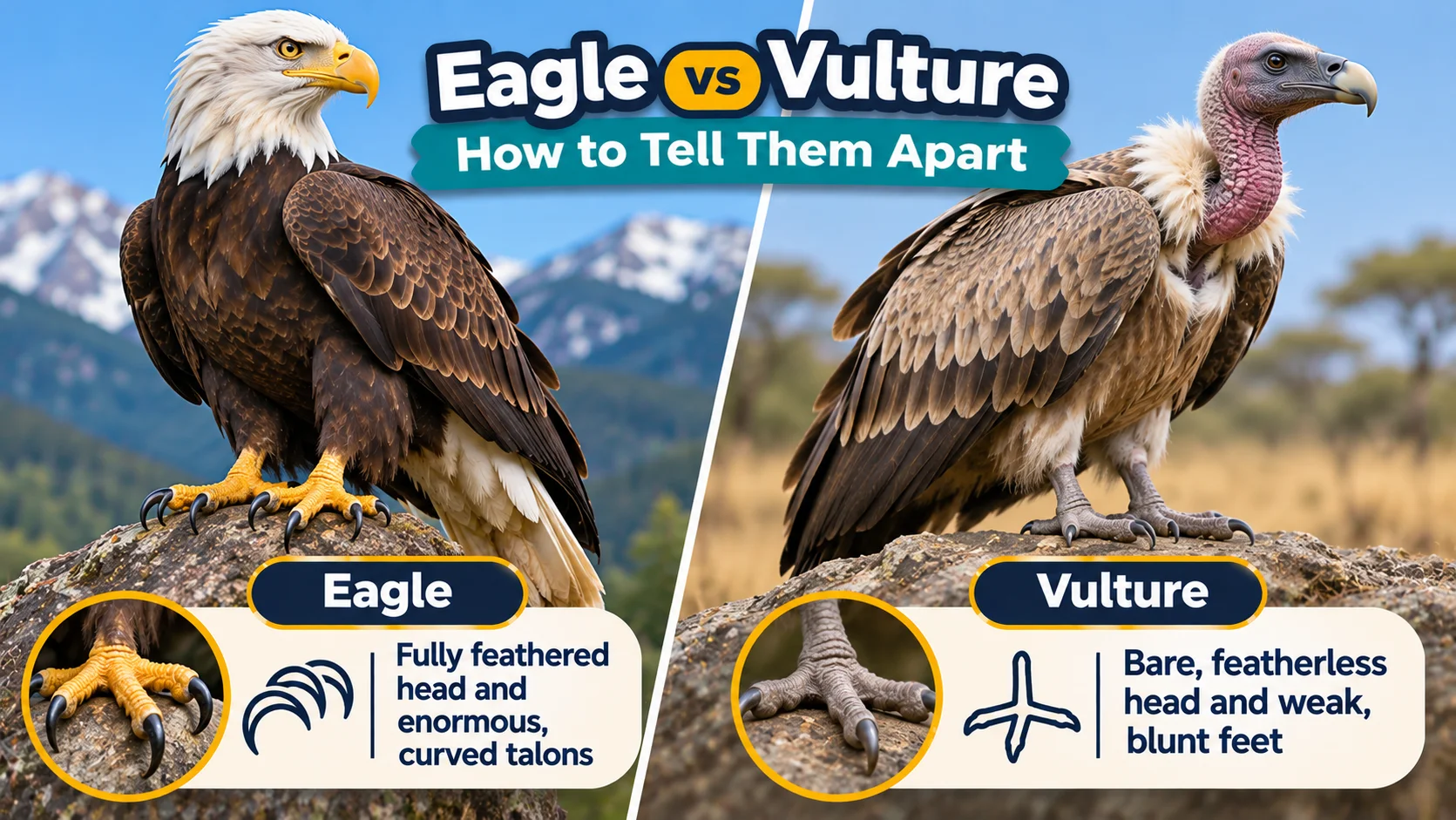
That family also holds hawks, kites and Old World vultures. “Eagle” is really a description for the big, heavy-beaked, powerful ones.
They fall into rough groups: sea eagles such as the bald eagle, booted eagles such as the golden eagle, snake eagles, and the enormous harpy-type eagles of tropical forest.
How Good Is an Eagle’s Eyesight?
Better than almost anything else alive, and for several reasons at once.
- Huge eyes. An eagle’s eyes are about the same size as an adult human’s, in a far smaller head. Together they weigh roughly as much as its brain.
- Densely packed receptors. The part of the retina responsible for sharp vision has about five times more light-sensing cells per area than ours.
- Two focal points per eye. Eagles have two foveae, one for looking forward and one for looking sideways, so they can track prey while scanning elsewhere.
- Ultraviolet vision. Some eagles and hawks see ultraviolet, which makes rodent urine trails visible as glowing paths across a field.
- A built-in visor. A bony ridge above the eye shades it from glare, and a clear third eyelid sweeps across to clean and protect without blinding the bird.
The cost of those eyes is that they barely move, so an eagle swivels its head instead, and it will cock its head sideways to bring the better focal point onto a distant target.
Types of Eagle and Their Characteristics
| Eagle | Where | Notable for |
|---|---|---|
| Harpy eagle | Central and South America | The most powerful; talons the size of a bear’s claws |
| Philippine eagle | The Philippines | Among the largest; Critically Endangered |
| Golden eagle | Northern hemisphere | Dives at over 150 mph |
| Bald eagle | North America | Fish specialist; national bird of the USA |
| Steller’s sea eagle | Russia and Japan | The heaviest eagle, up to 20 lb |
| Martial eagle | Africa | Takes prey as large as small antelope |
Appearance and Anatomy
Eagles range from small species around 18 inches long to giants with wingspans over 7 feet, weighing 1.5 to 20 pounds. Females are consistently larger than males, which is normal among birds of prey.
- Talons. The killing tools. A harpy eagle’s rear talon is around 5 inches long, and its grip can exceed the force of a human hand many times over.
- Beak. Deep and hooked, built for tearing rather than crushing.
- Wings. Broad with deeply slotted tips, for soaring on rising air with very little effort.
- Skeleton. Hollow bones, so the entire skeleton may weigh less than the feathers covering it.
- Feet. Rough-soled, and in fish eagles covered in spines called spicules to hold slippery prey.
Many eagles do not get their adult plumage for years. A bald eagle is brown and mottled until about five, when the white head finally appears.
Habitat and Range
Eagles live on every continent except Antarctica, in mountains, forest, coast, desert, savanna and tundra.
Different groups take different ground. Sea eagles stay near water, booted eagles hunt open country and mountains, and harpy eagles live inside dense rainforest canopy.
Most hold large territories and the same pair returns to the same nest year after year, adding to it each season. A bald eagle nest in Florida measured nearly 10 feet across and weighed over two tons, the largest tree nest ever recorded for any bird.
Diet and Feeding
Eagles are carnivores, taking fish, mammals, birds, reptiles and carrion depending on species.
They are specialists. Bald eagles take fish from the surface, golden eagles hunt rabbits and marmots, snake eagles eat venomous snakes, and harpy eagles pluck monkeys and sloths straight out of the canopy.
The kill is done with the feet, not the beak. An eagle strikes with its talons and crushes, then uses the beak only to tear the food apart.
They are also unashamed thieves, harassing ospreys and other birds into dropping their catch. Benjamin Franklin disliked the bald eagle for exactly this reason, calling it a bird of bad moral character.
Behavior and Lifestyle
Most eagles are solitary or live in pairs, and many pair for life.
They soar rather than flap wherever possible, riding columns of rising warm air to gain height for almost no effort, then gliding for miles.
Courtship is spectacular. Bald eagles perform a cartwheel display: two birds lock talons high in the air and tumble downward together, separating at the last moment.
Their calls often disappoint people. A bald eagle makes a weak chirping whistle, not the piercing scream used in films, which is almost always a red-tailed hawk dubbed over the top.
Reproduction and Life Cycle
Eagles build huge nests, called eyries, on cliffs or in tall trees, and reuse them for decades.
Clutches are small, usually one to three eggs, incubated for about 35 to 45 days by both parents.
Eggs hatch days apart, and in several species this has a grim consequence. The older, larger chick frequently kills its younger sibling, and the parents do not intervene. In some eagles the second egg is effectively an insurance policy that rarely survives.
Chicks fledge at two to three months but depend on their parents for months more. Harpy eagles raise a single chick only every two to three years.
Eagles live 20 to 30 years in the wild and longer in captivity.
Predators and Threats
Adult eagles have essentially no predators. Eggs and chicks are taken by other birds, raccoons and climbing mammals.
Human pressures have been severe: shooting, poisoning, habitat loss, collisions with power lines and wind turbines, and lead poisoning from eating animals shot with lead ammunition, which remains a major killer.
The pesticide DDT nearly destroyed the bald eagle. It thinned eggshells so badly that eggs broke under the weight of the incubating parent, and the species fell to a few hundred pairs in the United States before DDT was banned.
Conservation Status
There is no single status across about 60 species, and they span the full range.
The bald eagle is one of conservation’s great successes. From a few hundred breeding pairs in the lower United States it recovered to tens of thousands after DDT was banned and the bird was protected, and it came off the endangered list in 2007.
Others are in serious trouble. The Philippine eagle is Critically Endangered with a few hundred left, and several African and Asian eagles are declining fast.
The pattern is familiar: eagles need large territories, breed slowly and sit at the top of the food chain, which means they collect whatever poisons are in the system below them.
Role in the Ecosystem
As apex predators, eagles control the numbers of the animals they hunt and remove the sick and weak, which keeps prey populations healthier.
They also clean up carrion, more than their noble image suggests.
Their greatest value may be as a warning system. Because eagles accumulate whatever is in their prey, their decline revealed the damage DDT was doing long before people understood it, and lead poisoning in eagles is telling a similar story about ammunition today.
Protecting an eagle means protecting the large, intact territory it hunts over, which shelters a great deal else.