Meet the Bear
A hibernating bear does something doctors would like to understand. It spends months without eating, drinking or passing waste, loses almost no muscle, and recycles its own urine back into protein. A person lying still that long would be seriously ill.
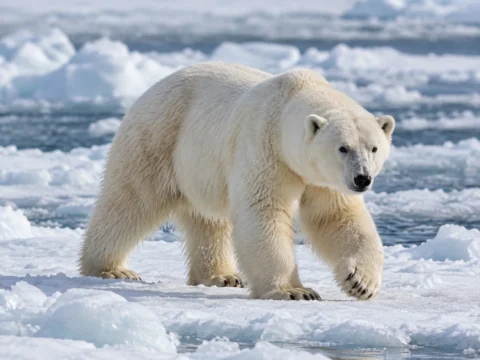
There are eight species of bear, from the polar bear at 1,500 pounds to the sun bear at under 150.
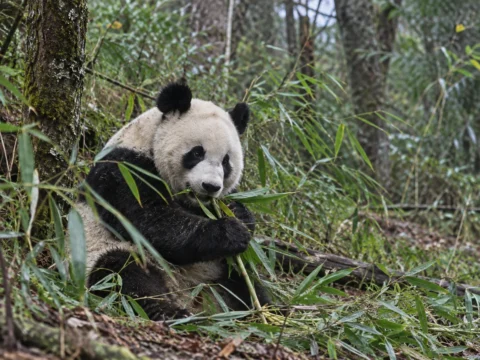
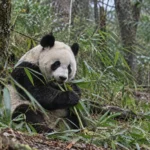
And the giant panda, despite eating almost nothing but bamboo, is a bear with the digestive system of a meat eater, which is exactly why it has to eat so much.
Scientific Name and Classification
Bears form the family Ursidae, with eight living species, so there is no single two-word name.
- Kingdom: Animalia
- Phylum: Chordata
- Class: Mammalia
- Order: Carnivora
- Family: Ursidae
Being in Carnivora does not mean bears eat only meat. The order is about ancestry, not diet, and most bears are omnivores.
Their closest relatives are seals, sea lions and walruses, which share a common ancestor with bears.
Types of Bear and Their Characteristics
| Bear | Where | Weight | Notable for |
|---|---|---|---|
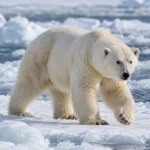
| Polar bear | Arctic | 700-1,500 lb | The largest; black skin under white fur |
| Brown bear (grizzly) | North America, Europe, Asia | 300-1,500 lb | Shoulder hump of digging muscle |
| American black bear | North America | 200-600 lb | The most numerous bear in the world |
| Asiatic black bear | Asia | 200-440 lb | White crescent on the chest |
| Giant panda | China | 200-250 lb | 99 percent of its diet is bamboo |
| Sloth bear | India, Sri Lanka | 120-310 lb | Sucks termites through a gap in its teeth |
| Sun bear | Southeast Asia | 60-150 lb | The smallest bear, with a 10-inch tongue |
| Spectacled bear | South America | 220-340 lb | The only bear in South America |
The sloth bear deserves a mention. It is missing two front teeth, leaving a gap it uses like a straw to suck termites out of their mounds, and the noise can be heard over 300 feet away.
How Does Hibernation Actually Work?
Not quite the way most people picture it.
A hibernating bear does not go into a deep cold sleep like a ground squirrel. Its body temperature drops only a few degrees, and it can wake up and move if disturbed. Scientists sometimes call it torpor rather than true hibernation.
What it does instead is remarkable. Through five to seven months a bear:
- Does not eat, drink, urinate or defecate at all.
- Drops its heart rate from around 50 beats a minute to as low as 8.
- Recycles its own urine, breaking the waste down and rebuilding it into protein.
- Loses almost no muscle or bone, despite months of lying still.
That last point is why medical researchers study bears. Humans lose muscle and bone density fast when immobile, which is a serious problem for bedridden patients and astronauts. Bears somehow do not.
Beforehand they go through hyperphagia, eating almost constantly and putting on huge amounts of fat. A brown bear can gain 3 to 4 pounds a day.
Females give birth during hibernation and nurse their cubs while still in the den, without eating anything themselves.
Appearance and Anatomy
Bears range from about 4 to 10 feet long and 60 to 1,500 pounds.
- Feet. Bears are plantigrade, walking on the whole sole like people rather than on their toes like dogs and cats. That is why a bear can stand up and walk a few steps on two legs.
- Claws. Non-retractable, for digging, tearing and climbing.
- Nose. Extraordinary. A bear’s sense of smell is many times better than a bloodhound’s, and a polar bear can smell a seal through three feet of ice.
- Teeth. A mix: sharp canines from their meat-eating ancestry, and broad flat molars for grinding plants.
- Hump. Brown bears have a shoulder hump of pure muscle that powers their digging. Black bears do not, which is a useful way to tell them apart.
Despite the bulk they are fast. A grizzly runs at about 35 miles an hour, faster than any human.
Habitat and Range
Bears live across North America, Europe, Asia and in one corner of South America. There are no bears in Africa or Australia.
Between them they occupy Arctic sea ice, mountain forest, bamboo forest, tropical rainforest, tundra and the edges of towns.
Black bears in particular have adapted to living near people, which is where most human-bear conflict comes from, and almost always starts with food left accessible.
Diet and Feeding
Most bears are omnivores, and plants usually make up most of the diet: berries, nuts, roots, grasses and fruit, plus insects, fish, carrion and occasionally larger prey.
Two species break the pattern. The polar bear is almost entirely a meat eater, living on seals. The giant panda is almost entirely a plant eater, living on bamboo.
The panda is the odd one, because it still has a carnivore’s short gut. Bamboo is poor food and it digests it badly, so it compensates by eating 25 to 85 pounds a day and spending up to 14 hours doing it. It did not evolve a better gut; it evolved patience.
Brown bears catching salmon are doing something seasonal and enormously important, as the next section explains.
Behavior and Lifestyle
Bears are mostly solitary, coming together only to mate, or at rich food sources such as a salmon run where dozens may tolerate each other in a loose hierarchy.
They are intelligent, with excellent memories for where food was found, and they learn fast. Bears work out latches, bins, coolers and car doors, which is why bear-proof containers have to be seriously engineered.
They communicate by scent, rubbing against trees and leaving claw marks high up as a measure of size.
Most bears avoid people. The usual cause of trouble is a bear that has learned to associate humans with food, and a bear that learns that is often killed as a result, which is where the saying a fed bear is a dead bear comes from.
Reproduction and Life Cycle
Bears use a trick called delayed implantation. A female mates in spring or summer, but the fertilized egg does not begin developing until fall, and only if she has put on enough fat. If the year was poor, the pregnancy simply does not start.
Cubs are born in the den in winter, tiny and helpless. A newborn brown bear weighs about a pound, roughly 1/500th of its mother, one of the smallest newborn-to-mother ratios of any mammal.
They nurse in the den while she continues to fast, and emerge in spring.
Cubs stay with their mother for one to three years, learning what to eat and where to find it. Bears live 20 to 30 years in the wild.
Predators and Threats
Adult bears have essentially no natural predators besides other bears, and males sometimes kill cubs.
Human threats are habitat loss, hunting, roads, and killing in response to conflict. Asiatic black bears and sun bears are also taken for bile farming and the trade in body parts.
Climate change is the central threat to polar bears, whose hunting depends on sea ice that is forming later and melting earlier each year.
Conservation Status
There is no single status for bears, since the family holds eight species in different situations.
American black bears and brown bears are doing well overall, with large and in places increasing populations.
Six of the eight species are considered threatened or vulnerable, including the polar bear, sun bear, sloth bear, spectacled bear and Asiatic black bear.
The giant panda is the success story. Once the global symbol of impending extinction, decades of habitat protection and reserve-building moved it from Endangered to Vulnerable, with wild numbers rising. It is one of the clearest proofs that sustained conservation work actually succeeds.
Role in the Ecosystem
Bears are major seed dispersers. A bear eating berries all fall spreads enormous numbers of seeds in its droppings, complete with fertilizer.
The salmon story is the striking one. Brown bears catch salmon and carry them into the forest to eat, leaving carcasses among the trees. Those fish carry nutrients from the ocean, and researchers can measure ocean-derived nitrogen in trees growing near bear fishing grounds. Forests beside salmon rivers grow measurably faster because bears carry the sea inland.
Their digging turns soil and aerates it, and the leftovers of their meals feed foxes, birds and insects.
Because bears need large wild areas, protecting them protects whole landscapes, which is why they are often used as a flagship for wilderness conservation.