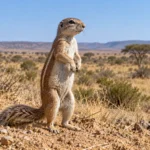
Meet the Squirrel
Most people picture one animal when they hear “squirrel”: a gray one running up a park tree with a nut in its mouth. The family is far bigger than that.
Squirrels are a family of nearly 280 species, and they include some animals you might not expect. Chipmunks are squirrels. So are prairie dogs, marmots and groundhogs. So are the flying squirrels that glide between trees in the dark.
They live almost everywhere on Earth except Australia and Antarctica, from Arctic tundra to tropical forest to city streets, and they are one of the few wild mammals most people see every single day.
Scientific Name and Classification
Squirrels are a family, not one species, so there is no single two-word scientific name. The family is Sciuridae, holding roughly 278 to 286 species in about 51 genera.
- Kingdom: Animalia
- Phylum: Chordata
- Class: Mammalia
- Order: Rodentia (rodents)
- Family: Sciuridae
Being rodents puts squirrels alongside mice, rats, beavers and porcupines. The defining rodent feature is the teeth: four chisel-shaped front incisors that never stop growing and are worn short by constant gnawing.
The name comes from Greek skiouros, from skia meaning shadow and oura meaning tail. The shadow-tailed animal, for the way it sits in the shade of its own tail.
Types of Squirrel and Their Characteristics
The family divides neatly into three ways of living.
| Group | Where they live | Tail | Examples |
|---|---|---|---|
| Tree squirrels | In trees, nesting in dreys or hollows | Long and bushy | Eastern gray squirrel, red squirrel, fox squirrel |
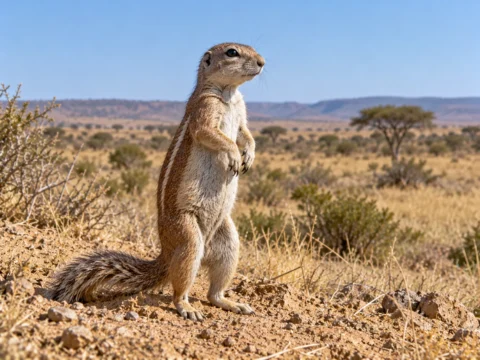
| Ground squirrels | In burrows, often in colonies | Furry but not bushy | Chipmunks, prairie dogs, marmots, groundhogs |
| Flying squirrels | In trees, mostly active at night | Flat, used as a rudder | Northern and southern flying squirrels |
The size range is startling. The African pygmy squirrel is about 5 inches long from nose to tail tip. The Indian giant squirrel reaches roughly 3 feet.
Difference Between Squirrel and Chipmunk
Start with the part that surprises people: a chipmunk is a squirrel. It belongs to the family Sciuridae, in the ground squirrel group. So the real question is how to tell a chipmunk from the tree squirrel in your garden.
- Stripes on the face. This is the clincher. Chipmunks have stripes running across the face as well as down the back. No tree squirrel does.
- Size. A chipmunk is much smaller, usually 4 to 7 inches of body.
- Tail. Chipmunk tails are thinner and often carried straight up. Tree squirrel tails are long and plumed.
- Cheeks. Chipmunks have stretchy cheek pouches and stuff them until the head looks swollen. Tree squirrels carry food in their mouths.
- Where you see them. Chipmunks stay low, darting along walls and logs. Tree squirrels are usually up a trunk.
Golden-mantled ground squirrels confuse this nicely: they have body stripes but no face stripes. Check the face.
Appearance and Anatomy
Across the family, squirrels run from about 5 inches to 3 feet including tail, and from under an ounce to around 18 pounds for a big marmot.
The body plan is consistent: slim, with strong hind legs, sharp curved claws and large dark eyes set high and wide for a broad field of view.
- Teeth. Four front incisors that grow continuously, backed by grinding cheek teeth.
- Tail. It does several jobs: balance along a branch, a rudder in mid-leap, a blanket in cold weather, a sunshade, and a signal flag flicked in warning.
- Ankles. Tree squirrels can rotate their hind feet almost backwards, which lets them come down a trunk head-first, gripping with the back claws.
- Patagium. In flying squirrels, a furred flap of skin from wrist to ankle. Spread out, it turns the animal into a kite.
Habitat and Range
Squirrels live across the Americas, Europe, Asia and Africa. They are naturally absent from Australia and Antarctica, and from most oceanic islands.
Within that range they take almost every habitat going: broadleaf and conifer forest, grassland, desert edge, mountain slope and rainforest. Himalayan marmots live well above the tree line.
They also do unusually well around people. Parks, gardens and tree-lined streets suit tree squirrels perfectly, which is why most people’s regular wildlife sighting is a squirrel.
Diet and Feeding
Squirrels are omnivores, despite the nut-eating reputation.
Nuts, seeds, acorns, pine cones, fruit, buds, bark and fungi make up most of it. But squirrels also take insects, eggs, nestling birds, small lizards and, when desperate, carrion. A squirrel is an opportunist, not a vegetarian.
The famous behavior is food caching. Tree squirrels are scatter-hoarders: instead of one big store they bury thousands of individual nuts across their range and relocate them later by memory and smell. They do not find them all, and the ones they miss are the point, ecologically speaking.
They also bluff. A squirrel that thinks it is being watched will dig a hole, mime burying something, and cover the empty hole up.
Behavior and Lifestyle
Most squirrels are active by day, with flying squirrels the main exception.
Social life varies hugely. Tree squirrels are largely solitary and defend a patch. Prairie dogs do the opposite, living in huge colonies called towns with an alarm-call system detailed enough that researchers can tell from the call whether the danger is a hawk, a coyote or a person.
Winter strategies differ too. Tree squirrels do not truly hibernate; they sit out bad weather in a nest and live off caches. Many ground squirrels, marmots and groundhogs are deep hibernators, dropping their body temperature close to freezing for months.
Flying squirrels do not fly. They climb high, launch, spread the skin flaps and glide, steering with the tail. A long glide can cover 150 feet or more, ending with an upward swoop to land softly on a trunk.
Reproduction and Life Cycle
Many squirrels breed twice a year, typically late winter and midsummer, though it varies by species and climate.
Pregnancy runs about 30 to 45 days and produces two to eight young. They arrive blind, hairless and entirely helpless, in a tree nest called a drey, a hollow, or an underground burrow.
Eyes open at around four to five weeks. The young are weaned by about two months and usually independent by three, though they often stay near their mother through their first winter.
Life is short and risky. Many squirrels die in their first year; those that survive typically live 5 to 10 years in the wild, and captive animals have reached about 20.
Predators and Threats
Squirrels are prey for almost every medium-sized hunter: hawks, eagles, owls, foxes, weasels, martens, bobcats, snakes and domestic cats. Flying squirrels are hunted largely by owls.
Their defenses are alertness and speed. They freeze, they put a tree trunk between themselves and the threat, they flick the tail and scold loudly, and ground-dwellers bolt for a burrow. The zig-zag run of a squirrel crossing open ground is designed to make a predator commit too early.
From people, the pressures are habitat loss, road traffic and, for some species, competition from introduced squirrels. The eastern gray squirrel brought to Britain and Italy has displaced native red squirrels across much of their range, partly by out-competing them and partly by carrying a virus that grays tolerate and reds do not.
Conservation Status
There is no single status for squirrels, because the family holds close to 280 species in very different situations.
The familiar ones are thriving. Eastern gray squirrels have expanded their range well beyond their native North America, and several ground squirrels are common enough to be treated as agricultural pests.
Others are in serious trouble, usually those confined to one island or mountain. Several Indonesian flying squirrels are endangered, the Namdapha flying squirrel of India is Critically Endangered, and species such as the Idaho ground squirrel and the San Joaquin antelope squirrel are threatened by habitat loss.
Role in the Ecosystem
Squirrels plant trees, and they do it by accident. A scatter-hoarding squirrel buries thousands of nuts a year and fails to retrieve a good share of them. Each forgotten acorn is a seed planted at exactly the right depth, often well away from the parent tree. Oak and hickory forests across North America owe much of their spread to squirrel forgetfulness.
They spread fungi too. Squirrels eat truffles and other underground fungi and pass the spores in their droppings, which matters because those fungi partner with tree roots and help forests grow.
Burrowing species turn and aerate soil, and their abandoned tunnels shelter burrowing owls, snakes and insects. Prairie dog towns support so many other animals, including the endangered black-footed ferret, that the species is considered a keystone of the North American grassland.
And across the board, squirrels are prey, converting seeds and nuts into food for everything that hunts them.