Meet the Wolf
A wolf pack is not a gang of rivals ruled by the toughest animal. It is a family: a breeding pair and their children of different ages.
The idea of the alpha wolf fighting its way to the top came from studies of unrelated captive wolves thrown together in enclosures, which is a bit like studying human families by watching strangers in a prison yard. The researcher who popularized the term later spent years trying to retract it.
Wolves are also the ancestors of every dog alive, and one of the clearest demonstrations anywhere of how a single predator shapes an entire landscape.
Scientific Name and Classification
The gray wolf’s scientific name is Canis lupus. It is the largest wild member of the dog family.
- Kingdom: Animalia
- Phylum: Chordata
- Class: Mammalia
- Order: Carnivora
- Family: Canidae
- Genus: Canis
- Species: Canis lupus
Several subspecies exist, including the Arctic wolf, the Eurasian wolf and the Mexican wolf. Other species carry the name too: the red wolf of the southeastern United States and the Ethiopian wolf, which is Africa’s rarest carnivore.
Dogs descend from wolves, but not from any wolf alive today. Both came from a wolf population that is now extinct, which makes a modern wolf a dog’s cousin rather than its ancestor.
Is There Really an Alpha Wolf?
Not in the way the word is used.
The idea came from research in the 1940s on captive wolves: unrelated adults put together in an enclosure, who fought for rank because they had no choice. That is where the picture of a wolf battling its way to alpha came from.
Wild wolf packs do not work like that. A pack is a family, normally a mated pair and their offspring from several years. The parents lead because they are the parents, not because they won fights.
Biologist David Mech wrote the book that spread the alpha idea, then spent decades correcting it after studying wild wolves, and has asked publishers to stop reprinting it.
The correction matters beyond wolves, because the alpha story became advice about dog training and about people, and it was never true of either.
Appearance and Anatomy
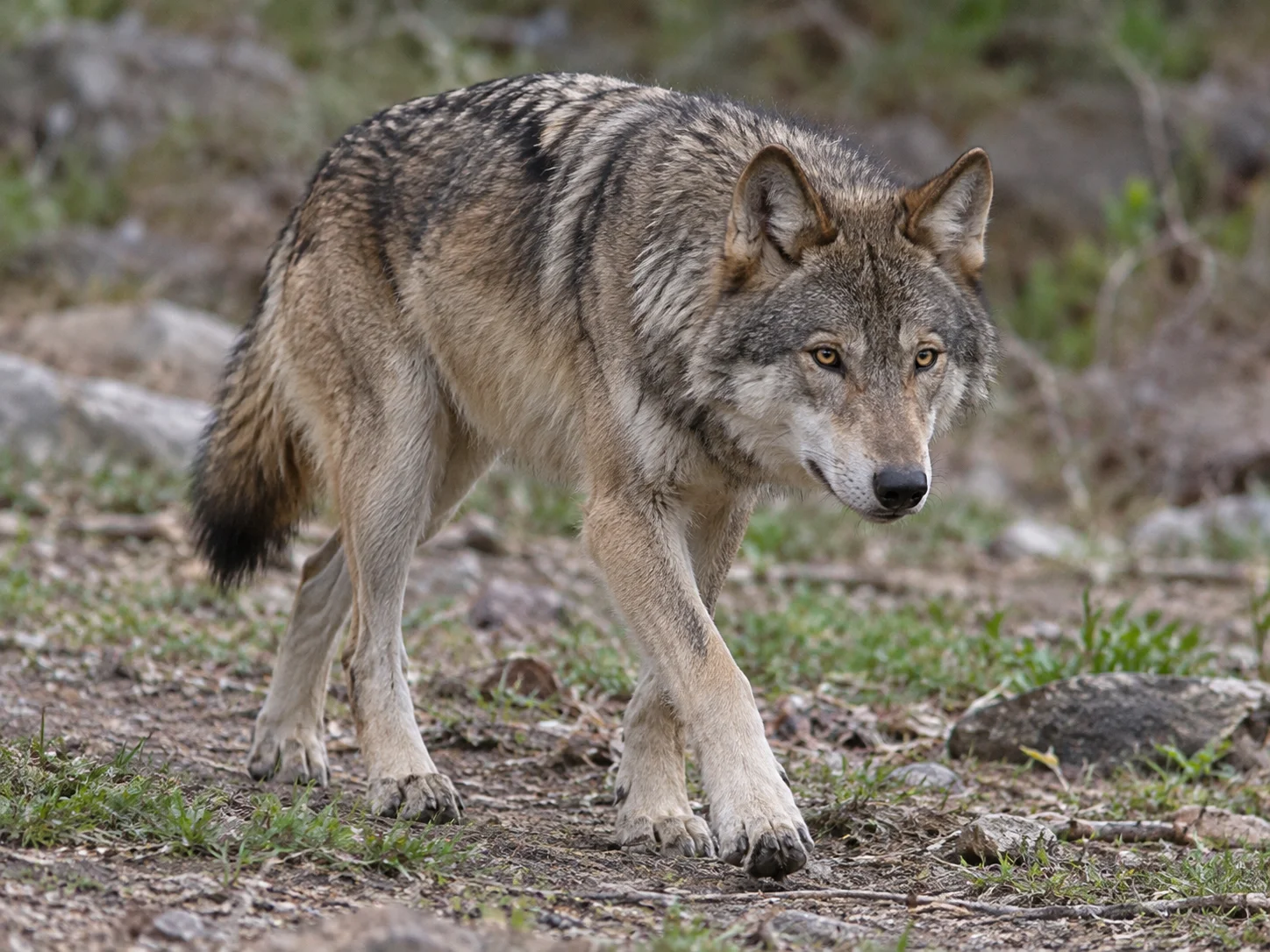
Gray wolves measure 4 to 6 feet from nose to tail and stand 26 to 32 inches at the shoulder, weighing 60 to 145 pounds. Northern wolves are much larger than southern ones.
- Jaws. Powerful enough to crack the leg bones of large prey to reach the marrow.
- Legs. Long and narrow-chested, built for distance rather than sprinting. A pack may cover 30 miles in a day.
- Feet. Large, which spread weight on snow, and wolves walk with the hind foot landing in the front footprint to save energy.
- Coat. Two layers: a dense insulating undercoat and long guard hairs that shed water. Wolves are comfortable at minus 40.
- Nose. Smell up to 100 times keener than ours, able to detect prey nearly two miles away.
Wolves are commonly mistaken for large dogs, but they have longer legs, bigger feet, narrower chests and a straighter tail that hangs rather than curls.
Habitat and Range
Wolves live across North America, Europe and Asia, in forest, tundra, mountain, grassland, desert and swamp.
They once had one of the largest ranges of any land mammal, covering most of the northern hemisphere. Humans removed them from the great majority of it.
Packs hold territories that run from 50 to over 1,000 square miles, depending on how much prey is available, and they patrol and scent-mark the boundaries constantly.
Wolves have returned to parts of Europe on their own in recent decades, walking back into countries that eradicated them centuries ago.
Diet and Feeding
Wolves are carnivores, hunting deer, elk, moose, caribou, bison and wild boar, with smaller animals taken when large prey is scarce.
Hunting as a pack lets them tackle animals many times their own size. A moose can weigh ten times what a wolf does.
Most hunts fail. Wolves test a herd, looking for an animal that is old, sick, injured or young, and the great majority of chases end with the prey escaping. They are not efficient killers so much as persistent ones.
They feast and fast. A wolf can eat 20 pounds of meat in one sitting, then go a week or more without food.
Behavior and Lifestyle
Pack life is cooperative. Wolves hunt together, raise pups together, defend territory together, and bring food back to animals that stayed behind.
Howling is the famous sound and it does several jobs: assembling the pack, warning rival packs off, and keeping in contact across distance. A howl carries up to 10 miles in open country. Wolves recognize each other individually by voice.
They do not howl at the moon. They howl at night because that is when they are active, and tilting the head upward simply projects the sound further.
Young wolves usually leave at one to three years old to find a mate and territory of their own, sometimes traveling hundreds of miles to do it.
Reproduction and Life Cycle
Normally only the breeding pair in a pack produces pups, which keeps the family to a size the territory can feed.
Pregnancy lasts about 63 days and produces four to six pups, born blind and deaf in a den.
The whole pack helps. Older siblings babysit, and returning hunters regurgitate meat for the pups and for whoever stayed at the den.
Pups emerge at around three weeks and join hunts by fall. Wolves live 6 to 8 years in the wild, occasionally to 13, and longer in captivity.
Predators and Threats
Adult wolves have few natural enemies besides other wolves. Fights between packs over territory are a leading cause of death.
Prey can kill them too. A moose or elk defending itself regularly injures or kills wolves, which is one reason most hunts are abandoned.
The real threat has always been people. Wolves were deliberately exterminated across Europe and most of the United States through shooting, trapping and poisoning, and they remain the most politically contested animal in conservation, because they kill livestock and feelings about them run very deep.
Conservation Status
The gray wolf is listed as Least Concern globally, because it still occupies a large area of Canada, Russia and central Asia with healthy numbers.
That global figure hides a great deal. Wolves were wiped out across western Europe, the British Isles, Japan and most of the lower United States, and many regional populations remain small and vulnerable.
Other wolves are in serious trouble. The red wolf is Critically Endangered with only a few dozen left in the wild, and the Ethiopian wolf numbers around 500.
The direction of travel is mixed but hopeful in places: wolves have recolonized much of Europe by walking back in, and legal protection has allowed recovery in several countries.
Role in the Ecosystem
Wolves are the textbook example of a keystone predator, and Yellowstone is the case everyone cites.
Wolves were exterminated there by the 1920s. Elk numbers rose and they grazed freely along rivers, stripping young willow and aspen. When wolves were reintroduced in 1995, elk began avoiding open valley bottoms where they were exposed, trees recovered along the streams, and beavers, songbirds and other species followed.
It is worth being accurate about this, because the story is often overstated. Wolves did not single-handedly change the course of rivers, and other factors including climate and bear and cougar numbers played a part. But the core finding holds: predators change where prey dares to feed, and that reshapes the landscape.
Wolves also remove sick and weak animals, limit disease spread in deer herds, and leave carcasses that feed ravens, eagles, foxes, bears and beetles. A wolf kill supports a surprising number of animals that never hunt anything.