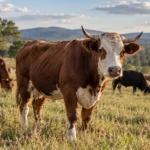
Meet the Ox
An ox is not a species. It is a job.
An ox is a castrated male of the cattle species, Bos taurus, that has been trained to work: pulling plows, carts, logs and sledges. He is usually at least four years old, because training takes years and the animal needs his full strength.
Oxen built a great deal of the world. For thousands of years, before tractors, they were the main source of power on farms across Europe, Asia and Africa, and in many places they still are.
The plural, usefully, is oxen rather than oxes.
Scientific Name and Classification
An ox is Bos taurus, the same species as every cow and bull. There is no separate scientific name, because “ox” describes what the animal does, not what it is.
- Kingdom: Animalia
- Phylum: Chordata
- Class: Mammalia
- Order: Artiodactyla
- Family: Bovidae
- Genus: Bos
- Species: Bos taurus
Watch out for two animals with ox in the name that are not oxen at all. The musk ox of the Arctic is a different species, Ovibos moschatus, more closely related to goats and sheep. The wild ox, or aurochs, is the extinct ancestor of all cattle.
Difference Between an Ox, a Steer and a Bull
This is the distinction almost everyone gets wrong, and it is simple once you see it.
| Castrated? | Purpose | Typical age | |
|---|---|---|---|
| Bull | No | Breeding | From 2 years |
| Steer | Yes | Beef | Slaughtered around 18 months |
| Ox | Yes | Work | 4 years and older |
Castration matters because an intact bull is too unpredictable to work safely beside people all day. A castrated male keeps the size and strength but becomes calm enough to be driven, year after year, often in a team.
Appearance and Anatomy
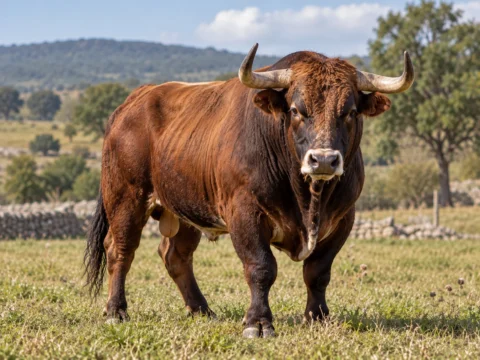
An ox stands roughly 5 to 6 feet at the shoulder and weighs 1,200 to 2,600 pounds, depending on breed.
Castration before maturity changes the build. An ox grows taller and longer-limbed than a bull of the same breed, because the growth plates in his bones stay open longer, but he does not develop the bull’s heavy shoulder crest. The result is a tall, powerful, rangy animal rather than a bulky one.
- Horns. Usually kept, because a traditional yoke rests against them and the horns help hold it in place.
- Neck and shoulders. Strong, but smoother than a bull’s; the pulling power comes from the whole frame.
- Feet. Cloven hooves, often shod with iron plates in working teams, since an ox walking stony roads wears his hooves down.
- Stomach. Four chambers, like all cattle, letting him work on grass and hay alone.
Habitat and Range
Working oxen are found on farms across Asia, Africa and parts of South America, and in smaller numbers in Europe and North America where traditional farming and heritage projects keep the skills alive.
They remain genuinely important in places where tractors are impractical: steep terrain, flooded rice paddies, soft forest soil, and smallholdings too small to justify machinery. An ox needs no fuel, repairs itself, runs on grass, and produces fertilizer.
Diet and Feeding
Oxen are herbivores and ruminants, living on grass, hay, straw and crop residues, with grain added when work is heavy.
That is the quiet advantage of an ox. He converts rough grazing that humans cannot eat into pulling power, on land that would otherwise grow nothing useful.
A working ox eats around 2 to 3 percent of his body weight in dry feed a day and needs plenty of water, more on hot working days. Like all cattle he spends hours chewing cud, which is why ox teams rest at midday.
Behavior and Lifestyle
Oxen are calm, patient and highly trainable, which is the entire point of using them.
Training starts young, often as calves, and takes years. A teamster works a pair together until they move as one unit, responding to voice commands and the touch of a stick rather than reins. Traditional commands in English-speaking countries include gee for right and haw for left, words that have been in use for centuries.
Oxen are usually worked in pairs, yoked at the neck or horns, and a pair that has trained together stays together. Splitting a bonded team upsets both animals and ruins their rhythm.
They are slower than horses but stronger for sustained heavy pulling, steadier on bad ground, and far cheaper to keep.
Reproduction and Life Cycle
Oxen cannot breed. Castration is what makes them workable, and it is irreversible.
Every ox therefore begins as a bull calf, castrated young, selected for size and temperament, and trained from a few months old. He reaches full working strength at around four, which is when the word ox properly applies, and may work for another ten to fifteen years.
Because a working ox is valuable and takes years to train, he is often kept well past the age at which a beef animal would be slaughtered, and may live 15 to 20 years.
Predators and Threats
A full-grown ox is too large for most predators, though wolves, big cats and hyenas take cattle where their ranges overlap.
The practical threats are working ones: lameness from hard roads, yoke sores from badly fitted harness, heat stress, and overwork. Good teamsters watch for all four, because a lame ox cannot work and an ox that cannot work is a serious loss to a small farm.
Conservation Status
Cattle are domestic animals and are not assessed by the IUCN.
What is disappearing is the knowledge. As tractors spread, the number of working oxen has fallen sharply and the skill of training and driving them is being lost, along with the breeds best suited to draft work. Heritage farms, living museums and some development projects are deliberately keeping both alive, partly because draft animals still make sense on small farms in much of the world.
Role in the Ecosystem
Oxen graze like other cattle, keeping grassland open and returning nutrients through their dung.
Their environmental case is unusual among farm animals. An ox replaces a machine rather than producing meat or milk, so a farm using oxen burns no diesel and compacts its soil far less than a tractor does. In forestry, horses and oxen are still used to pull logs out of woodland precisely because they do less damage to the ground and the remaining trees.
They still produce methane, as all cattle do. But an ox is the one form of cattle kept chiefly to do work that would otherwise need fuel.