Meet the Fox
A fox hunting in deep snow does something that sounds impossible. It listens, tilts its head, then leaps straight up and dives nose-first through the snow to catch a mouse it cannot see.
Stranger still, it works far better when the fox jumps facing roughly north, and nobody is quite sure why. One idea is that foxes can sense Earth’s magnetic field and use it to judge distance.
Foxes are among the most adaptable animals alive. There are around 37 species of fox, and the red fox has the widest natural range of any wild land mammal except people.
Scientific Name and Classification
“Fox” covers several groups, so there is no single two-word name. The true foxes belong to the genus Vulpes, with around 12 species including the familiar red fox, Vulpes vulpes.
- Kingdom: Animalia
- Phylum: Chordata
- Class: Mammalia
- Order: Carnivora
- Family: Canidae
- Main genus: Vulpes
Foxes are in the dog family alongside wolves and domestic dogs, but they are not small wolves. They sit on a separate branch and behave very differently: wolves hunt in packs, foxes hunt alone.
Some animals called foxes are not true foxes at all, including the gray fox of North America and the bat-eared fox of Africa. They are relatives on other branches of the dog family.
Types of Fox and Their Characteristics
| Fox | Where | Weight | Notable for |
|---|---|---|---|
| Red fox | Across the northern world | 7-15 lb | The most widespread wild land mammal after people |
| Arctic fox | Arctic tundra | 7-17 lb | Coat turns white in winter; survives minus 70 |
| Fennec fox | Sahara Desert | 2-3 lb | The smallest fox, with enormous ears |
| Gray fox | The Americas | 7-13 lb | Climbs trees, which almost no other dog can do |
| Bat-eared fox | Africa | 7-12 lb | Eats mainly termites; has 48 teeth |
The ears tell you the climate. A fennec in the Sahara has huge ears that radiate heat away; an arctic fox has tiny ones that lose as little as possible. Same problem, opposite answers.
Appearance and Anatomy
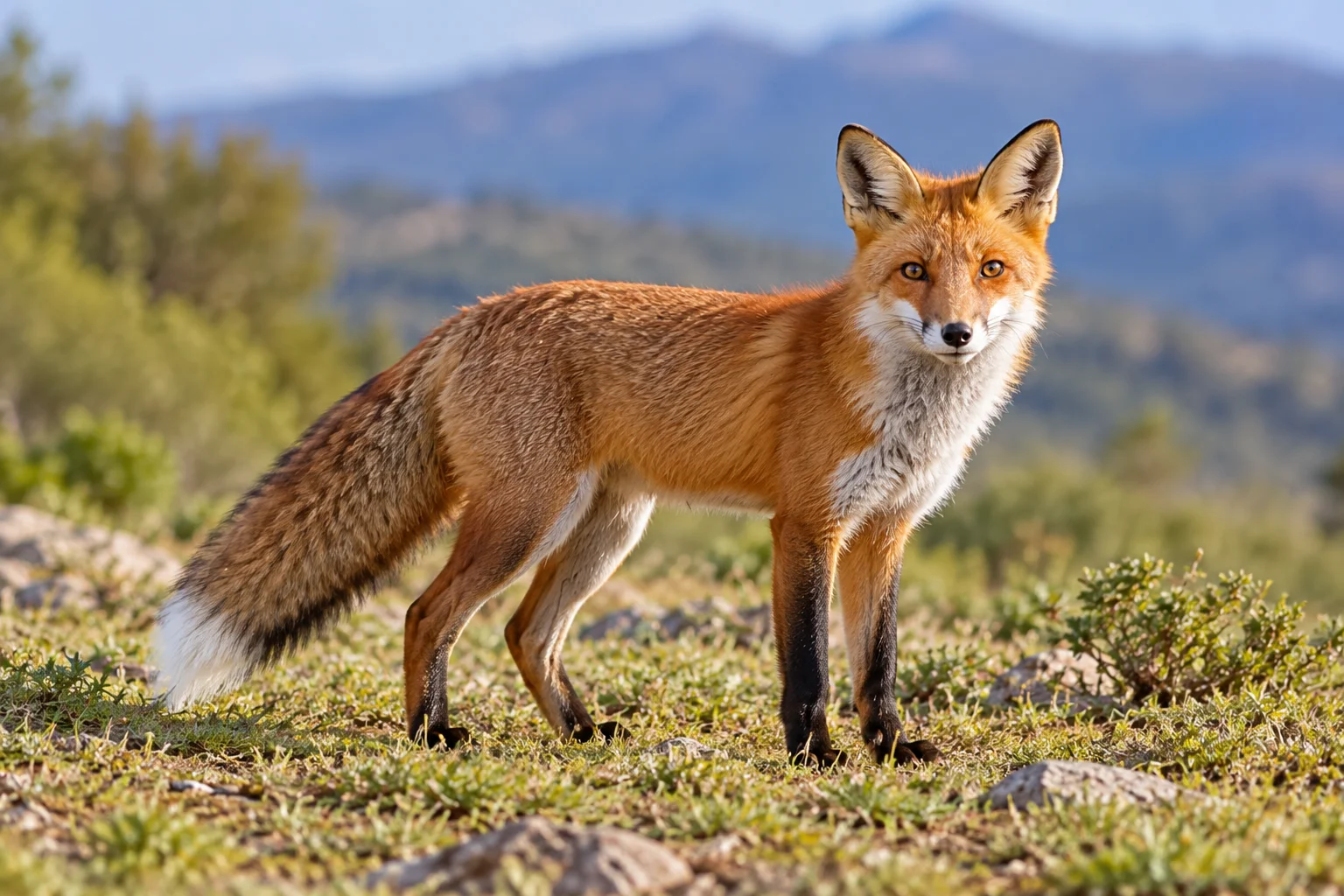
Foxes measure 1.5 to 3 feet in the body with a tail of 1 to 2 feet, and weigh 2 to 17 pounds depending on species. They look bigger than they are, because most of the bulk is fur.
- Tail, called a brush. Used for balance when running, as a signal to other foxes, and wrapped around the body like a blanket when sleeping.
- Ears. Large and able to swivel, tuned to low-frequency sounds. A fox can hear a mouse moving underground from several feet away.
- Whiskers. On the face and, unusually, on the legs, helping it feel its way in the dark.
- Eyes. Vertical slit pupils, like a cat’s, and a reflective layer behind the retina for night vision. Most dogs have round pupils.
- Legs. Slim and light, built for pouncing rather than long chases.
In several ways a fox is the most cat-like member of the dog family: slit pupils, partly retractable claws in the gray fox, and a hunting style based on stalking and pouncing rather than running prey down.
Habitat and Range
Foxes live on every continent except Antarctica, in forest, grassland, mountain, desert, tundra and increasingly in cities.
The red fox is the champion. Its natural range covers almost the whole northern hemisphere, and it was introduced to Australia, where it has become a serious problem for native wildlife.
Urban foxes are now common across Britain, Europe, North America and Japan, living on scraps, rodents and whatever gardens offer. A city fox may have a territory of less than a square mile, where a country fox needs several.
Diet and Feeding
Foxes are omnivores, and that flexibility is exactly why they are everywhere.
They eat rodents, rabbits, birds, eggs, insects, worms, frogs, fruit, berries and, in towns, a great deal of human garbage. Bat-eared foxes specialize in termites, and arctic foxes follow polar bears to scavenge what they leave.
The hunting style is the famous part: the mouse pounce. A fox listens, works out exactly where the sound is coming from, then leaps high and comes down nose-first, pinning the prey. Through snow it cannot see at all.
Foxes also cache food, burying surplus and covering it, then relocating it later by memory and smell.
Behavior and Lifestyle
Foxes are mostly solitary, which sets them apart from wolves and most other dogs. They hunt alone and defend a territory, though pairs raise cubs together and related females sometimes help.
They are active mainly at night and around dawn and dusk, especially near people.
They are also noisy. Foxes have a large vocabulary, and the sound that startles people awake at night is the vixen’s scream, a harsh drawn-out shriek used mainly in winter during the breeding season.
Their reputation for cleverness is earned. Foxes solve problems, learn fast, remember where food was cached months earlier, and adapt their behavior to whatever people do, which is why they thrive in cities.
Reproduction and Life Cycle
Foxes breed once a year, usually in winter. Pregnancy lasts about 52 days and produces four to six cubs, sometimes more.
Cubs are born in an underground den called an earth, blind, deaf and dark gray. Their eyes open at around two weeks.
The vixen stays with them at first while the dog fox brings food to the den. Cubs emerge at about four weeks, play outside through the summer, and disperse in the fall.
Wild foxes live only 2 to 5 years on average, with many cubs dying in their first year. In captivity they reach 14.
Can a Fox Be a Pet?
Not really, and the reasons are worth knowing.
Foxes are wild animals. Even hand-raised ones keep a strong smell that cannot be washed away, dig constantly, mark indoors with urine, and are awake and busy at night. They are illegal to keep in many places.
There is one famous exception, and it is a scientific experiment rather than a pet trade. Russian researchers began breeding silver foxes in 1959, selecting only for friendliness toward people. Within a few dozen generations the foxes wagged their tails, sought out human company and whined for attention. They also changed physically, developing floppy ears, curled tails and patches of white fur that nobody selected for.
That accidental result is one of the most important findings in the study of domestication, because it suggests tameness and those physical traits are linked. It is likely much the same thing happened to dogs.
Predators and Threats
Wolves, coyotes, eagles, large owls, bears and big cats all kill foxes, and cubs are vulnerable to much more. Coyotes in particular kill red foxes and push them out of their territories.
The pressures from people vary by place. Foxes are hunted for fur and shot as pests, and vast numbers are killed on roads. Mange is a serious disease in many populations.
For arctic foxes, the threat is warming. As the tundra heats, red foxes move north and displace them, being larger and stronger.
Conservation Status
There is no single status for foxes, with around 37 species involved.
Most are doing well, and the red fox is one of the great success stories of adapting to a human world.
A few are in trouble. Darwin’s fox of Chile is Endangered with only a few hundred animals, and the island fox of California crashed to near-extinction before a recovery program brought it back, one of the fastest mammal recoveries ever achieved.
In Australia, introduced red foxes are the problem rather than the victim, having driven several native species toward extinction.
Role in the Ecosystem
Foxes are important rodent controllers. A single fox eats thousands of mice and voles a year, which matters to farmers and to the spread of rodent-borne disease.
They also spread seeds. Foxes eat a lot of fruit in late summer and pass the seeds in their droppings, often well away from the parent plant.
Arctic foxes do something unexpected. Their dens are used for generations and are so enriched by droppings and food scraps that the tundra around them grows noticeably greener and lusher, visible from the air as bright patches in an otherwise bare landscape.
And as scavengers, foxes clean up carrion that would otherwise rot.