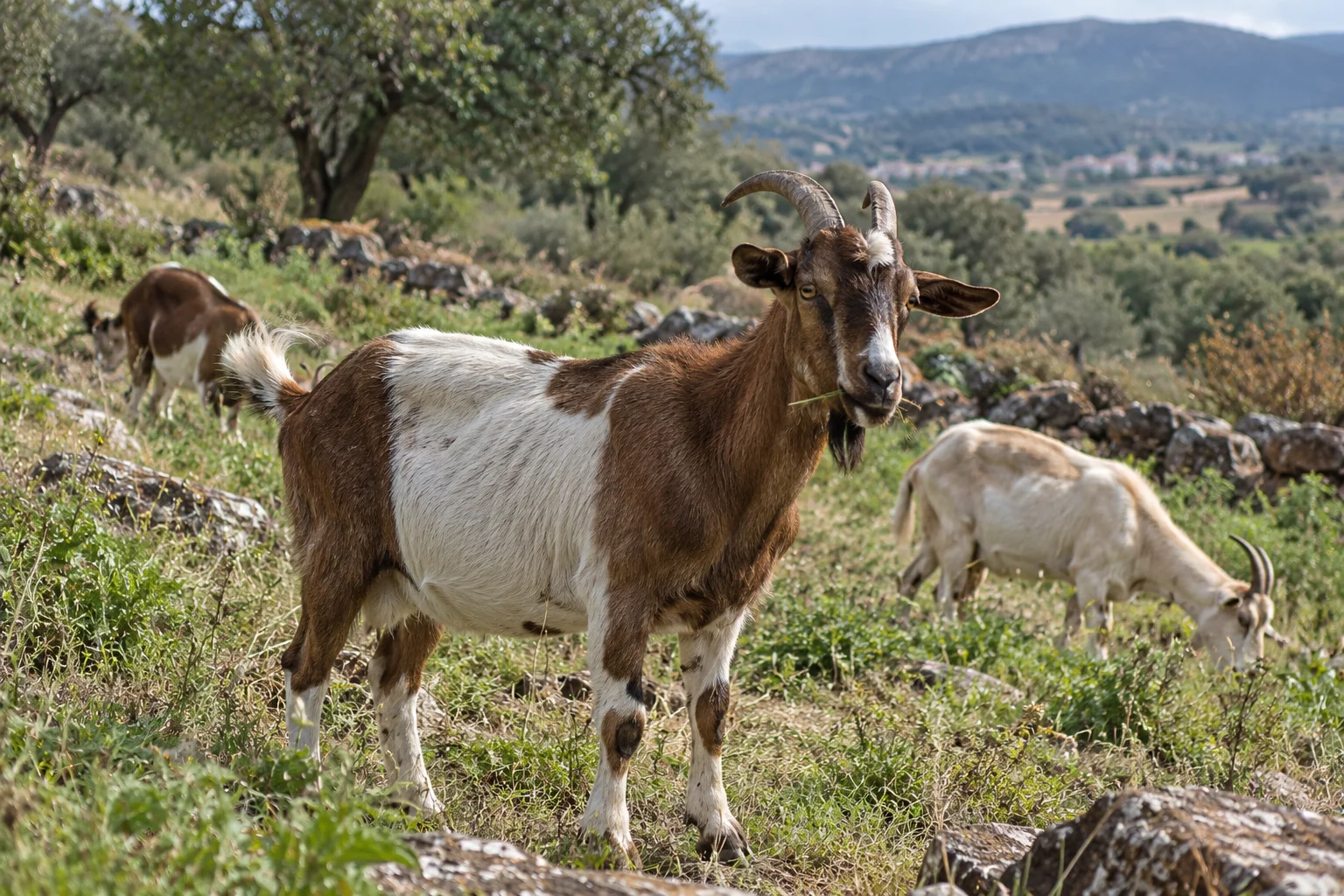

Meet the Goat
Goats have rectangular pupils. Look closely at a goat’s eye and the dark slit runs sideways, giving it a field of view of around 320 degrees, so it can watch for danger almost all the way around without turning its head.
They were among the first animals people ever domesticated, around 10,000 years ago in the mountains of the Middle East, and they have been following us around ever since.
Goats are also famous escape artists, and that reputation is deserved. They climb, they jump, they work out latches, and they will test a fence for as long as it takes.
Scientific Name and Classification
The domestic goat’s scientific name is Capra hircus. It is also written Capra aegagrus hircus, which treats it as a domesticated subspecies of the wild bezoar ibex, Capra aegagrus, its direct ancestor.
- Kingdom: Animalia
- Phylum: Chordata
- Class: Mammalia
- Order: Artiodactyla
- Family: Bovidae
- Genus: Capra
- Species: Capra hircus
Being in the family Bovidae puts goats alongside cattle, sheep and antelope, all of them horned animals that chew the cud.
Goats were domesticated in the Zagros Mountains of Iran and nearby areas roughly 10,000 years ago, making them one of the oldest domestic animals, alongside sheep and slightly behind the dog.
Appearance and Anatomy
Goats vary hugely by breed, from pygmy goats at about 45 pounds to large dairy and meat breeds over 300. Most stand 2 to 3 feet at the shoulder.
- Pupils. Rectangular and horizontal, giving roughly 320 degrees of vision. The pupils also rotate to stay level with the ground when the head tips down to feed.
- Hooves. Split into two toes that spread for grip, with a soft inner pad. This is what makes goats such extraordinary climbers.
- Horns. Usually in both sexes, permanent and never shed, used for fighting and for shedding heat.
- Beard. Many goats have one, males especially.
- Upper lip. Plain and undivided. A sheep’s upper lip is split by a groove down the middle.
- Wattles. Some goats have small dangling tags of skin on the neck, which serve no known purpose at all.
- Stomach. Four chambers for fermenting rough plant food.
Habitat and Range
Domestic goats live on every continent except Antarctica, and there are around a billion of them.
They are the livestock of difficult places. Goats thrive on steep, rocky, dry ground where cattle would starve, which is why they are so important to small farms across Africa, Asia and the Middle East. For many families a goat is the difference between having milk and not.
Their climbing is genuinely remarkable. Goats have been photographed high in argan trees in Morocco, eating the fruit, and feral goats in Italy climb near-vertical dam walls to lick salts off the stone.
Diet and Feeding
Goats are herbivores, and specifically browsers rather than grazers. They prefer leaves, twigs, bark, shrubs and weeds to plain grass, and they eat with their heads up.
Here is a myth worth correcting: goats do not eat tin cans. They are intensely curious and investigate new objects with their lips and tongue, which is how the story started. A goat nibbling your coat is tasting it, not eating it, and goats are in fact fussy about food that is dirty or trampled.
As ruminants they ferment food in a four-chambered stomach and chew the cud for hours, which lets them extract a living from vegetation other livestock cannot use.
Behavior and Lifestyle
Goats are social and live in herds, but they are independent in a way sheep are not. A goat explores on its own account and does not simply follow the animal in front.
They are clever. Goats learn to open gate latches and keep the skill for years, solve puzzle boxes for food and remember the solution almost a year later, and recognize the faces and voices of individual people and other goats.
They also prefer a smiling human face to an unhappy one in tests, and will approach a person who looks at them for help with a problem they cannot solve.
Herds have a rank order, settled by rearing up and clashing horns. Kids play hard, leaping and head-butting, which is practice for exactly that.
One more thing: fainting goats do not faint. A breed called the myotonic goat has a muscle condition that makes its legs stiffen when startled, so it topples over fully conscious, then gets up.
Reproduction and Life Cycle
Pregnancy lasts about 150 days, five months. Twins are the norm, with single kids and triplets both common.
Kids are up and walking within an hour and start nibbling solid food within days, though they nurse for two to three months.
Mothers and kids recognize each other by call almost immediately, and research suggests a mother can still identify her kid’s voice long after they have been separated.
Goats live 15 to 18 years, though farm animals are usually kept for far less. A doe produces milk after kidding, like any mammal.
Predators and Threats
Wolves, big cats, bears, coyotes, foxes and eagles all take goats or kids where their ranges meet, and domestic dogs cause a great deal of loss.
Goats defend themselves with horns and by getting somewhere a predator cannot follow, which is often straight up.
Parasites, especially internal worms, are the main day-to-day problem for goat keepers, along with foot problems on wet ground. Goats evolved on dry mountainsides and do badly in persistent mud.
Conservation Status
Domestic goats are a farm animal and are not assessed by the IUCN. With roughly a billion worldwide they are in no danger.
Two related points are worth knowing. Their wild ancestor, the bezoar ibex, is Near Threatened in its mountain range. And feral goats are a serious problem on islands: released goats have stripped vegetation and driven native plants to extinction in places like the Galapagos, where removing them has been a major conservation effort.
Role in the Ecosystem
Managed well, goats are useful land-clearing machines. Herds are hired to eat invasive brush, bramble and poison ivy on steep ground where machinery cannot go, and cities use them to cut fire risk on hillsides without herbicides.
Their browsing keeps scrub from closing over open habitat, and their droppings fertilize as they work.
Managed badly, they do the opposite. Goats eat bark and pull up roots, and too many on fragile ground strip it bare and cause erosion that is slow to heal. Few animals show the difference between good and bad grazing management as sharply.