Meet the Giraffe
A giraffe has the same number of neck bones as you do. Seven. Each one is simply enormous, up to 10 inches long.
It is the tallest animal on Earth, reaching 18 feet, and almost everything about its body is a solution to the problems that height creates. Pumping blood up to a brain that far above the heart takes real engineering, and so does lowering that head to drink without blacking out.
Giraffes are also disappearing more quietly than almost any other large African animal, which is why conservationists talk about a silent extinction.
Scientific Name and Classification
The giraffe’s scientific name is Giraffa camelopardalis. The species name means “camel leopard”, because early naturalists thought it looked like a camel wearing a leopard’s coat.
- Kingdom: Animalia
- Phylum: Chordata
- Class: Mammalia
- Order: Artiodactyla
- Family: Giraffidae
- Genus: Giraffa
Only two animals remain in the family Giraffidae: the giraffe and the okapi, a shy forest relative with a short neck and striped legs.
How many giraffes there are is genuinely unsettled. Traditionally one species with several subspecies, recent genetic work suggests there may be four separate species: northern, southern, reticulated and Masai. The question matters, because splitting one widespread species into four smaller ones changes how endangered each is.
How Does a Giraffe’s Neck Work?
The neck creates three problems, and the giraffe solves all three.
Getting blood up. A giraffe’s heart weighs about 25 pounds and generates blood pressure roughly twice that of any other large mammal, enough to push blood 6 feet straight up to the brain.
Not blacking out when it bends down. With that pressure, lowering the head should flood the brain. Giraffes have valves in the neck veins that close as the head drops, plus a spongy network of vessels at the base of the skull that absorbs the surge. Raising the head again should cause a faint; the same system prevents it.
Keeping blood out of the legs. The skin on a giraffe’s lower legs is extremely tight, acting like a pressure stocking so fluid does not simply pool in the feet. Engineers studied it when designing flight suits for pilots.
One more oddity. A nerve runs from the giraffe’s brain, down the entire neck, loops around an artery near the heart and travels all the way back up to the larynx: a journey of around 15 feet to cover a distance of a few inches. It is inherited from fish ancestors and is one of the clearest pieces of evidence that bodies evolve by modification rather than design.
Appearance and Anatomy
Giraffes stand 14 to 18 feet tall and weigh 1,800 to 3,000 pounds, with males considerably larger than females.
- Tongue. Up to 20 inches long, muscular, and dark blue-purple. The dark pigment is thought to protect it from sunburn during hours of feeding.
- Ossicones. The horn-like knobs on the head are neither horns nor antlers. They are bone covered in skin and fur, and giraffes are born with them lying flat.
- Coat. Patterned uniquely to each animal, like a fingerprint. Beneath each patch is a network of blood vessels that helps shed heat.
- Legs. About 6 feet long, with tight lower skin, and powerful enough to kill a lion with one kick.
- Heart. Around 25 pounds, with unusually thick walls.
They move at a gallop up to 35 miles an hour, and walk with both legs on the same side swinging together.
Habitat and Range
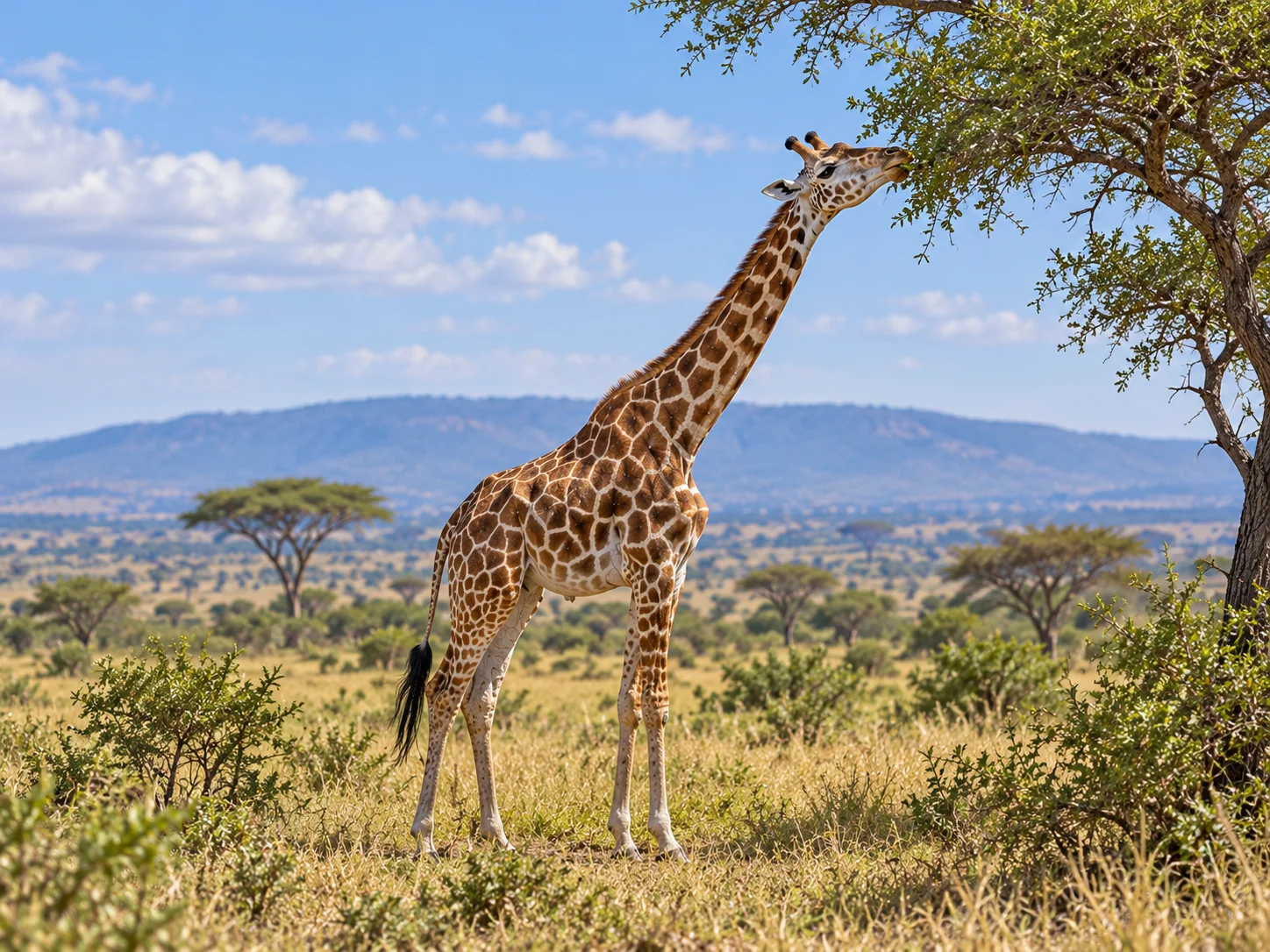
Giraffes live in sub-Saharan Africa, in savanna, open woodland and grassland with scattered trees.
Acacia country suits them best, since acacias provide most of their food, and they avoid dense forest where the neck is a liability rather than an advantage.
Their range has become badly fragmented. Giraffes have vanished from at least seven African countries where they once lived, and the remaining populations are increasingly isolated from one another.
Diet and Feeding
Giraffes are herbivores and browsers, eating leaves, shoots, flowers and fruit, with acacia leaves the staple.
An adult eats up to 75 pounds a day and spends 16 to 20 hours feeding.
Acacias fight back with long thorns, so a giraffe wraps its 20-inch tongue around a branch and strips the leaves off, using tough lips and thick saliva to handle the spines.
The trees retaliate chemically. Browsed acacias flood their leaves with bitter tannins within minutes and release a gas that warns nearby trees to do the same. Giraffes have learned to counter it, feeding briefly on one tree then moving upwind to trees that have not had the warning.
They are ruminants and chew the cud, and they can go days without drinking, getting most of their water from leaves.
Behavior and Lifestyle
Giraffes live in loose, shifting herds, with individuals joining and leaving freely. Females form lasting friendships and have been recorded associating with the same companions for years.
Males establish rank by necking: standing side by side and swinging their heads at each other like clubs, using the heavy ossicones. Most contests are ritual, but serious fights can knock an animal unconscious.
They sleep remarkably little, often under two hours a day in short standing naps, because lying down and getting up again takes dangerous seconds.
They were long thought silent. In fact giraffes hum at a very low frequency at night, below the range humans notice easily, and nobody is sure yet what the humming is for.
Reproduction and Life Cycle
Pregnancy lasts about 15 months and produces a single calf, delivered standing up. The newborn falls roughly 6 feet to the ground, and the shock helps start it breathing.
A calf is about 6 feet tall at birth, stands within an hour and runs within a day.
Mothers leave calves in groups called creches, watched by one adult while the others feed, and that is one of the few arrangements that keeps calves alive. Even so, a large share are taken by lions and hyenas in the first year.
Giraffes live 20 to 25 years in the wild.
Predators and Threats
Lions are the main predator of adults, with hyenas, leopards and African wild dogs taking calves. Crocodiles take giraffes at waterholes, which is the moment a drinking giraffe is most vulnerable.
A healthy adult is a dangerous target. A giraffe kick can kill a lion outright, and most hunts fail.
Human pressures are the real problem: habitat loss and fragmentation as land is converted to farming, poaching for meat and for tails and hides, civil conflict across parts of their range, and drought.
Conservation Status
Giraffes are listed as Vulnerable, and the numbers behind that are worse than most people realize. The population has fallen roughly 30 to 40 percent over the past three decades, to somewhere around 117,000 animals.
There are now fewer giraffes in Africa than elephants, which surprises almost everyone.
Some populations are far worse off than the overall figure suggests. Certain northern groups number only a few hundred animals and are Critically Endangered.
This is why conservationists call it a silent extinction. Giraffes are so familiar that their decline attracted little attention until recently, and they received far less protection than more obviously threatened animals.
Role in the Ecosystem
Giraffes feed where nothing else can reach, which shapes the savanna from the top down. Their browsing prunes acacias and keeps the tree line open, and trees they feed on regularly grow into distinctive hourglass shapes.
They are important pollinators and seed dispersers, carrying pollen between acacia flowers on their faces and spreading seeds in their dung.
They also act as lookouts. Other grazers watch giraffes, because an animal that tall sees a predator long before anything at ground level does, and a giraffe staring in one direction is information the whole plain can use.