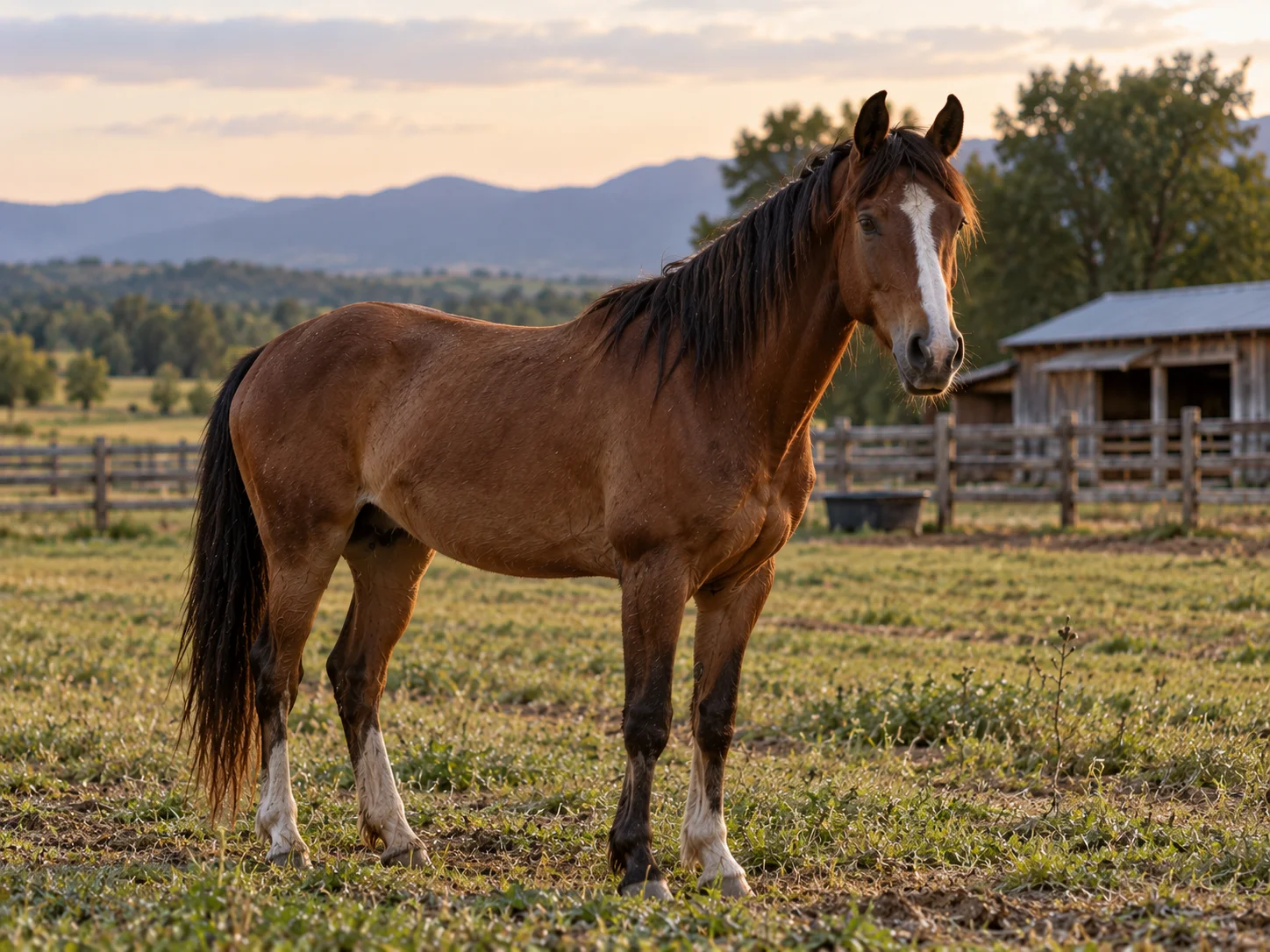
Meet the Horse
Horses evolved in North America. They spread across the world from there, and then went extinct in the place they came from, around 10,000 years ago. The horse (Equus caballus) is a large grazing mammal, domesticated around 6,000 years ago and now kept on every continent except Antarctica.
There were no horses anywhere in the Americas for thousands of years. The ones that gallop across every Western film arrived on Spanish ships in the 1500s, returning to a continent their ancestors had left.
A horse also cannot breathe through its mouth, cannot vomit, and sleeps standing up by locking its own legs in place.
Scientific Name and Classification
The domestic horse’s scientific name is Equus caballus, also written Equus ferus caballus when treated as a domesticated subspecies of the wild horse.
- Kingdom: Animalia
- Phylum: Chordata
- Class: Mammalia
- Order: Perissodactyla
- Family: Equidae
- Genus: Equus
Being in Equus makes the horse a close relative of the zebra, the donkey and the wild asses. Being in Perissodactyla puts it with rhinos and tapirs: odd-toed animals that walk on a single large toe.
There are over 350 breeds, from Shetland ponies to Shire horses, and all of them are the same species.
No truly wild horses survive anywhere. Przewalski’s horse of Mongolia is the closest thing, though genetic work suggests even it descends partly from early domesticated stock. Mustangs and brumbies are feral, not wild: domestic horses living free.
Did Horses Really Evolve in North America?
Yes, and the full story is one of the best-documented in the fossil record.
The horse family began in North America around 55 million years ago with a forest animal the size of a dog, with four toes on its front feet, browsing leaves. Over tens of millions of years, as forests gave way to grassland, the line grew larger, grew teeth suited to grinding tough grass, and reduced its toes to the single large hoof a modern horse stands on.
Horses crossed the land bridge into Asia and spread through Europe and Africa. Then, around 10,000 years ago, they vanished from the Americas entirely, along with mammoths, giant sloths and other large animals, in a wave of extinctions linked to climate change and human hunting.
The survivors in Eurasia were domesticated around 5,500 years ago, most likely on the steppes of what is now Russia and Kazakhstan.
And in 1519 the Spanish brought horses to Mexico, and they walked back onto the continent where the whole family had started. The mustang herds of the American West descend from those animals.
Appearance and Anatomy
Horses stand 2.5 to 6 feet at the shoulder and weigh 300 to 2,200 pounds, depending entirely on breed. Height is traditionally measured in hands, each 4 inches.
- Eyes. The largest of any land mammal, set on the sides of the head for nearly 350-degree vision. The cost is two blind spots: directly in front of the nose and directly behind. A horse cannot see its own feet, which is worth knowing when approaching one.
- Nose only. Horses are obligate nasal breathers. A flap of tissue seals the mouth off from the airway, so a horse cannot breathe through its mouth even when exhausted.
- Hooves. A single toe, with the whole weight on one enlarged nail, growing continuously.
- Teeth. Grow throughout life and wear down with grinding, which is why you can estimate a horse’s age by its teeth, and where “don’t look a gift horse in the mouth” comes from.
- Stay apparatus. A system of tendons and ligaments that locks the leg joints, letting a horse doze standing without using muscle.
Horses cannot vomit. A strong muscular valve at the stomach entrance only opens one way, which is why colic is so dangerous: a horse with a blocked or twisted gut has no way to relieve it.
Habitat and Range
Domestic horses live on every continent except Antarctica, wherever people keep them. There are around 60 million worldwide.
They suit open grassland best, which is what they evolved on, and need space to move and grazing to work through.
Feral populations live free in several countries: mustangs in the United States, brumbies in Australia, Camargue horses in France and the ponies of Assateague Island and Dartmoor. In Australia, feral horses are treated as a pest because they damage fragile alpine habitat that evolved without hard-hooved grazers.
Diet and Feeding
Horses are herbivores and grazers, living on grass, hay and other plants.
They are not ruminants and do not chew the cud. Instead they ferment food in a very large hindgut, which handles a steady trickle of fiber well but copes badly with sudden change or large meals.
That is why horses are designed to graze almost constantly, 16 to 18 hours a day, in small amounts. A horse’s stomach is surprisingly small for its size and empties quickly.
Because they cannot vomit, what goes in has to come out the far end, and a gut blockage or twist causes colic, which remains one of the leading causes of death in horses.
An adult horse drinks 5 to 10 gallons of water a day, more in heat or work.
Behavior and Lifestyle
Horses are herd animals and genuinely need company. A horse kept entirely alone is a stressed horse, and many develop repetitive habits like weaving or crib-biting as a result.
They sleep in short bursts totalling only a few hours a day, mostly standing, using the stay apparatus. They must lie down for proper deep sleep, and in a herd they take turns while others keep watch.
They read people closely. Research has found horses can distinguish angry from happy human facial expressions in photographs, respond differently to each, and remember how a particular person behaved toward them.
Their ears are a readable signal: forward means attention, sideways relaxed, pinned flat back means a warning.
As prey animals they startle first and ask questions later, which is not stupidity but the behavior that kept their ancestors alive on open plains.
Reproduction and Life Cycle
Pregnancy lasts about 11 months and almost always produces a single foal. Twins rarely survive.
A foal is remarkable at birth. It has legs nearly as long as an adult’s, stands within an hour and can run the same day, because a newborn that cannot keep up with a moving herd does not survive on open grassland.
Foals nurse for several months and stay with their mothers for a year or more.
Horses live 25 to 30 years, and well-cared-for individuals reach their late 30s. The record belongs to Old Billy, an English barge horse said to have reached 62 in the early 1800s.
Predators and Threats
Wolves, mountain lions, bears and big cats take feral horses and foals. A horse’s defenses are speed, a hard kick and herd vigilance.
For domestic horses the dangers are mostly medical and management-related: colic, laminitis, respiratory disease from dusty stabling, and injury.
Welfare issues vary by place and use, from overwork in some working-horse economies to overbreeding and unwanted horses in others.
Feral herd management is a long-running controversy, particularly in the American West and the Australian high country, where the arguments about culling, rehoming and habitat damage have run for decades.
Conservation Status
Domestic horses are not assessed by the IUCN and are in no danger, with around 60 million worldwide.
Their wild relative is a different story. Przewalski’s horse was declared extinct in the wild in the 1960s, and every surviving animal descends from a dozen or so individuals taken into captivity. A long reintroduction effort has returned herds to Mongolia and China, and the species is now listed as Endangered, having been brought back from nothing at all.
Traditional horse breeds are disappearing too, as working horses are replaced by machinery, and several heavy breeds that once plowed fields and pulled barges now have very small numbers.
Role in the Ecosystem
Where they belong, grazing horses maintain grassland, keeping scrub from taking over and creating the varied turf that many insects, wildflowers and ground-nesting birds need. Conservation grazing projects in Europe now use hardy pony breeds deliberately for this.
Where they do not belong, the same grazing and hard hooves cause erosion and damage habitats that evolved without them.
Their importance to people is on a different scale from almost any other animal. For roughly 5,000 years the horse was the fastest way to travel, the strongest way to plow, and the decisive factor in war. Empires expanded at the speed of a horse. Messages, trade and armies all moved at that speed, and they did so until the railway and the engine arrived barely two centuries ago.
Much of human history was, quite literally, carried on horseback.