Meet the Hare
In spring you can watch two hares stand up on their hind legs in a field and box each other, striking with their front paws hard enough to pull out fur.
For centuries this was assumed to be two males fighting over a female, and it gave us the phrase mad as a March hare.
It is almost always a female hitting a male. She is not yet ready to mate, or she is testing him, and she drives him off with her paws. The maddest-looking behavior in the British countryside turned out to be a female saying no.
Scientific Name and Classification
Hares are the genus Lepus, with about 32 species. The European brown hare is Lepus europaeus, the mountain hare is Lepus timidus, and the black-tailed jackrabbit is Lepus californicus.
- Kingdom: Animalia
- Phylum: Chordata
- Class: Mammalia
- Order: Lagomorpha
- Family: Leporidae
- Genus: Lepus
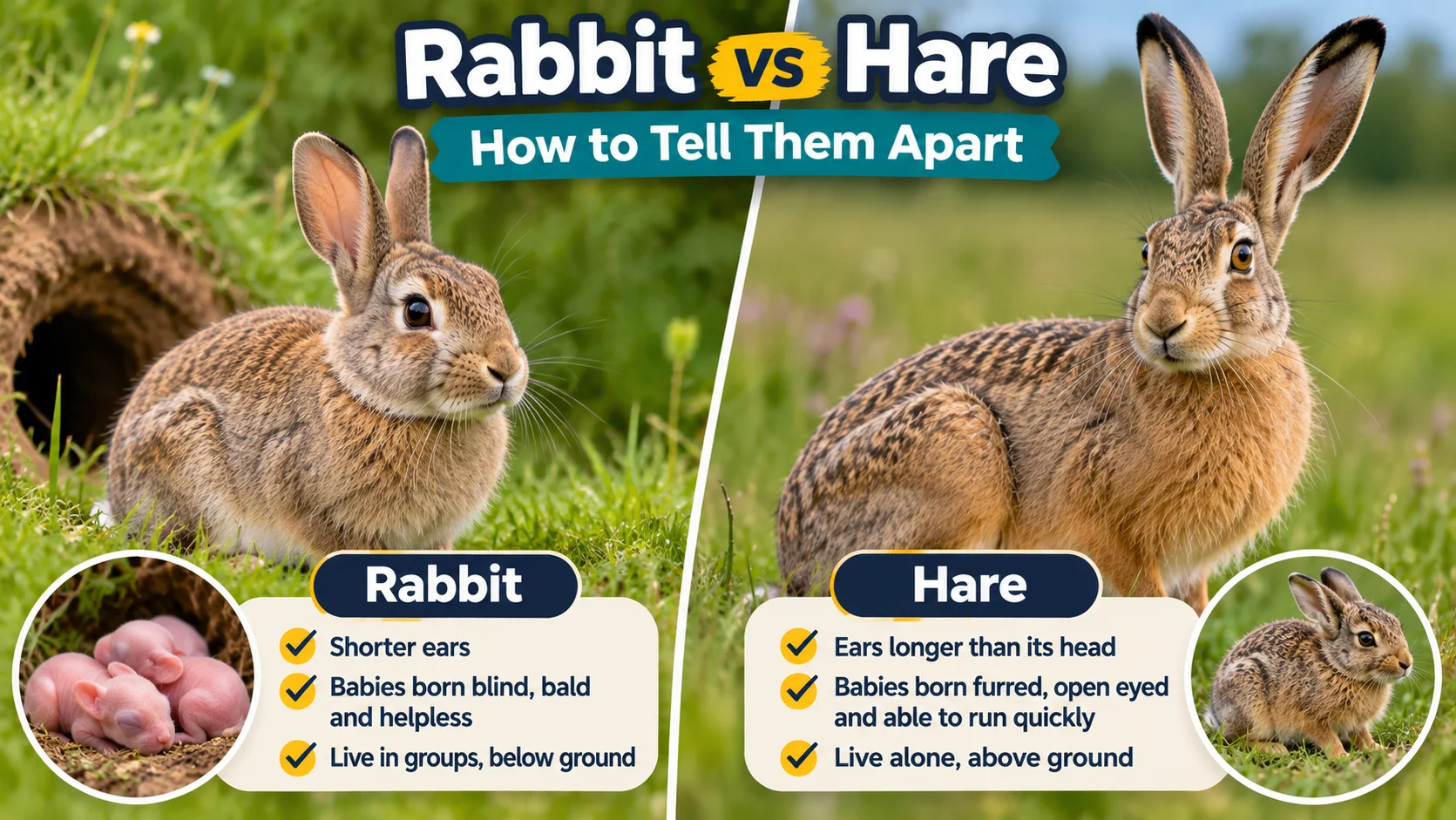
Two naming points are worth clearing up. Hares are not rodents — they are lagomorphs, with four upper incisors rather than a rodent’s two. And jackrabbits are hares, not rabbits, despite the name, while the Belgian hare is a domestic rabbit breed and not a hare at all.
Appearance and Anatomy
Hares measure 16 to 28 inches long and weigh 5 to 13 pounds (2.5 to 6 kg), with the largest species being the European brown hare and some jackrabbits.
- Hind legs. Very long and heavily muscled. A brown hare runs at up to 45 miles an hour, which makes it one of the fastest land animals in Europe, and it can turn almost instantly at speed.
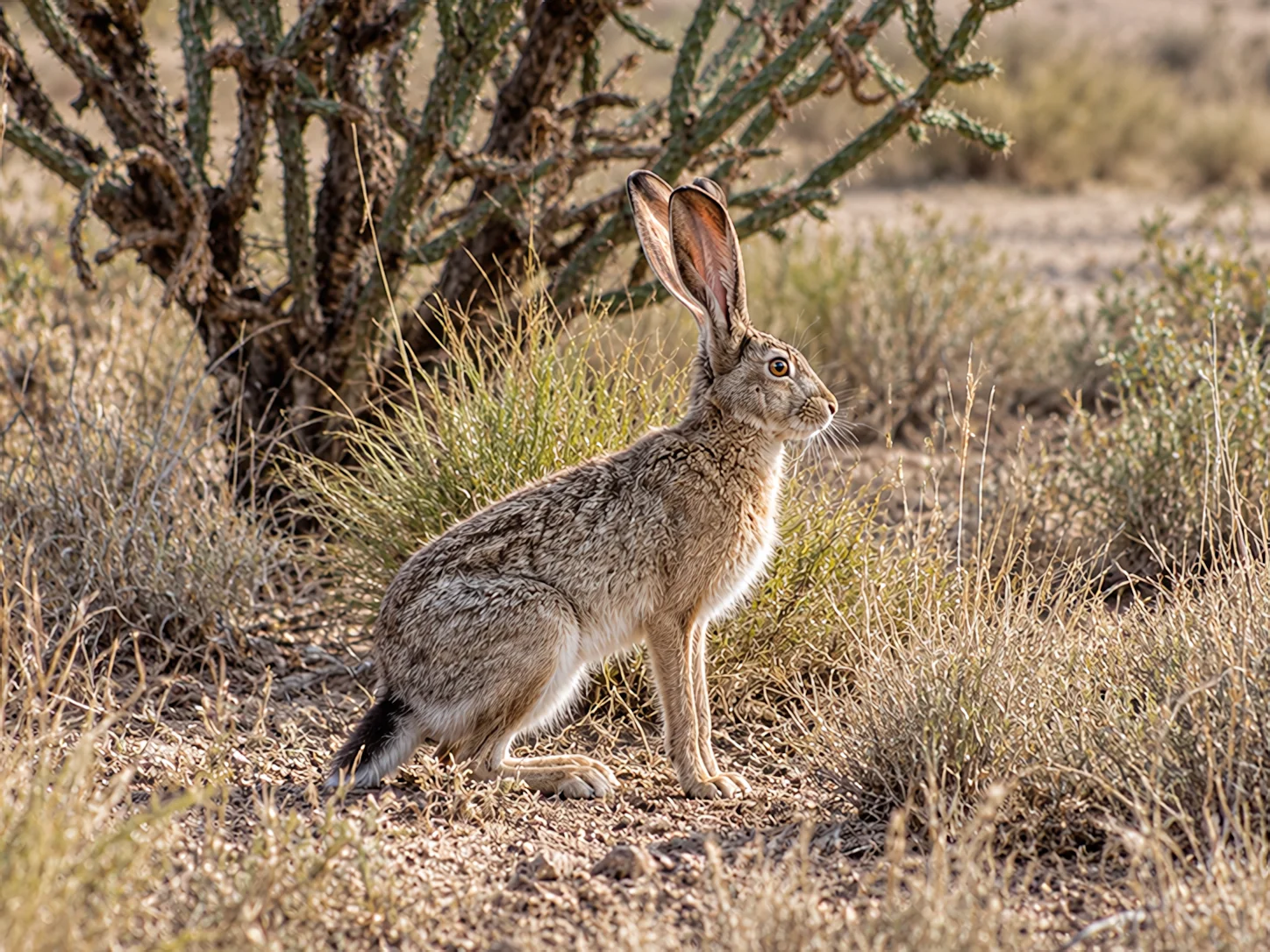
- Ears. Up to 7 inches, used for hearing and for shedding heat. Jackrabbits in the desert have enormous ears full of blood vessels, which work as radiators.
- Eyes. Set high and wide on the head, giving almost 360-degree vision. The blind spot is directly in front of the nose.
- Fur. Mountain and Arctic hares turn white in winter and brown in summer, triggered by day length rather than temperature.
That seasonal coat change has become a problem. Where snow now arrives later or melts earlier, mountain hares spend weeks in white fur on brown ground, highly visible to every predator around, because the trigger is daylight and daylight has not changed.
Habitat and Range
Hares live across Europe, Asia, Africa and North America, and have been introduced to South America and Australasia.
They prefer open country: grassland, farmland, steppe, moorland, tundra and desert. What a hare wants is space to see danger coming and room to outrun it, which is why hedgerows and woodland edges suit them less well than a wide field.
The Arctic hare lives on the tundra of Greenland and northern Canada, where it sometimes gathers in groups of hundreds, which is unusual for the genus. The snowshoe hare lives in North American forests and has oversized hind feet that work as snowshoes.
A hare’s form is remarkably minimal: a depression scraped in soil or grass, often facing into the wind, where the animal sits still with its ears flat and relies on being unnoticed.
Diet and Feeding
Hares are herbivores, eating grasses, herbs, clover and crops in summer, and switching to twigs, bark, buds and shoots in winter.
They do something that sounds unpleasant and is essential. A hare produces two kinds of droppings: soft green ones, which it eats, and hard dry ones, which it does not. The soft pellets come from a chamber where bacteria ferment tough plant matter, and eating them lets the hare absorb the nutrients and vitamins the bacteria produced. It is effectively a second pass through the gut, doing the same job as a cow’s rumen in a different order.
They feed mainly at dusk and through the night, and get most of their water from their food.
Because they eat crops and strip bark from young trees, hares are often treated as pests, which is part of why their numbers are managed in some regions.
Behavior and Lifestyle
Hares are mostly solitary and active at night and twilight, spending the day lying low in the form.
Their first defense is not speed but stillness. A hare will flatten itself and hold absolutely motionless, letting a person or a fox walk within a few feet, and it only bolts at the last possible moment, which is why hares seem to explode out of empty ground.
When it does run, it is formidable: 45 miles an hour, with sharp changes of direction and long leaps to break the scent trail. A hare being chased will often run a wide circle rather than a straight line.
In the breeding season they become conspicuous, gathering in groups in open fields, chasing and boxing, which is the behavior that gave March hares their reputation.
They are almost silent, but a hare caught by a predator gives a scream that is genuinely shocking to hear.
Reproduction and Life Cycle
Hares breed from winter into late summer, producing three or four litters a year of one to five leverets each.
Gestation is 41 to 42 days, and the leverets are born in the open, fully furred, eyes open, able to hop almost at once.
The mother then does something that looks like neglect and is not. She scatters the litter, putting each leveret in a separate form some distance from the others, and visits once a day, usually around sunset, to nurse them for a few minutes. Then she leaves again.
The logic is blunt: a mother sitting with her young would lead predators straight to them, and a scattered litter cannot all be lost at once. Her milk is very rich, so a few minutes a day is enough.
This is why a leveret found alone in a field should be left exactly where it is. It is not abandoned, and moving it usually kills it.
Leverets are weaned at about three weeks and independent soon after. Hares live 3 to 4 years in the wild, occasionally up to 12.
Predators and Threats
Foxes, eagles, buzzards, lynx, wolves, stoats, badgers, domestic dogs and cats all take hares, and leverets are vulnerable to almost everything. Most hares do not reach their first birthday.
The snowshoe hare is the classic case in ecology: its numbers rise and crash on a roughly ten-year cycle, and the Canada lynx population follows a few years behind. It is the textbook example of a predator-prey cycle, though the hare side of it turns out to be driven by food, predators and stress together rather than predation alone.
Human pressures are larger. Intensive farming has removed the mix of crops, grass and cover that brown hares need, and a field of a single crop harvested all at once leaves them nothing for much of the year. Add hunting, coursing where it still happens illegally, road deaths, pesticides and farm machinery that kills leverets lying in grass.
Disease matters too. European brown hare syndrome and myxomatosis, which crossed from rabbits into Iberian hares, can kill in large numbers.
Conservation Status
Most hare species are listed as Least Concern, but the regional picture is often much worse than the global one.
The brown hare has declined sharply across much of western Europe, with Britain losing a large share of its hares since the 1960s, almost entirely because of changes in farming. Ireland and parts of central Europe have fared better.
Some species are genuinely threatened: the hispid hare of the Himalayan foothills is Endangered, and the riverine rabbit of South Africa, a relative, is Critically Endangered.
What helps is unglamorous and well tested. Leaving uncropped margins and strips of rough grass along field edges, growing a mix of crops rather than one, and cutting grass later in the season all raise hare numbers measurably, which makes the hare a useful indicator of whether farmland has any room left in it for wildlife.
Role in the Ecosystem
Hares are a major prey species, and in places like the boreal forest and the tundra they are the main food supply for foxes, lynx, eagles and wolves. When hare numbers crash, their predators crash with them.
Their grazing shapes grassland and slows the spread of scrub, and their droppings return nutrients to thin soils.
Culturally the hare is everywhere. It is the moon hare of Chinese and Indian tradition, the trickster of west African and African-American stories that became Brer Rabbit, the companion of the Anglo-Saxon spring, and almost certainly the origin of the Easter bunny, which was a hare before it was a rabbit. The Mad Hatter’s tea party guest is a March hare.
And the boxing is a good lesson in how long an explanation can survive without being checked. People watched hares fight every spring for centuries and assumed it was males competing, because that is what fighting animals are supposed to be doing. Someone eventually looked closely, and it was the females all along.