Meet the Guppy
In the 1970s a biologist began moving guppies between streams in Trinidad. He took fish from pools full of predators and released them upstream above waterfalls, where the predators could not reach.
Within a few generations the transplanted guppies had changed. The males became more brightly colored, they matured later and larger, and they produced fewer, bigger offspring. In the dangerous pools, the opposite had been true: drab males, early maturity, many small young.
This was evolution observed directly, in the wild, in years rather than epochs, as a result of a change someone made on purpose. The guppy is one of the most important animals in the history of evolutionary biology, and it costs about two pounds in a pet shop.
Scientific Name and Classification
The guppy is Poecilia reticulata, and it is also called the millionfish, for reasons that become obvious once you keep a few.
- Kingdom: Animalia
- Phylum: Chordata
- Class: Actinopterygii
- Order: Cyprinodontiformes
- Family: Poeciliidae
- Species: Poecilia reticulata
Its family, the Poeciliidae, are the livebearers, and they include mollies, platies and swordtails, all of which share the guppy’s unusual approach to reproduction.
The name comes from Robert John Lechmere Guppy, a clergyman and naturalist in Trinidad who sent specimens to the British Museum in the 1860s. He did not discover the fish, which had already been described, but the name stuck to him.
The Fish That Gives Birth
Most fish lay eggs. A guppy does not: the eggs are fertilized and develop inside the female, and she gives birth to free-swimming young that can feed and hide within minutes.
The mechanics are worth knowing, because they explain why guppies multiply so relentlessly:
- The male has a gonopodium, a modified anal fin folded into a tube, which he uses to transfer sperm.
- Females store sperm. A single mating can produce several broods months apart, so a female bought alone from a shop will often produce young with no male present.
- Gestation is three to four weeks, and a female can be pregnant again almost immediately.
- Brood sizes run from a handful to over a hundred, and a female may produce young every month for much of her life.
There is no parental care at all, and adult guppies readily eat their own fry, which is the main thing limiting numbers in a planted tank.
Anyone keeping mixed-sex guppies should expect a population rather than a few fish. The practical advice is to keep males only unless you want to breed them, and to plan where the young will go.
Appearance and Anatomy
Males are 0.6 to 1.4 inches long and females 1.2 to 2.4 inches, so the female is noticeably the bigger fish.
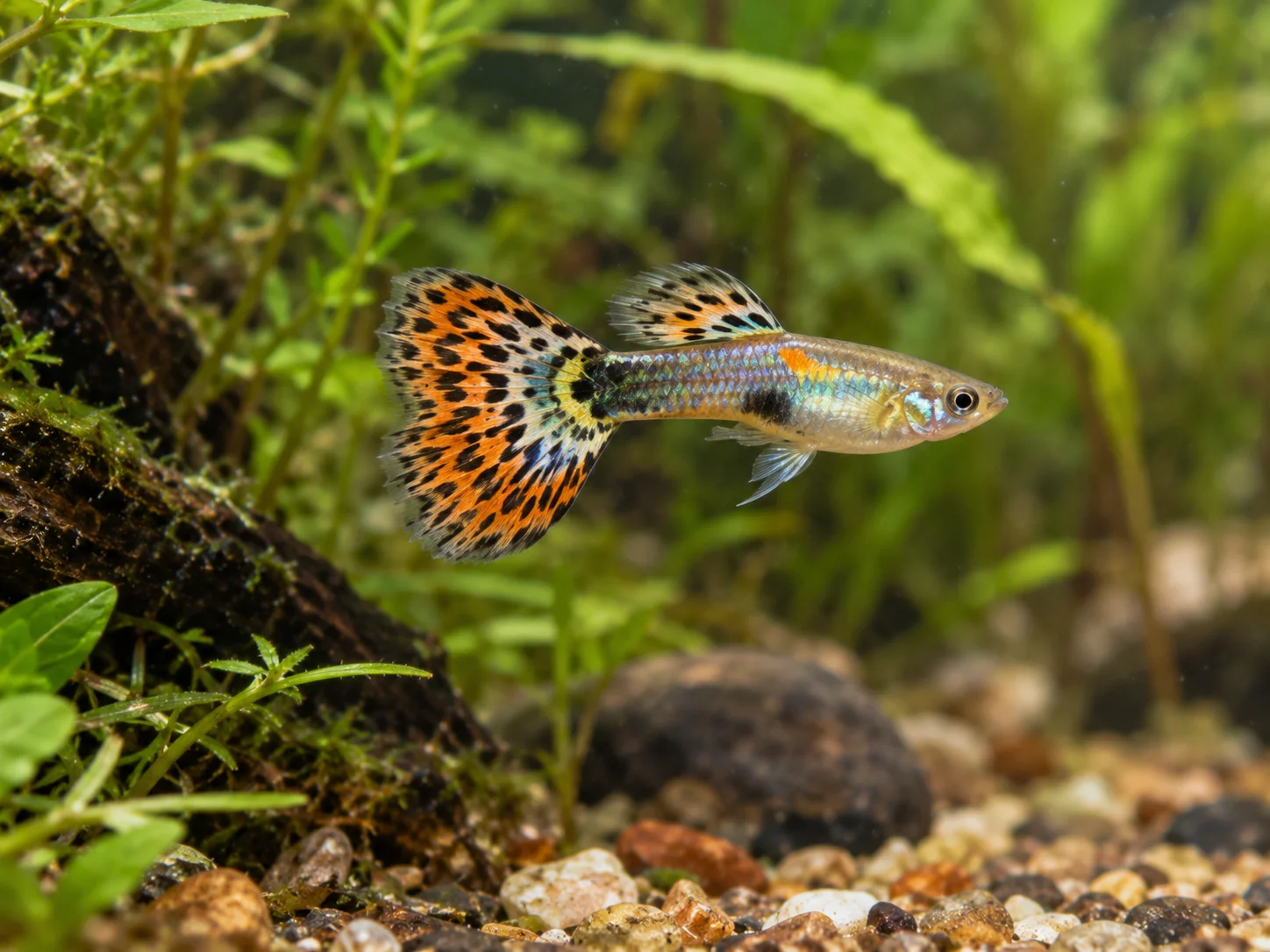
The sexes look so different that beginners sometimes think they have two species. Males are small, slim and brightly patterned with large showy tails; females are larger, plumper and mostly plain gray-silver.
That difference is the Trinidad story in physical form. Bright color attracts females and also attracts predators, so how colorful a male guppy population is reflects the balance of those two pressures, and it shifts measurably when the predators change.
Wild males carry individual color patterns, and females tend to prefer unusual ones, which keeps rare patterns in circulation. Domesticated guppies have been bred into dozens of fixed strains with names like cobra, tuxedo, snakeskin and moscow.
Habitat and Range
Guppies are native to northern South America and the southern Caribbean: Trinidad and Tobago, Venezuela, Guyana, Suriname, Brazil and nearby islands, in warm streams, ditches, ponds and brackish coastal water.
They are now established on every continent except Antarctica, and almost none of that is accidental. Guppies were deliberately introduced to dozens of countries through the twentieth century as mosquito control, on the reasoning that they eat mosquito larvae.
That program is now generally regarded as a mistake. The evidence that introduced guppies reduce malaria or dengue is weak, and in many places they have damaged native fish and amphibians by competing with them and eating their eggs. Several countries list the guppy as an invasive species, and it appears on assessments of the world’s most problematic introduced fish.
It is an unusually clear case of the pattern: a small, hardy, fast-breeding animal released widely to solve a problem it did not solve.
Diet and Feeding
Guppies are omnivores, eating algae, plant matter, diatoms, insect larvae including mosquito larvae, and small invertebrates.
They graze more or less continuously, picking at surfaces and taking anything small enough, which makes them easy to feed and easy to overfeed.
In a tank, good flake food with occasional frozen brine shrimp or daphnia suits them, in small amounts once or twice a day. Males color up better on a varied diet.
Their appetite for their own fry is worth planning around: dense planting or floating plants give the young somewhere to hide, and without that cover most of a brood is eaten.
Behavior and Lifestyle
Guppies are sociable, active and best kept in groups, and they spend most of the day swimming in the open rather than hiding.
Male courtship is relentless. He performs a sigmoid display, curving his body into an S shape and quivering in front of the female, and when that fails he attempts sneaky matings without display at all. A single female in a tank of males is harassed constantly, which is why the usual advice is two or three females per male, or males only.
They are also more capable than they look. Guppies have been shown to learn escape routes, retain them for weeks, and learn by watching other guppies, and females copy the mate choices of other females in experiments, which is a form of social learning.
Shoaling behavior varies with risk: guppies from high-predation streams shoal more tightly and inspect threats more cautiously than those from safe pools, and those differences persist in fish bred in captivity.
Reproduction and Life Cycle
Females mature at one to three months, which is extraordinarily fast, and can produce a brood every three to four weeks thereafter.
Fry are born fully formed, between 5 and 100 or more at a time, and immediately swim for cover.
The sperm-storage trick means a female can keep producing young for months after a single mating, and it also means guppies arriving in a new stream do not need a pair to establish a population.
They live one to three years. Fast maturity, short life and continuous breeding is exactly what makes them so useful to biologists: a researcher can watch several generations in a single year.
Predators and Threats
In Trinidad the main predators are the pike cichlid and various killifish, and the difference between streams with and without them is what drove the famous experiments.
Elsewhere, larger fish, birds, dragonfly larvae and other guppies eat them.
As a species the guppy is under no threat at all. It is abundant, adaptable, and bred in the millions.
In the aquarium trade the welfare problem is the opposite of rarity: generations of inbreeding for fancy strains have produced fish noticeably less hardy than they once were, and mass-produced guppies are often prone to disease. Fish from a local breeder or aquarium society are usually tougher than those from a large-scale supplier.
Conservation Status
The guppy is listed as Least Concern, and it is one of the most abundant freshwater fish on earth.
Its conservation relevance is as an introduced species. Where guppies have been released outside their range they compete with native fish, prey on the eggs and larvae of amphibians and fish, and can carry parasites into new populations.
So the practical rule is the same one that applies to every aquarium animal: never release them, and never tip tank water into a drain, stream or garden pond.
Role in the Ecosystem
In its native streams the guppy is a small grazer and insect-larvae eater, and prey for a long list of larger animals.
Its real importance is scientific, and it is hard to overstate. The Trinidad guppy work has produced hundreds of papers and is a standard example in textbooks of natural selection, sexual selection, life-history evolution and the speed at which populations can change. Because guppies breed fast, live in discrete streams and can be moved between them, they gave biologists something very rare: a wild animal you can run a controlled experiment on.
They are also one of the genuinely good first fish for a beginner, being small, hardy, cheap, captive-bred and interesting to watch. Our beginner’s guide to keeping pet fish covers the setup, and the one thing to decide before buying is whether you want males only, because mixed guppies do not stay a few guppies for long.