Meet the Zebra
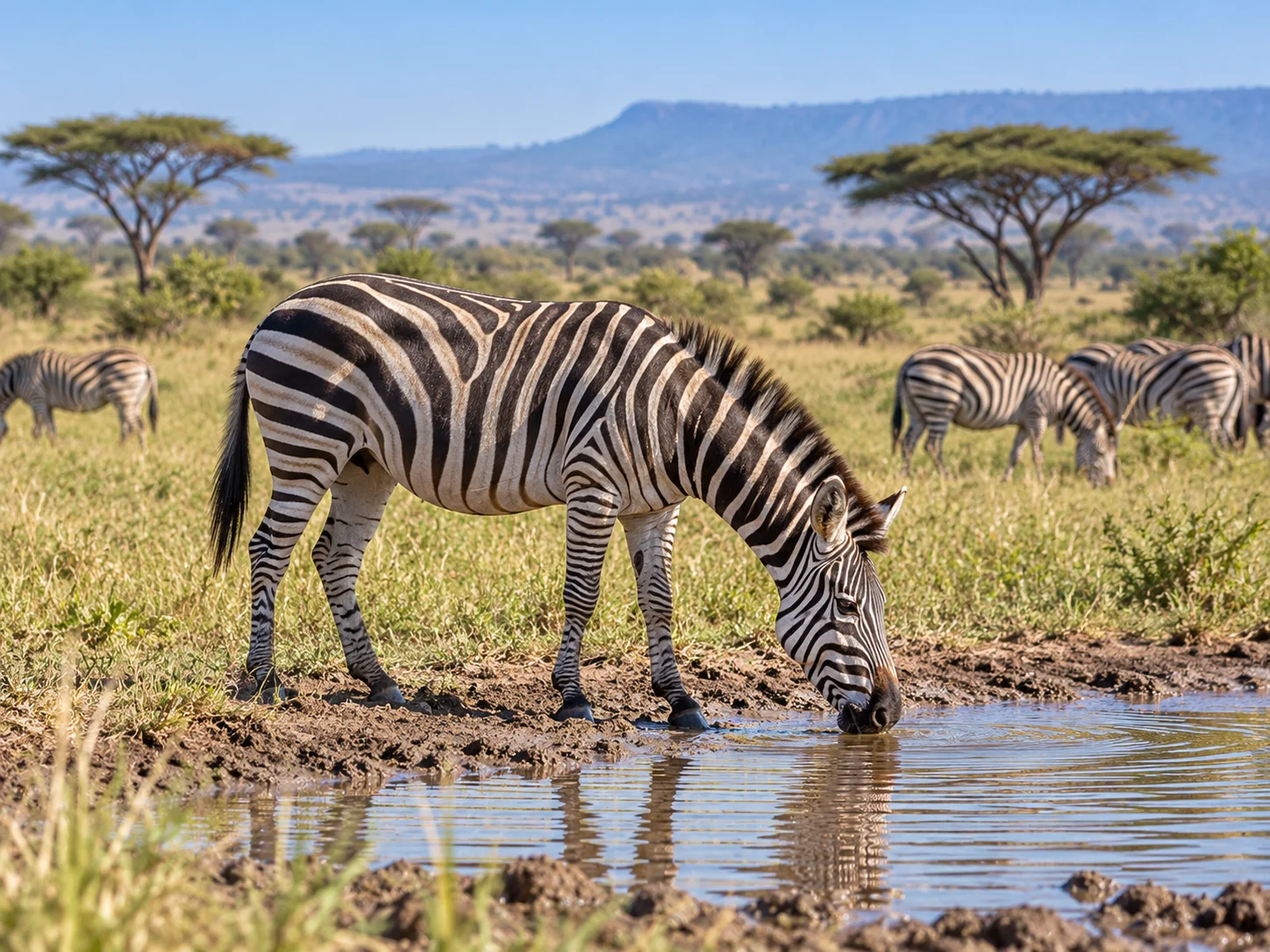
Every zebra’s stripes are unique. No two animals carry the same pattern, and a foal learns its mother’s by sight in the first days of life. Zebras are African wild horses, and there are three species: the plains zebra, the mountain zebra and Grevy’s zebra.
Why they have stripes at all turned out to be a much harder question than anyone expected, and after a century of argument the answer looks like something nobody originally guessed: flies.
There are three species of zebra, all African, and they are horses, in the same genus as the one you can ride. They have simply never been tamed, and there are good reasons why not.
Scientific Name and Classification
There are three zebra species, all in the genus Equus, so there is no single two-word name for “zebra”.
- Plains zebra (Equus quagga), by far the most numerous and the one most people picture.
- Mountain zebra (Equus zebra), of southwestern Africa, with a dewlap on the throat.
- Grevy’s zebra (Equus grevyi), the largest, with narrow stripes and big rounded ears, and the most endangered.
- Kingdom: Animalia
- Phylum: Chordata
- Class: Mammalia
- Order: Perissodactyla
- Family: Equidae
- Genus: Equus
Being in Equus makes zebras genuine horses, alongside the domestic horse, the donkey and wild asses. Being in Perissodactyla puts them with rhinos and tapirs: odd-toed animals that walk on a single large toe.
The quagga, a plains zebra with stripes only on its front half, was hunted to extinction in the 1880s.
Why Do Zebras Have Stripes?
This was argued over for more than a hundred years. Four explanations were proposed, and three of them have largely failed their tests.
- Camouflage. Appealing, but lions hunt mainly by smell and hearing, and see poorly in color. Striped zebras are no harder for them to catch.
- Confusing predators in a herd. The idea that a running mass of stripes dazzles a lion. Tests have found little support.
- Keeping cool. That black and white stripes set up cooling air currents. Measurements have not borne this out convincingly.
- Biting flies. This one keeps winning.
The fly experiments are hard to argue with. Horseflies and tsetse flies land far less often on striped surfaces, and researchers who put striped coats on plain horses found flies stopped landing on them. The flies approach normally and then fail to slow down properly at the last moment, so they bump into the animal and veer off.
That matters more than it sounds. African biting flies carry diseases including sleeping sickness and African horse sickness, and zebras have thin coats that flies bite easily.
One more question, often asked: a zebra is black with white stripes. The underlying skin is black, and the white stripes are where pigment was switched off.
Appearance and Anatomy
Zebras stand 3.8 to 5 feet at the shoulder and weigh 480 to 990 pounds depending on species, with Grevy’s zebra the largest.
- Stripes. Unique to each animal, like a fingerprint. The three species differ in pattern: plains zebras have broad stripes, Grevy’s narrow ones, mountain zebras a gridiron pattern on the rump.
- Mane. Short and stiff, standing upright rather than falling over like a horse’s.
- Hooves. A single toe, hard and tough enough for rocky ground.
- Ears. Large and mobile, turning independently to locate sound. Grevy’s zebra has notably rounded ones.
- Teeth. Grow continuously, because grinding coarse grass wears them down.
They run at about 40 miles an hour, slower than a lion over a short sprint but able to keep going much longer, and they zigzag hard, which is how most escapes are actually made.
Habitat and Range
Zebras live only in Africa, and each species keeps to its own country.
Plains zebras occupy grassland and savanna across eastern and southern Africa. Mountain zebras live on dry rocky slopes in Namibia and South Africa. Grevy’s zebra holds on in the arid scrub of northern Kenya and Ethiopia.
Plains zebras take part in one of the great animal movements on Earth, migrating with wildebeest across the Serengeti and Masai Mara following the rains and fresh grass.
Diet and Feeding
Zebras are herbivores and mainly grass eaters, taking leaves, bark and shoots when grass is short.
Unlike cattle they are not ruminants and do not chew the cud. They ferment food in a large hindgut instead, a system that handles coarse low-quality grass well but extracts less from it, so zebras must eat a great deal and graze for much of the day.
That turns out to be ecologically useful. Zebras move into long tough grass that other grazers cannot manage, crop it down, and open it up for the wildebeest and gazelle that follow behind them.
They need to drink daily and rarely stray far from water.
Behavior and Lifestyle
Plains and mountain zebras live in small family groups called harems: one stallion with several mares and their foals, and those bonds last for years. Grevy’s zebra does it differently, with stallions holding territory and mares moving freely between them.
Families gather into larger herds for safety, and zebras often graze alongside wildebeest, each relying on the other’s alarm.
They groom each other by nibbling along the neck and back, which keeps bonds strong, and sleep standing up, taking turns so someone is always awake.
Attacked, a zebra kicks backwards hard enough to break a lion’s jaw, and a mare will defend her foal directly rather than flee.
Why Can’t Zebras Be Tamed Like Horses?
People have tried, repeatedly, and it has never really worked.
Individual zebras have been broken to harness and even ridden, but no one has ever domesticated them as a population, and the reasons are temperament rather than stubbornness.
- They panic rather than freeze. Evolving alongside lions has made zebras extremely reactive, which is dangerous around people.
- They do not have the right social structure. Horses follow a leader in a way a person can step into. Zebra groups do not work like that.
- They are aggressive. Zebras bite and hang on, and kick with real force. They injure zookeepers more often than tigers do.
- They have superb dodging reflexes. Escaping lions for millions of years has made them very hard to catch with a rope.
Domestication needs an animal that is calm, hierarchical, breeds readily in captivity and tolerates crowding. Horses happen to tick all of those. Zebras do not tick most of them.
Reproduction and Life Cycle
Pregnancy lasts about 12 to 13 months and produces a single foal.
The foal is standing within 15 minutes and running within an hour, which is necessary on open plains full of predators.
For the first days the mother keeps everyone else away so the foal learns her stripe pattern, her voice and her smell without confusion. In a herd of hundreds of near-identical animals, that imprinting is what keeps them together.
Foals nurse for about a year. Zebras live 20 to 25 years in the wild and longer in captivity.
Predators and Threats
Lions are the main predator, with hyenas, leopards, cheetahs, African wild dogs and crocodiles at river crossings taking their share, especially foals.
Zebras defend themselves by running, kicking and by the herd closing around the young.
Human pressures are habitat loss, fences that cut migration routes in half, competition with livestock for grass and water, and hunting for meat and skins. Drought is increasingly serious for Grevy’s zebra in particular.
Conservation Status
The three species are in very different positions.
The plains zebra is Near Threatened and still numerous, though declining. The mountain zebra is Vulnerable and recovering slowly from a very low point. Grevy’s zebra is Endangered, down to around 2,000 animals from perhaps 15,000 in the 1970s, and it is one of the most threatened large mammals in Africa.
The quagga is a reminder of what happens when nobody acts. It was hunted out in the 1880s, and the last one died in an Amsterdam zoo in 1883.
Role in the Ecosystem
Zebras are the opening act of African grazing. Because their hindgut can handle coarse tall grass, they move in first, crop it down and expose the shorter, softer growth that wildebeest and gazelle depend on. Remove the zebras and the grassland works less well for everything that follows.
Their grazing keeps grassland open rather than letting scrub take over, and their droppings return nutrients and spread seeds.
They are also a staple prey animal, supporting lions, hyenas and the scavengers that follow them, which puts zebras near the center of the whole savanna food web.