Meet the Rhinoceros
A rhinoceros can weigh as much as a small car, run at 30 miles an hour, and carry a horn made of the same stuff as your fingernails.
“Rhinoceros” covers five living species spread across Africa and Asia. They are among the largest land animals alive, second only to the elephant, and they are survivors of a group that once included dozens of kinds, including a woolly rhino that lived alongside mammoths.
Today three of those five species are Critically Endangered. About 27,000 rhinos remain in the wild in total, and the reason is almost entirely one thing: people kill them for their horns.
Scientific Name and Classification
Rhinos are a family rather than a single species, so there is no one two-word scientific name for them. The family is Rhinocerotidae, and each of the five species has a name of its own.
- Kingdom: Animalia
- Phylum: Chordata
- Class: Mammalia
- Order: Perissodactyla (odd-toed hoofed animals)
- Family: Rhinocerotidae
Being odd-toed puts rhinos in the same order as horses, zebras and tapirs. Every rhino walks on three toes, which is why their tracks look like a clover leaf pressed into the mud.
The name comes from Greek: rhino meaning nose and keras meaning horn. Nose-horn.
Types of Rhinoceros and Their Characteristics
Five species survive. Their situations could hardly be more different.
| Rhino | Scientific name | Horns | Where | Wild population | IUCN status |
|---|---|---|---|---|---|
| White rhino | Ceratotherium simum | Two | Southern Africa | About 15,752 | Near Threatened |
| Black rhino | Diceros bicornis | Two | Eastern and southern Africa | About 6,788 | Critically Endangered |
| Greater one-horned rhino | Rhinoceros unicornis | One | India and Nepal | About 4,075 | Vulnerable |
| Javan rhino | Rhinoceros sondaicus | One | One park in Indonesia | About 50 | Critically Endangered |
| Sumatran rhino | Dicerorhinus sumatrensis | Two | Indonesia | 34 to 47 | Critically Endangered |
The Javan rhino is the rarest large mammal on Earth. Every surviving individual lives in a single national park, Ujung Kulon, on the western tip of Java, and none exists in any zoo. The Sumatran rhino is the smallest and the strangest, covered in reddish hair, and is the closest living relative of the extinct woolly rhino.
Difference Between Black and White Rhino
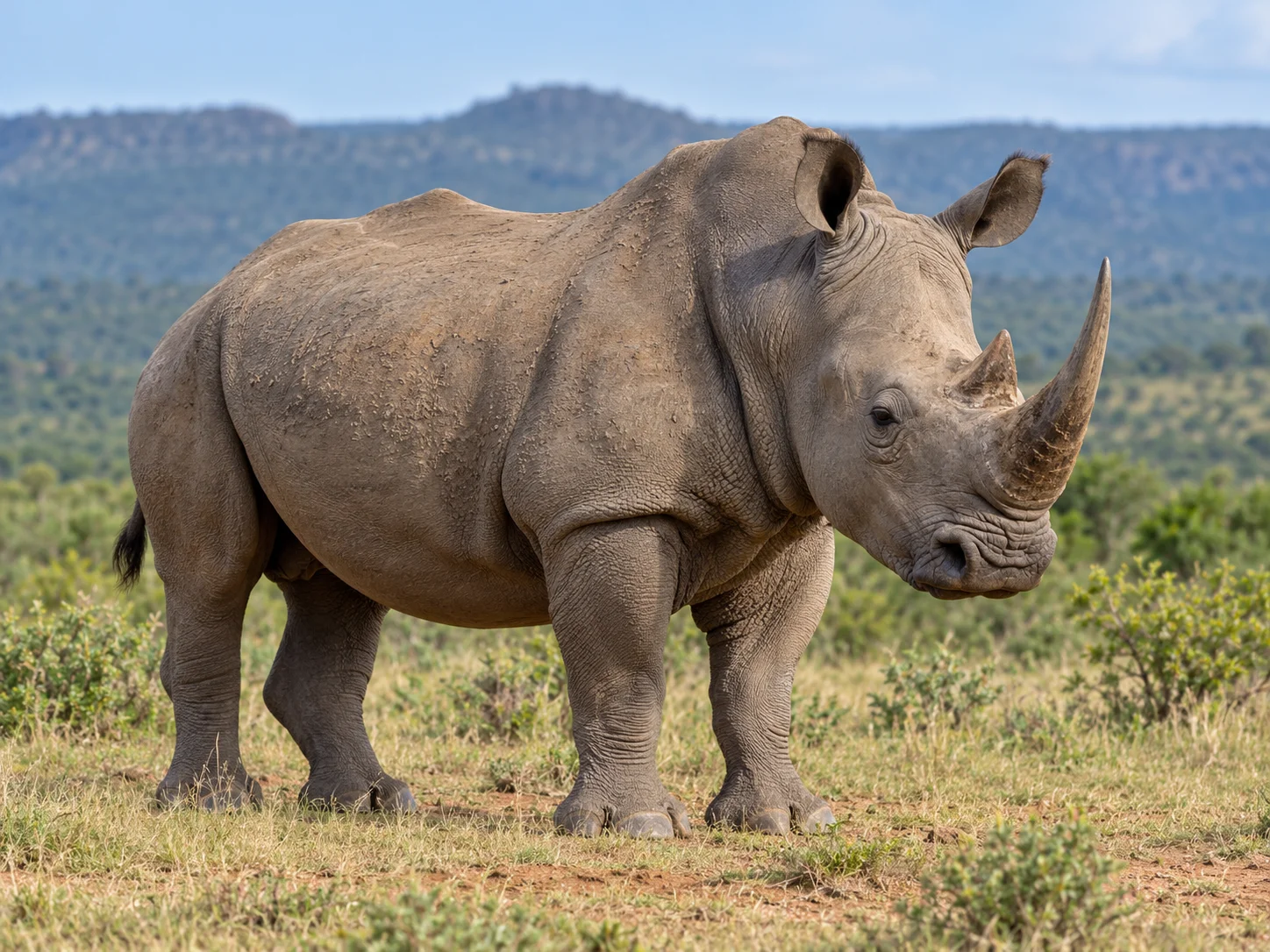
Here is the first thing to know: they are both gray. The names tell you nothing about color.
The real difference is the mouth, and it comes from what each one eats.
- White rhino: a wide, square upper lip, built like a lawnmower for cropping grass close to the ground. It grazes, so it spends its days head-down in open grassland.
- Black rhino: a pointed, hooked upper lip that works like a finger, gripping twigs and pulling leaves off bushes. It browses, so it lives among shrubs and trees.
Size separates them too. A white rhino is the bigger animal by some margin and usually travels in small groups. A black rhino is smaller, more solitary and has a reputation for being considerably more bad-tempered.
Where did “white” come from, then? The explanation usually given is that English speakers misheard an Afrikaans or Dutch word for “wide”, describing that square lip, and then called the other species black to tell them apart. Linguists argue about whether that is really what happened, so treat it as a good story rather than a settled fact.
Appearance and Anatomy
Across the family, rhinos weigh from about 1,100 pounds (500 kg) for a Sumatran rhino up to around 5,500 pounds (2,500 kg) for a big white rhino. They stand roughly 4 to 6 feet at the shoulder and measure 8 to 13 feet long.
The skin is thick and gray or brown, hanging in heavy folds on the Asian species so they look faintly armored. Only the Sumatran rhino is noticeably hairy.
The horn is the part everyone asks about, and the key fact is that it is not bone and not attached to the skull. It is solid keratin, the same protein as human hair and fingernails, packed tightly into a cone. It grows continuously through the animal’s life, and if it breaks it grows back.
Rhino eyesight is famously poor. A rhino may not recognize a person standing still 100 feet away. Hearing and smell more than make up for it: the ears turn independently, and the nasal passages are larger than the animal’s entire brain.
Habitat and Range
The two African rhino species, white and black, live in savanna, grassland and bush country, mostly in South Africa, Namibia, Kenya, Zimbabwe and Tanzania.
The three Asian species live in much wetter places. Greater one-horned rhinos occupy tall floodplain grassland and swamp in India and Nepal, with more than 80 percent of them in India. Javan and Sumatran rhinos live in dense tropical rainforest.
All of them need water nearby, and not only for drinking. Rhinos wallow in mud daily. The coating cools them, blocks sun, and smothers the biting insects that thick skin alone cannot keep off.
Diet and Feeding
Rhinos are herbivores, and a big one eats well over 100 pounds of plant food a day.
The split between grazers and browsers runs right through the family. White rhinos and greater one-horned rhinos are mainly grass eaters. Black, Javan and Sumatran rhinos are browsers, taking leaves, shoots, twigs and fruit from shrubs and small trees.
Unlike cattle and deer, rhinos do not chew the cud. They ferment their food in a large hindgut instead, which handles coarse, low-quality plant material well but means they must simply eat a great deal of it.
Behavior and Lifestyle
Most rhinos are solitary. White rhinos are the sociable exception, forming small groups called crashes, usually females and their young.
They feed in the cooler hours and rest or wallow through the heat of the day. Males hold territories and advertise them with dung heaps called middens, which work as a noticeboard: a rhino can read who has passed by, and how recently, from the smell alone.
For their bulk they are startlingly fast, reaching about 30 miles an hour, and they turn more sharply than anything that size should. The charge is usually a bluff, driven by bad eyesight and a preference for dealing with surprises decisively.
Oxpecker birds ride on their backs, eating ticks and shrieking at disturbances, which gives a half-blind animal a useful early warning system.
Reproduction and Life Cycle
Rhinos reproduce slowly, and that is central to why they are so hard to save.
Pregnancy lasts 15 to 16 months, among the longest of any mammal, and produces a single calf. The calf weighs 90 to 140 pounds at birth and can stand within an hour. It stays with its mother for two to four years, and she will not breed again until it leaves.
That works out at one calf every three to four years at best. A female poached today takes decades of population growth with her.
Rhinos live 35 to 50 years, and reach breeding age at around six or seven.
Predators and Threats
A healthy adult rhino has essentially no natural predators. Lions, tigers and hyenas occasionally take a calf, and a mother rhino is formidable about preventing it.
The threat is people.
- Poaching for horn. Rhino horn sells for enormous sums in parts of Asia, where it is used in traditional medicine and as a status symbol. It is keratin. It has no proven medical effect whatsoever. Chewing your own fingernails would do the same.
- Habitat loss. Farming, logging and settlement have broken the remaining habitat into fragments.
- Small, isolated populations. In South Africa the median rhino population is around seven white rhinos or eleven black rhinos per site, which leaves very little genetic room.
Between 2019 and 2023, poachers killed 18 to 26 Javan rhinos, possibly a third of the entire species.
Conservation Status
There is no single status for rhinos, because the five species sit in very different places.
Three are Critically Endangered: the black rhino, the Javan rhino and the Sumatran rhino. The greater one-horned rhino is Vulnerable. The white rhino is Near Threatened.
The news is genuinely mixed, and both halves matter. Black rhinos rose from about 6,195 in 2022 to 6,788 in 2024. Greater one-horned rhinos have climbed to 4,075, up from a few hundred a century ago, which is one of conservation’s real success stories and the result of hard protection work in India and Nepal.
Against that, Javan rhinos fell from 76 to about 50, and Sumatran rhinos sit between 34 and 47, down from nearly 300 at the start of this century. White rhino numbers dropped by more than 1,700 between 2023 and 2024, almost all of it poaching in South Africa.
The northern white rhino, a subspecies of the white rhino, is already finished as a breeding population. Two females remain alive and no males. Scientists are attempting to recover it using stored sperm and advanced embryo techniques.
Role in the Ecosystem
Rhinos are landscape shapers. A white rhino herd grazing an area hard creates short-grass lawns that smaller grazers then use, and those patches support different insects and birds than the tall grass around them.
Browsing rhinos do the reverse job, pruning shrubs and keeping bush from closing over open ground. Both kinds spread seeds in their dung, and the middens become feeding sites for dung beetles and, through them, for birds.
Because they need large protected areas, rhinos also act as an umbrella species. Land guarded for rhinos shelters everything else living on it, which is why rhino conservation tends to lift whole ecosystems rather than one animal.