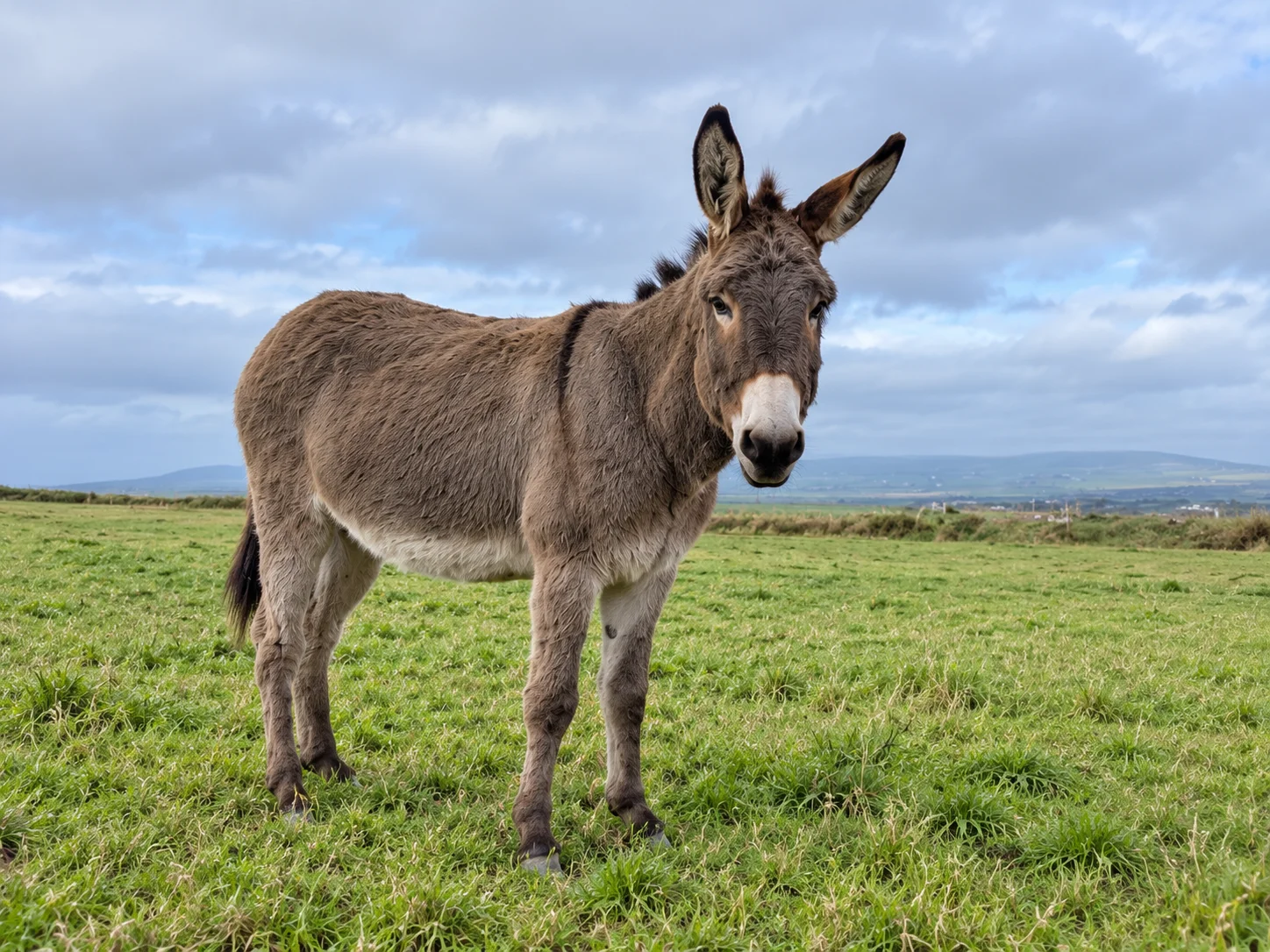
Meet the Donkey
A donkey that stops and refuses to move is usually described as stubborn. What is actually happening is a safety assessment.
A horse frightened by something will bolt. A donkey will not. Donkeys evolved in rocky North African desert, where running blindly from danger meant a broken leg, so their instinct is to freeze, look, and decide. A donkey asked to cross something it judges unsafe will plant itself and think about it.
Handlers who work with them know this. A donkey being stubborn is a donkey that has spotted a problem, and forcing it almost never works, whereas showing it the footing usually does.
Scientific Name and Classification
The domestic donkey is Equus asinus, sometimes written Equus africanus asinus to show its descent from the African wild ass, Equus africanus.
- Kingdom: Animalia
- Phylum: Chordata
- Class: Mammalia
- Order: Perissodactyla
- Family: Equidae
- Species: Equus asinus
Donkeys are equids, so horses and zebras are their relatives, and donkey, ass and burro are all the same animal: burro is simply the Spanish word, used in the Americas.
The crosses are where it gets interesting. A mule is a male donkey crossed with a female horse. A hinny is the reverse, a male horse with a female donkey, and hinnies are harder to produce and generally smaller. Both are almost always sterile, because a donkey has 62 chromosomes and a horse has 64, and the odd number out leaves the offspring unable to produce viable gametes.
Mules are bred deliberately because they combine a horse’s size with a donkey’s toughness, sure-footedness and sense, and they have been the pack animal of choice for armies and miners for centuries.
Built for the Desert
Almost everything distinctive about a donkey comes from its origin in the dry country of northeast Africa, and these are real physiological differences from a horse rather than matters of temperament:
- Water. A donkey can lose up to 30 percent of its body weight in water and recover, rehydrating in a few minutes at a trough. A horse in that state would be dying.
- Food. It extracts far more from poor, fibrous forage than a horse, which is why a donkey kept on rich grass gets dangerously fat.
- Ears. Large, and full of blood vessels that shed heat, as well as giving exceptional hearing.
- Hooves. Small, upright and tough, built for rock rather than soft pasture.
- Coat. Not waterproof, unlike a horse’s. This is the single most important thing for anyone keeping one in a wet climate, because a donkey left out in rain gets cold and sick. They need a shelter they can choose to use.
The efficiency has a cruel edge in modern keeping. Most donkey health problems in wealthy countries come from too much food: obesity, laminitis, and a fat-related liver condition that can kill. A donkey does well on what a horse would starve on.
Appearance and Anatomy
Donkeys vary enormously by breed, from the miniature Mediterranean at 36 inches at the shoulder to the American Mammoth Jackstock at over 56 inches. Weight runs 200 to 1,000 pounds (90 to 450 kg).
Most are gray, with a paler muzzle and belly and a dark stripe down the back crossed by another over the shoulders. That cross marking is ancient and appears in the wild ancestor, and it has attracted religious stories for centuries, including the Christian legend that it was given to the donkey that carried Christ into Jerusalem.
The mane is short and stiff and stands upright rather than falling, and the tail is cow-like, with a tuft at the end rather than long hair throughout.
The bray carries up to two miles, and each donkey’s bray is individually recognizable to the donkeys that know it.
Habitat and Range
Donkeys live worldwide, with the great majority in Africa, Asia and Latin America, where they are working animals rather than pets.
They were domesticated around 5,000 to 7,000 years ago in northeast Africa, and recent genetic work points to a single domestication event in the Horn of Africa, from which donkeys spread across the ancient world. That spread mattered enormously: donkeys made long-distance trade possible before the camel, and the economies of Egypt and Mesopotamia ran on them.
Feral populations exist in the American southwest, where burros descended from gold-rush animals are a contested management problem, and in Australia, where there are hundreds of thousands.
The wild ancestor, the African wild ass, is Critically Endangered, with perhaps a few hundred left in Eritrea, Ethiopia and Somalia. There may be more feral donkeys in Australia than there are wild asses anywhere.
Diet and Feeding
Donkeys are herbivores, and browsers as much as grazers, eating grass, straw, thistles, bark, twigs, shrubs and coarse scrub that other livestock will not touch.
They are hindgut fermenters like horses, with gut microbes breaking down fiber, and they are notably better at it, extracting more from the same poor feed.
They eat slowly and more or less constantly, which matters for their health, because a donkey left with nothing to chew develops both digestive and behavioral problems.
The correct diet in a temperate country is mostly barley straw with limited grazing, which looks like neglect to anyone used to horses and is in fact what keeps a donkey alive.
Behavior and Lifestyle
Donkeys form intense bonds with a chosen companion, and this is the most important thing to understand about them.
A bonded pair will stand together, graze together and become seriously distressed if separated. Donkey welfare organizations treat separation as a genuine medical risk, because a donkey whose companion is taken away may stop eating, and that can trigger the fatal fat-mobilisation problem. Bonded donkeys are rehomed together as a rule, and when one dies the other is usually allowed to stay with the body for a time.
They are also excellent guard animals. Donkeys dislike canids intensely, and a donkey will chase, strike and bite a fox or coyote, which is why they are kept with sheep and goats in parts of the United States and Europe as living protection.
Their memory is long and their learning careful. Donkeys remember routes, places and people for years, including people who treated them badly, and they learn from being shown rather than driven.
Reproduction and Life Cycle
A jenny, or female donkey, carries a single foal for 11 to 14 months, which is longer than a horse and one of the longer gestations among domestic animals.
The foal stands and nurses within an hour or two and is weaned at six to eight months.
Donkeys reach sexual maturity at one to two years but should not be bred until three or four, and a jenny usually has one foal every other year at most.
They are long-lived. A well-kept donkey reaches 30 to 40 years, and 50 is documented, which is considerably longer than a horse and a serious commitment for an owner. Working donkeys in poor conditions often live less than 15.
Predators and Threats
Wolves, lions, hyenas and feral dogs take donkeys where they overlap, and a donkey defends itself by kicking with both hind and front feet and biting, which it does with commitment.
The threats that matter are human. Around the world donkeys are worked beyond their capacity, with untreated wounds from badly fitted harness, overloading, lameness and no veterinary care, and they are the transport of the poorest people, which means their welfare depends on circumstances their owners often cannot change.
A newer and severe pressure is the trade in ejiao, a traditional Chinese remedy made from gelatin in donkey hide. Demand has driven slaughter on a scale that has cut national donkey populations sharply in several African countries, and because donkeys breed slowly the losses are not quickly replaced. Several countries have banned donkey skin exports, and the African Union agreed a continent-wide ban on donkey slaughter for skins in 2024.
Mechanisation also leaves donkeys unwanted, and abandonment is common where they are no longer needed.
Conservation Status
The domestic donkey is not assessed for conservation, since it is a domestic animal, and there are around 50 million of them worldwide.
Its wild ancestor is a different matter entirely. The African wild ass is Critically Endangered and may be down to a few hundred animals, lost to hunting, competition with livestock for scarce water, and conflict in the region it lives in. It is one of the most endangered mammals in the world and almost unknown to the public.
Some donkey breeds are also at risk, and the Poitou of France, a huge shaggy breed, fell to fewer than 50 animals before a recovery effort.
Feral burros present the opposite problem, and managing them in the American west is genuinely contested, since they damage desert springs that native wildlife depends on while also being protected by law and popular with the public.
Role in the Ecosystem
Feral donkeys dig for water in desert washes, creating wells that other animals use, and research in the American southwest found these donkey-dug wells supporting dozens of other species and even germinating trees. It is a genuine ecological contribution from an animal usually classed as a pest.
They also graze coarse scrub that other livestock leave, which is used deliberately for conservation grazing in some European reserves.
Their largest role, though, is human. Donkeys carry water, firewood, crops, bricks and children to school for tens of millions of the world’s poorest households, and in many places a donkey is the single most valuable thing a family owns and the reason the women of the household are not carrying the water themselves.
Which makes the donkey’s reputation one of the clearest injustices in the way we talk about animals. It is called stupid and stubborn, and it is cautious, careful, retentive, deeply loyal to its companions, and has been carrying the basic weight of human life for 5,000 years.