Meet the Lion
The lion is the only cat in the world that lives in a group, and that single fact explains almost everything else about it.
Every other cat, from the house cat to the tiger, hunts alone and meets its own kind mainly to mate or fight. Lions live in prides, hunt together, raise cubs communally and defend shared territory, and because of that they can take prey far larger than themselves and hold the best ground against everything else on the savanna.
It also makes them the loudest. A lion’s roar can be heard five miles away, and it is produced by vocal folds shaped quite differently from other cats’: square, flat and unusually loose, so they vibrate with very little air pressure. The lion is not shouting. It is built to be loud cheaply.
Scientific Name and Classification
The lion is Panthera leo, one of the five true big cats in the genus Panthera, along with the tiger, leopard, jaguar and snow leopard.
- Kingdom: Animalia
- Phylum: Chordata
- Class: Mammalia
- Order: Carnivora
- Family: Felidae
- Species: Panthera leo
Being in Panthera is what makes a lion a big cat in the strict sense: these five species share a specialized ligament in the voice box that lets them roar, and no other cat can. The puma is larger than a leopard and cannot roar at all.
Two subspecies are now recognized: Panthera leo leo, covering the lions of West and Central Africa and the surviving Asiatic population, and Panthera leo melanochaita in East and southern Africa. The older habit of naming a separate subspecies for every region has been abandoned.
Do Male Lions Actually Hunt?
Yes, and the familiar claim that males are idle while females do all the work is one of the most persistent half-truths about any animal.
Females do most of the hunting in open country, where coordination and speed matter and a conspicuous mane is a liability. But males hunt regularly in thicker cover, they hunt alone when they have no pride, and they are the ones who take on the largest and most dangerous prey. Male lions kill buffalo and even young elephants and giraffes, which a lioness will rarely attempt.
The division of labor is better understood like this:
- Females supply most of the day-to-day food through cooperative hunting.
- Males do the fighting. Defending a territory against rival coalitions is dangerous, exhausting work, and it is what keeps the pride’s cubs alive.
- Both scavenge heavily, and lions steal from hyenas and cheetahs at every opportunity.
A male who loses that fight loses everything, and the arithmetic is brutal: when a new coalition takes over a pride, it usually kills the cubs sired by the previous males, because a female with no cubs comes into season again within weeks.
Appearance and Anatomy
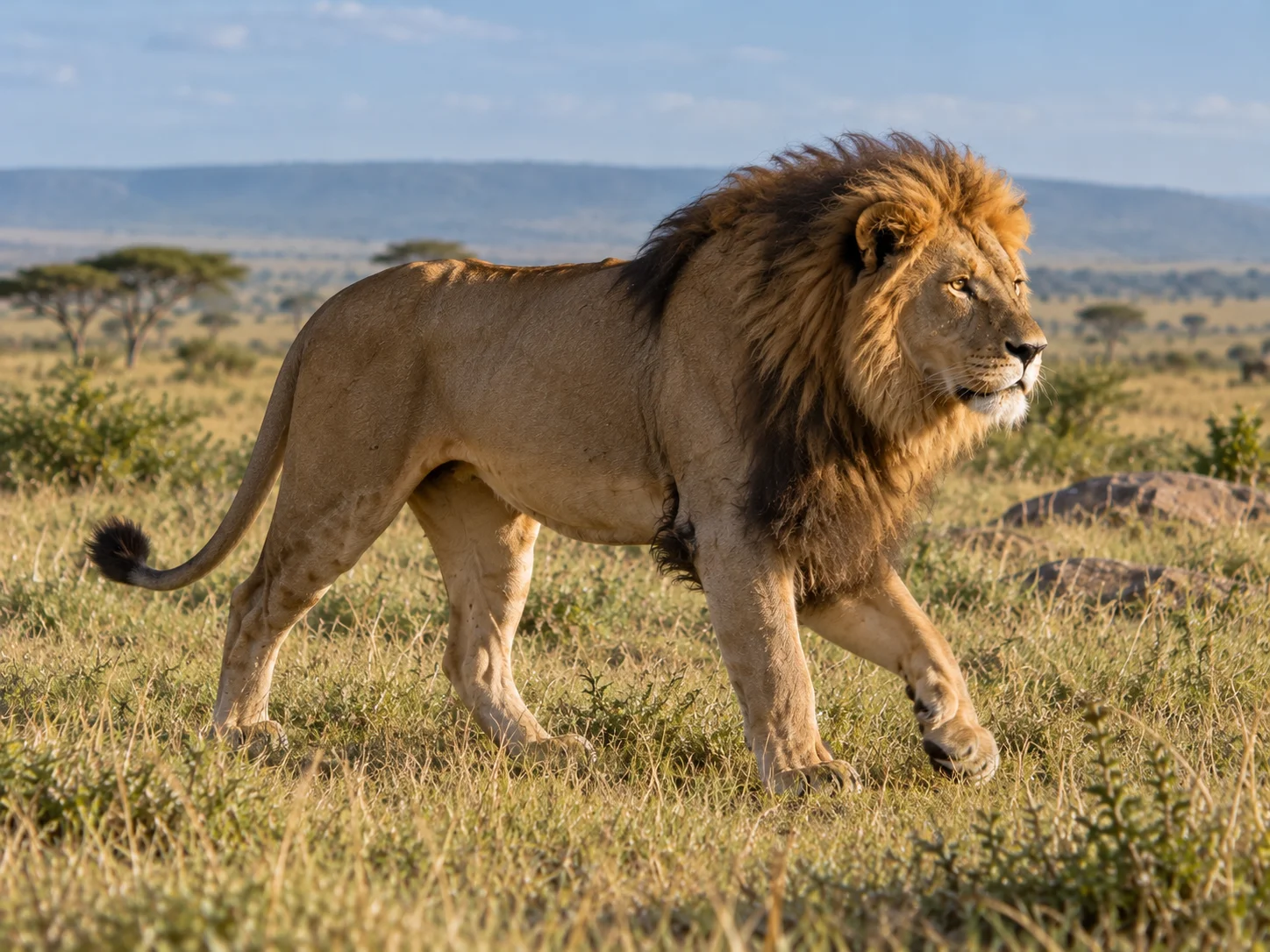
Males measure 5.6 to 8.2 feet in body length with a 2 to 3 foot tail, stand about 4 feet at the shoulder and weigh 330 to 570 pounds (150 to 260 kg). Females are considerably smaller at 250 to 400 pounds. Only the tiger is a larger cat.
- The mane. Unique among cats, and an honest signal: darker, fuller manes indicate higher testosterone and better condition, females prefer them, and rival males are more wary of them. Manes also grow thinner in hot climates, and the lions of Kenya’s Tsavo region are often nearly maneless.
- Tail tuft. Lions are the only cat with a tuft at the tail tip, and it conceals a small hard spur of fused vertebrae whose purpose nobody has established.
- Claws. Retractable, up to 1.5 inches, used to hook and hold prey.
- Eyes. Roughly six times more light-sensitive than ours, which is why most hunting happens at night.
White lions are not albinos and not a subspecies. They carry a recessive gene found in the Timbavati region of South Africa, and they are rare in the wild largely because pale cubs are easier for predators to spot.
Habitat and Range
Lions live in savanna, grassland, open woodland and scrub across sub-Saharan Africa, plus one small population in India.
They are not jungle animals, despite the title. Lions avoid dense rainforest and need open country where cooperative hunting works, and the phrase king of the jungle appears to come from an older English use of jungle to mean wilderness generally.
Their range has collapsed. Lions once lived across Africa, through the Middle East, into Greece and across southwest Asia to India, and as recently as 2,000 years ago there were lions in southern Europe. They now occupy something like 8 percent of their historical range.
The Asiatic lion survives only in and around the Gir Forest in Gujarat, India, where it fell to perhaps a few dozen animals in the early twentieth century and has since recovered to roughly 670. Every Asiatic lion alive descends from that tiny remnant.
Diet and Feeding
Lions are carnivores, taking wildebeest, zebra, buffalo, antelope, warthog and young giraffe, with the mix depending on what is locally abundant.
They hunt mostly at night, stalking to within 100 feet before a short charge. Lions are fast but have poor stamina, reaching about 35 miles an hour over a few hundred yards, so a hunt that is spotted early simply fails. Most attempts do.
An adult eats around 11 to 15 pounds of meat a day on average, but feeds in bouts, and a lion can take 70 pounds in a single sitting and then not eat for days.
They scavenge far more than their reputation suggests. In some studies a substantial share of lion food is stolen or found rather than killed, and the familiar image of hyenas driving lions off a carcass is frequently the reverse in practice.
Behavior and Lifestyle
A pride is a family of related females, their cubs, and a coalition of one to four adult males, typically 10 to 15 animals in all but occasionally far more.
The females are the permanent core. Daughters usually stay for life, so a pride is a line of grandmothers, mothers, sisters and aunts holding the same territory across generations. Males are temporary, holding tenure for two to four years before being driven out by a stronger coalition.
Young males leave at two to three years old and spend years as nomads, usually with their brothers, before trying to take a pride of their own. Brothers who stay together do much better than lone males, which is why coalitions form.
They are also remarkably lazy, resting up to 20 hours a day, and that is not idleness but economics: hunting is expensive, meals are large and irregular, and conserving energy in the heat is the sensible strategy.
Lions greet by rubbing heads and bodies, which maintains bonds and spreads a shared scent through the pride.
Reproduction and Life Cycle
Lionesses give birth after a gestation of about 110 days to one to four cubs, weighing around 3 pounds each, hidden away from the pride in thick cover.
She keeps them hidden for six to eight weeks and moves them repeatedly, then brings them into the pride, and the timing matters enormously: females in a pride tend to give birth around the same time, so the cubs join a creche and are nursed by any lactating female, not only their own mother.
That communal nursing is almost unique among cats, and it is why synchronized breeding exists: a cub with several possible nurses is far likelier to survive.
Even so, cub mortality is severe, and roughly half do not reach their first year, with starvation and takeovers by new males the main causes.
Cubs are weaned at six to seven months and can hunt by about two years. Lions live 10 to 14 years in the wild and up to 25 in captivity, with males generally shorter-lived because of fighting.
Predators and Threats
Adult lions have no natural predators, though they are killed by buffalo, giraffes and elephants defending themselves, and by other lions, which is a leading cause of death.
Human pressures have cut the population hard, and the main ones are:
- Habitat loss. Savanna converted to farmland and settlement, which also fragments populations into pockets too small to stay genetically healthy.
- Retaliatory killing. Lions take livestock, and herders poison or spear them. This is the single largest direct cause of lion deaths across much of Africa.
- Loss of prey. Bushmeat hunting removes the antelope and zebra lions depend on, so a protected lion in an emptied landscape still starves.
- Snaring. Wire snares set for bushmeat catch lions indiscriminately.
- Trade in body parts, including bones sold into Asian markets as a substitute for tiger products.
Trophy hunting is genuinely contested rather than simple. It kills lions and has removed pride males whose deaths caused cub losses, and it also funds conservation areas that would otherwise be farmland, and the evidence on balance differs by country and by how well it is regulated.
Conservation Status
The lion is listed as Vulnerable, with roughly 20,000 to 25,000 left in the wild. It has lost around half its numbers in the last 25 years, and the decline in West and Central Africa has been far steeper than elsewhere, where the West African lion is Critically Endangered.
The pattern is divided. Lions are stable or increasing in a handful of well-funded reserves in southern Africa and in the Gir Forest, and collapsing almost everywhere that protection is thin.
What works is unspectacular and well tested: reinforced livestock enclosures, which cut losses sharply and therefore cut retaliation; compensation schemes; community conservancies where local people earn directly from wildlife; and removing snares at scale. The Lion Guardians program in Kenya, which employs Maasai warriors, including former lion hunters, to track and protect lions, has measurably reduced killings.
The Asiatic population shows both the promise and the risk: it recovered from a few dozen animals to around 670, and it is all in one place, so a single disease outbreak could take most of it.
Role in the Ecosystem
Lions are apex predators, and by keeping grazing herds moving and in check they shape where grass grows and how savanna holds together. Where lions have gone, herbivore numbers and browsing pressure change measurably.
They also suppress smaller predators. Lions kill cheetahs, leopards, hyenas and wild dogs, and in doing so hold the whole carnivore community in a particular shape.
Their kills feed a long queue of other animals, from hyenas and jackals to vultures and beetles, so a lion pride is a reliable supplier of carrion across its territory.
Economically they are the single biggest draw in African wildlife tourism, which funds a great deal of conservation that has nothing to do with lions.
And they carry more symbolic weight than any other animal: on the flags, coins and coats of arms of dozens of countries, in the Bible and the Quran, in Aesop, on the gates of Mycenae and the pillars of Ashoka, which is now the national emblem of India. It is worth noticing that a great many nations put a lion on their crest, and almost none of them have any lions left.