Meet the Zebra Finch
A young male zebra finch has about three months to learn to sing. He listens to an adult, usually his father, practices badly for weeks, and then arrives at one song that he will sing for the rest of his life without ever changing it.
That is the whole reason this small gray bird from the Australian desert is one of the most studied animals on Earth. A zebra finch learns its voice the way a human child learns to speak: by listening to an adult, during a window that closes.
It is also, on its own terms, an extraordinary survivor. Zebra finches live across about three quarters of mainland Australia, including country where water arrives once in a bad year.
Scientific Name and Classification
There are two zebra finches, and the split is recent. Until 2016 they were counted as one species. The IUCN and BirdLife International separated them that year, and the International Ornithological Congress followed in 2022.
- Kingdom: Animalia
- Phylum: Chordata
- Class: Aves
- Order: Passeriformes
- Family: Estrildidae
- Species: Taeniopygia castanotis, the Australian zebra finch
- Species: Taeniopygia guttata, the Sunda zebra finch
The Australian bird is the one in pet shops and laboratories. The Sunda zebra finch lives in the Lesser Sunda Islands of Indonesia, from Lombok to Timor, and is smaller, with a narrower breast band and no fine barring on the throat.
The split was argued on three grounds: the plumage differences, how far apart their mitochondrial DNA has drifted, and the fact that in captivity the two prefer to pair with their own kind.
Appearance and Size
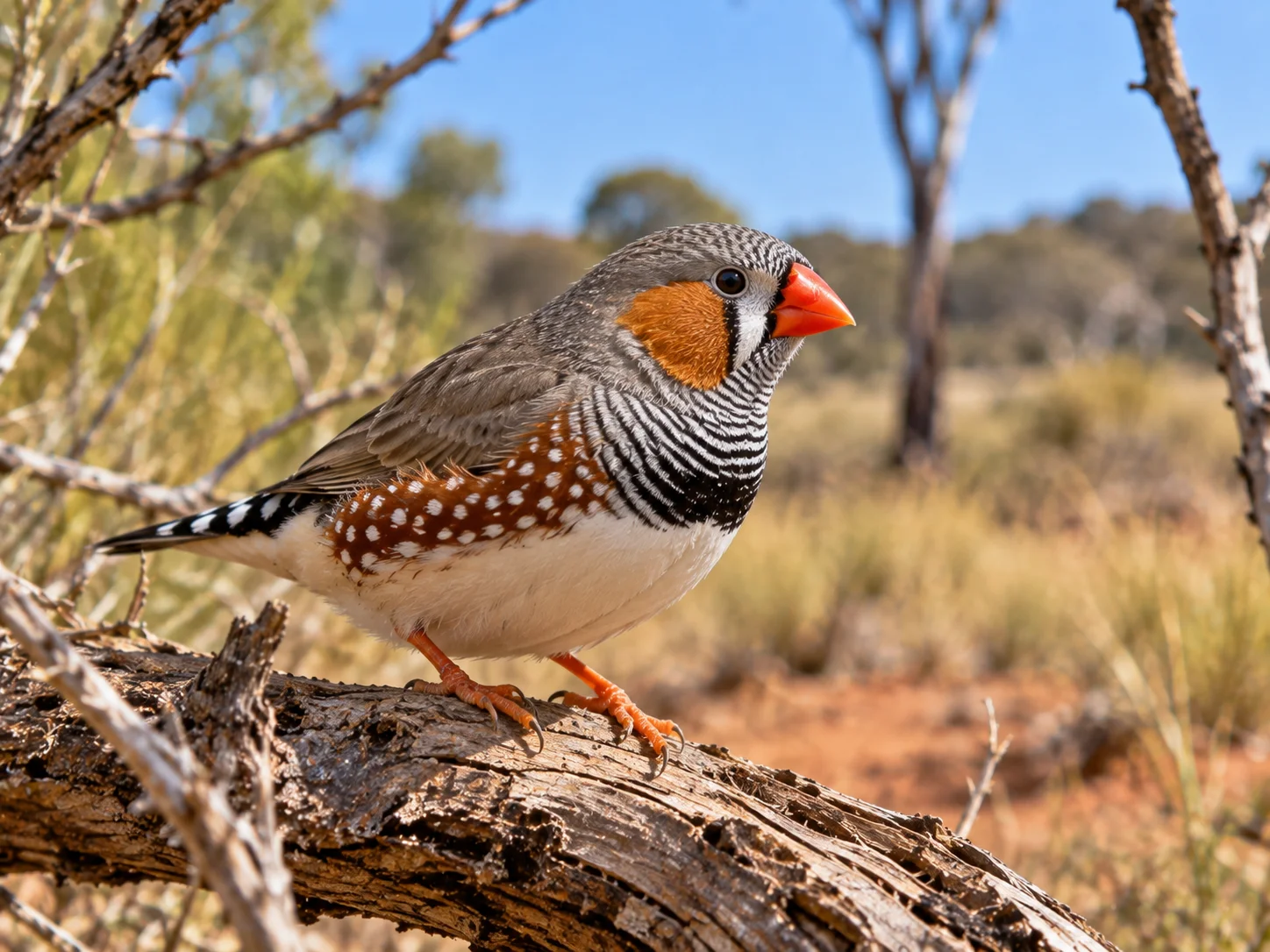
A zebra finch is about 4 inches (10 cm) long and weighs around half an ounce. Males and females are close to the same size, so you tell them apart by color rather than build.
- Males: bright orange cheek patches, a red beak, and bolder black and white markings
- Females: no cheek patch, and an orange beak rather than a red one
- Both: the black and white barring across the throat that gives the bird its name
- Both: a black and white barred tail and chestnut flanks spotted with white
Among small birds this is unusually clear. A sparrow takes some looking at before you can sex it. With a zebra finch you check the beak.
Habitat and Range
The Australian zebra finch is the most widespread estrildid finch on the mainland, living on roughly 75 percent of it. It skips the cool humid south, parts of the tropical far north, and most of the coast apart from the dry western edge.
It likes dry country with water somewhere in it: grassland with scattered trees, open grassy woodland, and farmland, including rice fields. It has also been introduced to Puerto Rico and Portugal.
How a Zebra Finch Handles Drought
A zebra finch drinks a great deal for its size, between 24 and 28 percent of its own body weight every day. At comfortable temperatures that is about 3 milliliters. At 40 degrees Celsius it can rise to 12.
Which makes what it can do without water harder to believe. In one experiment birds cut to between half a milliliter and one milliliter a week survived. In another, more than half the birds came through 513 days with no drinking water at all, living on the moisture in seeds and the water their own bodies made from digesting them.
There is a hard limit, though, and it is heat rather than thirst. A body temperature over 45 degrees Celsius can kill a zebra finch within an hour, and mass die-offs have happened in extreme heat waves.
Diet and Feeding
Grass seed is the staple, preferably half-ripe or ripe, and the bird dehusks each one before swallowing it. Most feeding happens on the ground, though zebra finches will also work seeds straight off the grass heads.
They top that up with insects, mostly ants and termites, and with the flowers of saltbush and its relatives. Nestlings get half-ripe and ripe seed plus green plant material.
Breeding and Life Cycle
Zebra finches do not breed by the calendar. They breed when the desert allows it, usually starting one to three months after water appears, which times the hatching to when seed is ripening. Heavy sustained rain is actually bad for them.
The nest is a domed structure 5 to 10 inches long with a short entrance tunnel, often built on top of an old nest and lined with wool and feathers. A clutch is 2 to 8 eggs, most often 5, pale and incubated for 14 to 16 days.
Not every egg in a nest belongs to the pair sitting on it. Between 5 and 11 percent of young zebra finches come from a female slipping an egg into someone else’s nest.
Chicks fledge at 17 or 18 days, feed themselves by about 35 days, go fully independent somewhere between 36 and 50 days, and most are breeding by around 80 days old. In the wild a zebra finch may reach about 5 years. In captivity 5 to 9 is normal, 12 happens, and one bird reached 14 and a half.
Song: How a Zebra Finch Learns to Sing
Only males sing. A female calls, but she does not sing, and she never learns a song.
A young male goes through recognizable stages. First comes subsong, which is quiet and formless, the bird equivalent of babbling. Then plastic song, where recognizable pieces of the tutor’s song appear and get rearranged. By about 90 days the song crystallizes, and from then on it barely changes.
He has to be able to hear himself to do it. Without auditory feedback the song does not form properly, and traffic noise alone is enough to slow the learning down.
The audience is more discerning than we are. Females can hear differences between songs that humans cannot detect at all, and they prefer males whose dialect matches the one they grew up hearing from birds their own age. Song in zebra finches is partly cultural, passed from bird to bird, and separated populations drift into distinct dialects.
Why Scientists Study the Zebra Finch
Humans and zebra finches are both vocal learners, and there are very few of us. Most animals are born with their calls. Learning your voice from an adult during a critical period is rare, and the zebra finch does it in a brain small enough to map.
So it has become Australia’s most studied bird and, by 2010, the most studied captive songbird in the world. Its genome was sequenced in 2008, the second bird genome finished after the chicken, and work on the gene FoxP2 in finch song feeds directly into research on human speech.
There is a plainer reason too, which the literature states outright: zebra finches are easy to keep and easy to breed. A great deal of what we know about how brains learn rests on a desert finch that does not mind living in a cage.
Predators and Threats to the Zebra Finch
Nests are raided by tiger snakes and brown snakes, dragon lizards and monitors, crows, babblers and honeyeaters, black rats, house mice and carnivorous marsupials. Barn owls take adults off their roosts at night.
Against all of that the species is listed as Least Concern, and both zebra finches are. The answer is arithmetic: breeding at 80 days old, whenever there is water, in flocks, across three quarters of a continent.
Zebra Finches as Pets
They are a common first bird, and the one rule that matters most is that you do not keep one alone. Zebra finches are flock animals and need at least a pair, ideally a group.
Beyond company they want a cage of decent length rather than height, bars no more than about 1 cm apart, a shallow dish to bathe in, a seed and millet mix with greens, fruit and vegetables, and something for calcium such as crushed cuttlefish bone or eggshell. Avocado is toxic to them and should never be offered.
And if you keep a male, you will hear the thing itself: one short song, repeated, that he worked out for himself before he was three months old and will never revise.