Meet the Yorkshire Terrier
A Yorkshire terrier weighs no more than 7 pounds and is usually described as a lap dog. It was invented to kill rats in textile mills.
The breed came out of nineteenth-century Yorkshire, and it was not developed by aristocrats with kennels and stud books. It was put together by the workers in the cotton and woolen mills of Yorkshire and Lancashire, which is why the early records are so thin: the people doing the breeding were not in the habit of writing things down for publication.
What they produced was a working terrier small enough to go where rats go, with a coat that happened to be spectacular. The coat is why it ended up in handbags. The rats are why it exists.
Scientific Name and Classification
The Yorkshire terrier is a breed of domestic dog, Canis lupus familiaris, and therefore a subspecies of the gray wolf like every other dog.
- Kingdom: Animalia
- Phylum: Chordata
- Class: Mammalia
- Order: Carnivora
- Family: Canidae
- Genus: Canis
- Species: Canis lupus familiaris
Its ancestors were larger Scottish terriers, brought south in the mid-1800s by Scottish workers moving to Yorkshire for mill jobs. The Skye terrier is in there, and so is the Paisley terrier, a smaller Skye bred specifically for a long silky coat, which is now extinct. Some authorities think the Maltese was used as well.
Miners wanted a ratter, so Black-and-Tan Terriers were crossed with Paisley and Clydesdale Terriers. Three early dogs are named in the records: a male called Old Crab, a female called Kitty, and a second female whose name nobody wrote down.
Huddersfield Ben
Almost every modern breed has a dog at the root of it, and for the Yorkshire terrier that dog is Huddersfield Ben.
He was a Paisley-type show dog of the late 1860s, owned by a Yorkshire woman named Mary Ann Foster, and he was used at stud so heavily that he effectively set what the breed was going to look like. A writer in 1891 called him the best stud dog of his breed during his lifetime. He is still called the father of the breed, and the painter George Earl did his portrait.
Appearance and the Coat
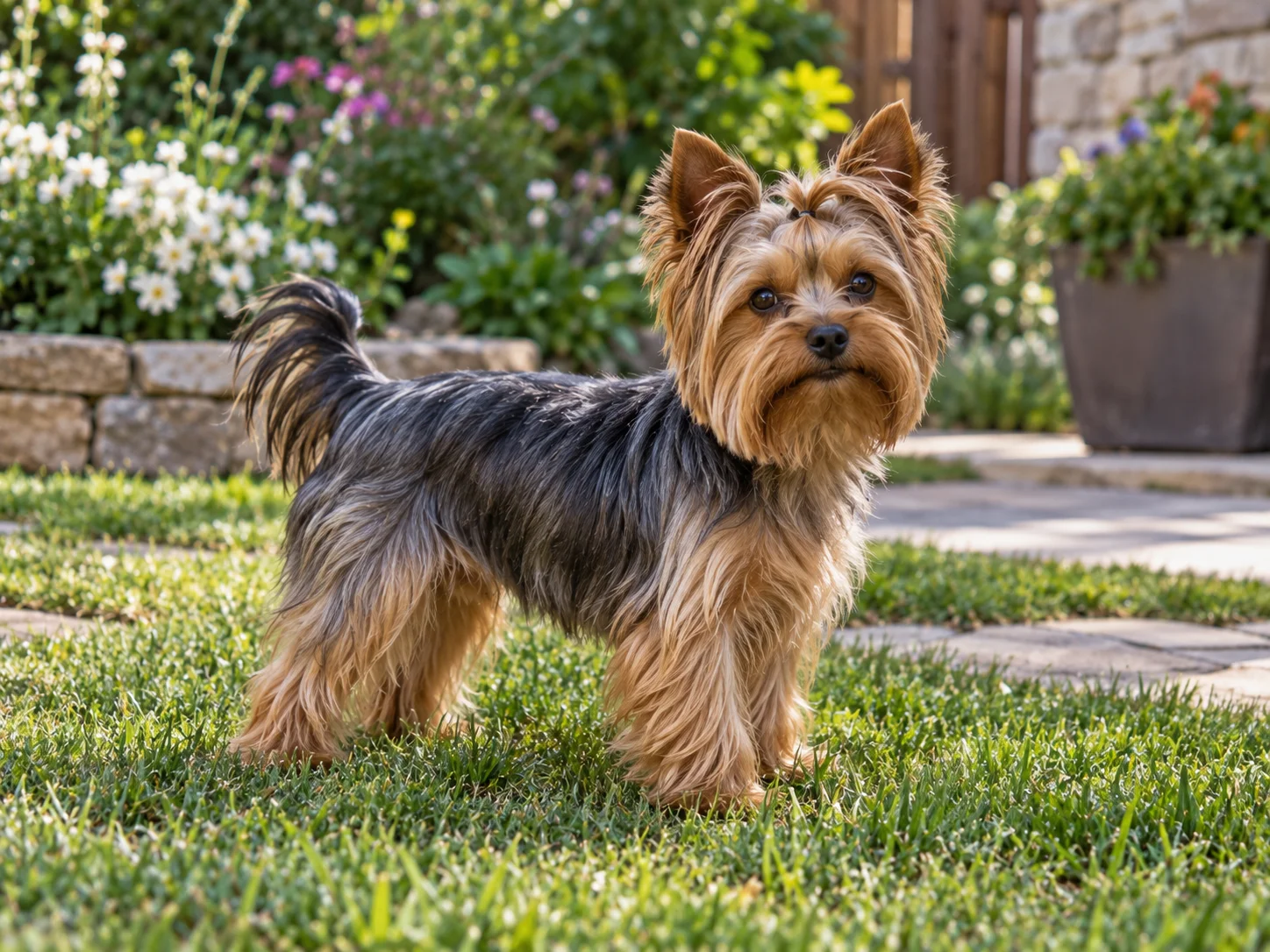
The breed standard sets a weight limit and no height: a Yorkshire terrier should weigh no more than 7 pounds (3.2 kg).
- Glossy, fine, straight, silky coat, traditionally grown very long
- Dark steel-gray body with rich tan on the head, chest and legs
- Small head, erect V-shaped ears, dark alert eyes
- A noticeably upright carriage
- No black hairs in the tan areas of an adult
The coat is the breed’s signature, and it does not arrive finished. Puppies are born dark, and the color shifts as the dog matures. Reaching the final adult color commonly takes three years or more, and a writer in 1891 observed the same thing: the full coat often did not come in until a dog was three or four.
Long as it grows, the standard is clear that it must never get in the way of the dog’s movement. This was a working animal first.
Temperament
Yorkshire terriers are playful, energetic and bold, and they are kept almost entirely as companions now rather than as working dogs.
The terrier character is still there underneath, which surprises people who expect a small dog to be a passive one. A ratting breed is bred to go into a dark space after something that will fight back, and that is not a temperament that disappears in a few generations.
In Stanley Coren’s rankings of working and obedience intelligence, the breed places 27th.
Health and Lifespan
Yorkshire terriers are long-lived. UK studies have put the average at 13 years in 2013, 12.5 in 2022 and 13.3 in 2024, against 12.7 for purebred dogs generally. An Italian study in 2024 found 13 years against an overall average of 10, and a Japanese pet cemetery study reported 14.3.
Being very small carries specific costs, and they are worth knowing before buying one.
- Tracheal collapse, common in the very smallest dogs, which produces a distinctive goose-honking cough
- Luxating patellas, where the kneecap slips out of place, considered genetic in this breed
- Puppy hypoglycemia between 5 and 16 weeks, which can cause seizures or death if untreated
- Dental disease: a 2019 study found 98 percent of dogs had early periodontitis somewhere by 37 weeks old
- Poor tolerance of anesthesia and a delicate digestive system
Others include bronchitis, cataracts, dry eye, portosystemic shunt, color dilution alopecia in blue-coated dogs, and an inherited eye condition called progressive rod-cone degeneration.
The pattern in that list is worth noticing. Most of it follows from size, so breeding Yorkshire terriers smaller does not make them cuter in any way a vet would recognize.
Smoky, the War Dog
In the Pacific during the Second World War, an American serviceman named William Wynne of Cleveland, Ohio, serving with the 5th Air Force, adopted a Yorkshire terrier called Smoky.
She went through the war with him and came home a celebrity. The timing mattered: small breeds had fallen to an all-time low of 18 percent of total registrations in the 1940s, and Smoky is credited with starting the revival of interest that made the Yorkshire terrier one of the most popular small dogs in the world.
A 7-pound ratting dog from a Yorkshire mill town got famous by going to war in the Pacific, which is not a sentence anyone would have predicted in 1860.
Care
Like any domestic dog, a Yorkshire terrier eats a prepared diet rather than hunting, and portions have to be small and regular, especially in puppies at risk of low blood sugar.
The coat is the real commitment. A full-length silky coat needs daily attention or it mats, and many owners keep their dogs clipped short instead, which is practical and loses nothing the dog cares about. Teeth need attention too, given how early dental disease sets in.
The Yorkshire Terrier and Its Relatives
The Airedale terrier comes from the same part of England and the same tradition of working terriers, built for bigger quarry. Set the two side by side and the family resemblance is obvious once you ignore the scale.
Compared with a breed like the Akita, developed as a large guardian and hunter, the Yorkshire terrier shows how far selective breeding can push a single species in a few human generations. Same animal, same ancestor, 7 pounds against 100.
Which is the useful thing about this dog. It looks like the least natural animal imaginable, and it is really a mill worker’s rat-catcher that got a very good haircut and a lucky break in a war.