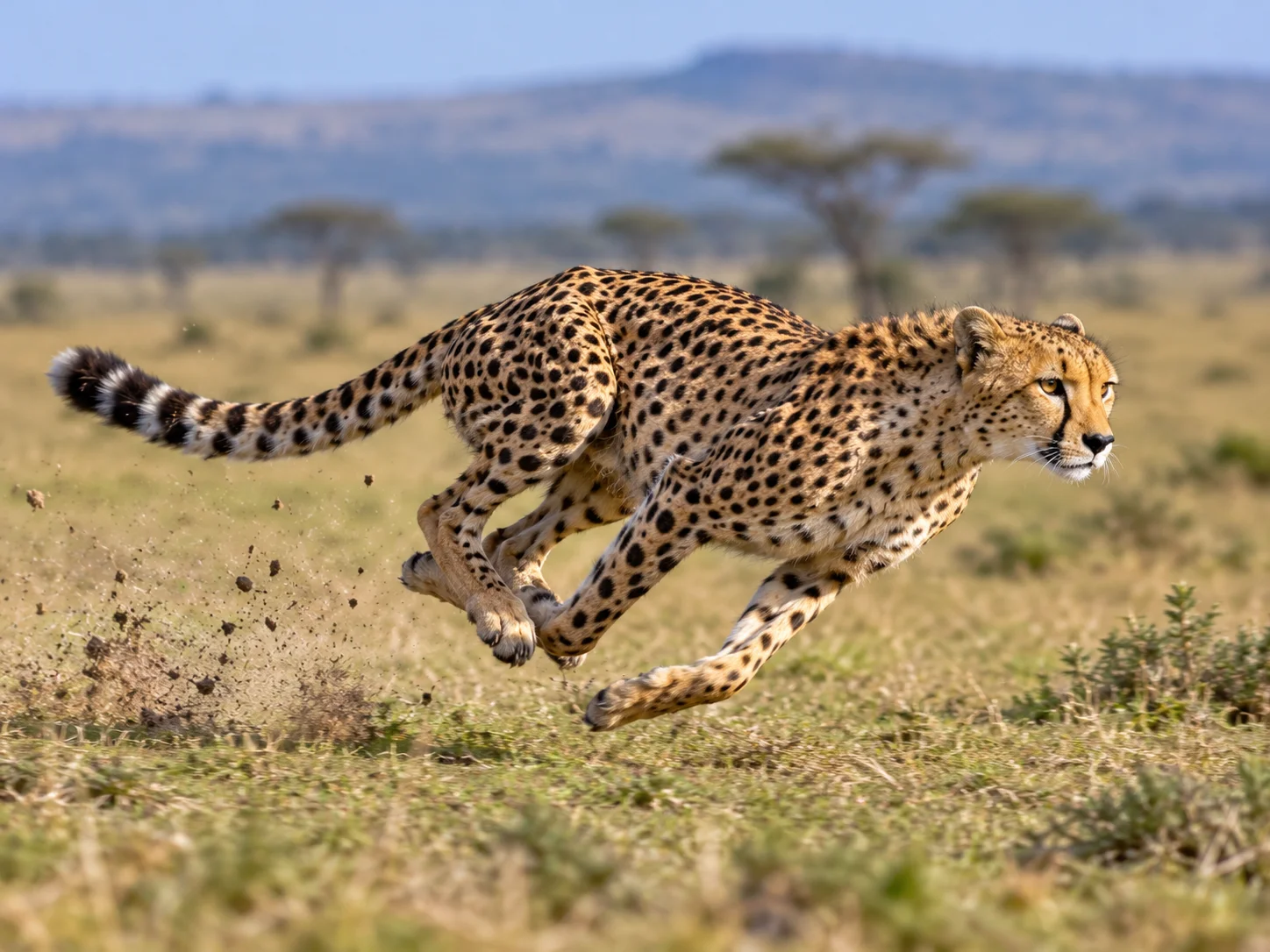
Meet the Cheetah
A cheetah can reach 70 miles an hour and accelerate from standing to 60 in about three seconds, which beats most sports cars.
It can only do it for around 20 to 30 seconds. After that its body temperature has climbed so far that it must stop, and it then needs half an hour to recover before it can even eat.
Everything about a cheetah is built for that one burst, and the costs are heavy. It is the lightest of the big cats, it cannot roar, and it loses a large share of its kills to animals strong enough to simply take them.
Scientific Name and Classification
The cheetah’s scientific name is Acinonyx jubatus. It is the only living species in its genus.
- Kingdom: Animalia
- Phylum: Chordata
- Class: Mammalia
- Order: Carnivora
- Family: Felidae
- Genus: Acinonyx
- Species: Acinonyx jubatus
Cheetahs sit outside the group people call the big cats. Lions, tigers and leopards belong to the genus Panthera and can roar. A cheetah cannot. It chirps, purrs, growls and makes a birdlike call that carries for a mile.
The genus name means “no-move claw”, for the claws that barely retract, and jubatus means maned, for the ruff cubs carry on their backs.
How Fast Can a Cheetah Run?
Up to about 70 miles an hour, making the cheetah the fastest land animal alive. The acceleration is the more impressive number: 0 to 60 in roughly three seconds.
The whole body is one piece of engineering for it:
- A spine that flexes like a spring. It coils and extends with every stride, letting a cheetah cover 20 feet in a single bound.
- Semi-retractable claws. Unlike other cats, a cheetah’s claws stay partly out and work as running spikes.
- A long tail. Used as a rudder, counterbalancing hard turns so the cat can follow prey that jinks.
- Huge nostrils, lungs and heart. For taking in oxygen fast.
- A light frame. Small head, slim body, long legs, and far less muscle bulk than a leopard.
At full speed a cheetah is airborne for more than half of each stride.
The limit is heat. Sprinting raises the body temperature so quickly that the cat has to stop after 20 to 30 seconds, and then pants for 20 to 30 minutes to cool down. During that time it is too exhausted to defend its kill, which is why cheetahs lose so much of what they catch.
Appearance and Anatomy
Cheetahs stand 2.5 to 3 feet at the shoulder, measure 3.5 to 4.5 feet in the body with a tail of about 2.5 feet, and weigh 75 to 160 pounds.
The coat is tan with around 2,000 solid black spots, and the tail ends in rings and a white tip that cubs follow through tall grass.
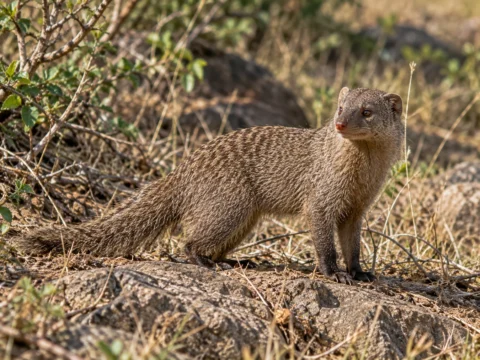
Cubs look quite different. For the first months they carry a thick silver-gray mantle of fur down the back, which may make them resemble the honey badger, an animal most predators avoid.
The king cheetah is not a separate species but a rare coat pattern caused by a single gene, with blotches and stripes instead of spots.
Habitat and Range
Cheetahs live mainly in eastern and southern Africa, with Namibia, Botswana and Kenya holding the largest populations.
They need open country: savanna, grassland and dry scrub where there is room to run. Dense forest is useless to a sprinter.
A tiny separate population survives in Asia. The Asiatic cheetah hangs on in Iran with only a few dozen individuals, making it one of the rarest cats on Earth. India, where cheetahs went extinct in 1952, began reintroducing African cheetahs in 2022.
Most cheetahs now live outside protected reserves, on farmland and communal land, which is why coexistence with people matters so much to their survival.
Diet and Feeding
Cheetahs are carnivores, hunting gazelle, impala, springbok, young wildebeest, hares and game birds.
They hunt by day, which is unusual among big cats and is largely a way of avoiding lions and hyenas. A cheetah stalks to within about 100 feet, then sprints, trips the prey with a swipe at the legs and kills by suffocation.
Then comes the hard part. Exhausted and overheated, the cheetah must rest before eating, and lions, hyenas, leopards and vultures regularly steal the kill. Cheetahs lose a substantial share of their catches this way and will abandon a carcass rather than fight, because an injury would end their hunting entirely.
They rarely return to a kill and almost never scavenge, so what they lose is simply gone.
Behavior and Lifestyle
Cheetah society is unusual. Females live alone, raising cubs by themselves across large home ranges. Males often live in small permanent groups called coalitions, usually brothers, which hold territory far better than a lone male could.
They are active in the day and rest in shade through the hottest hours, often climbing termite mounds or fallen trees to scan for prey. They are poor climbers otherwise.
Their voices suit their size rather than their reputation. Cheetahs purr continuously like a house cat and call with a high chirp that sounds much more like a bird than a big cat.
They avoid conflict wherever possible, because a cheetah that cannot run is a cheetah that cannot eat.
Reproduction and Life Cycle
A cheetah mother gives birth to three to five cubs, sometimes more, after a pregnancy of about three months.
Cub mortality is brutally high. In some areas most cubs die before three months, taken by lions and hyenas while the mother is away hunting. She moves them between dens every few days to make them harder to find.
Survivors stay with their mother for about 18 months, learning to hunt, and littermates often remain together for months afterward. Sisters eventually leave; brothers may stay together for life.
Cheetahs live 10 to 12 years in the wild, longer in captivity.
Predators and Threats
Lions, hyenas and leopards kill cheetah cubs and steal adult kills. Cheetahs are near the bottom of the large-predator order despite their speed, because they are built light.
Human pressures are worse: habitat loss and fragmentation, which matters hugely for an animal needing open ground; shooting by farmers protecting livestock; and the illegal trade in cubs as exotic pets, which kills most of the animals taken.
They also carry an inherited problem. Cheetahs passed through a severe population bottleneck thousands of years ago and are unusually alike genetically, which leaves them more exposed to disease and to poor breeding success.
Conservation Status
The cheetah is listed as Vulnerable, with roughly 6,500 to 7,000 adults left in the wild and numbers falling.
They have vanished from the great majority of their historic range, which once stretched across Africa, the Middle East and into India.
The Asiatic cheetah in Iran is Critically Endangered and reduced to a few dozen animals.
One conservation approach has worked unusually well. Giving farmers livestock guardian dogs, which drive cheetahs off without harming them, has sharply cut the number shot in Namibia, and it protects the farmer’s income at the same time.
Role in the Ecosystem
Cheetahs are specialist predators of fast, healthy antelope rather than the sick and weak, which is unusual. Catching the quickest animals in a herd puts a different kind of pressure on prey populations than lions or hyenas apply.
Because they hunt by day and lose kills so often, they also feed a great many other animals. A cheetah kill supports hyenas, jackals and vultures almost as reliably as it supports the cheetah.
They need large areas of open country connected together, so protecting cheetahs means protecting whole landscapes rather than single reserves, which benefits everything else living across them.