Meet the African Wild Dog
African wild dogs decide whether to go hunting by sneezing. The more sneezes, the more likely the pack sets off.
This is not a joke and it is not loose interpretation. Researchers counted the sneezes at hundreds of pack gatherings and found a clear pattern: enough sneezes and the pack moves, not enough and everyone lies back down.
They are also the most successful large hunter in Africa, catching prey on most attempts while a lion fails three times out of four. And they are among the continent’s most endangered carnivores.
Scientific Name and Classification
The African wild dog’s scientific name is Lycaon pictus, which means “painted wolf-like animal”. Many conservationists now prefer the name painted wolf, partly because it is a better description and partly because “wild dog” makes people think of stray dogs rather than a wild species.
- Kingdom: Animalia
- Phylum: Chordata
- Class: Mammalia
- Order: Carnivora
- Family: Canidae
- Genus: Lycaon
- Species: Lycaon pictus
It is the only living species in its genus, and it is not a close relative of domestic dogs, wolves or foxes. Its line split from theirs millions of years ago, and it cannot interbreed with any of them.
One physical detail gives the separation away: African wild dogs have four toes on each front foot, not five. They lost the dewclaw that every other dog carries.
Do African Wild Dogs Really Vote by Sneezing?
Something very like it, and the detail is better than the headline.
Before a hunt, a pack performs a greeting ceremony: milling about, touching, whining, wagging. Researchers in Botswana noticed the dogs also sneeze during these rallies, and set out to count them.
They found that the number of sneezes predicted whether the pack would actually leave. More sneezes meant departure was far more likely.
The clever part is what happened when the dominant pair joined in. If the breeding pair sneezed, only about three sneezes were needed to get the pack moving. If they stayed out of it, around ten were required.
So the threshold shifts depending on who is asking. It is not one dog deciding and it is not pure majority rule; it is a quorum, weighted by rank. Researchers called the paper “Sneeze to leave”.
Appearance and Anatomy
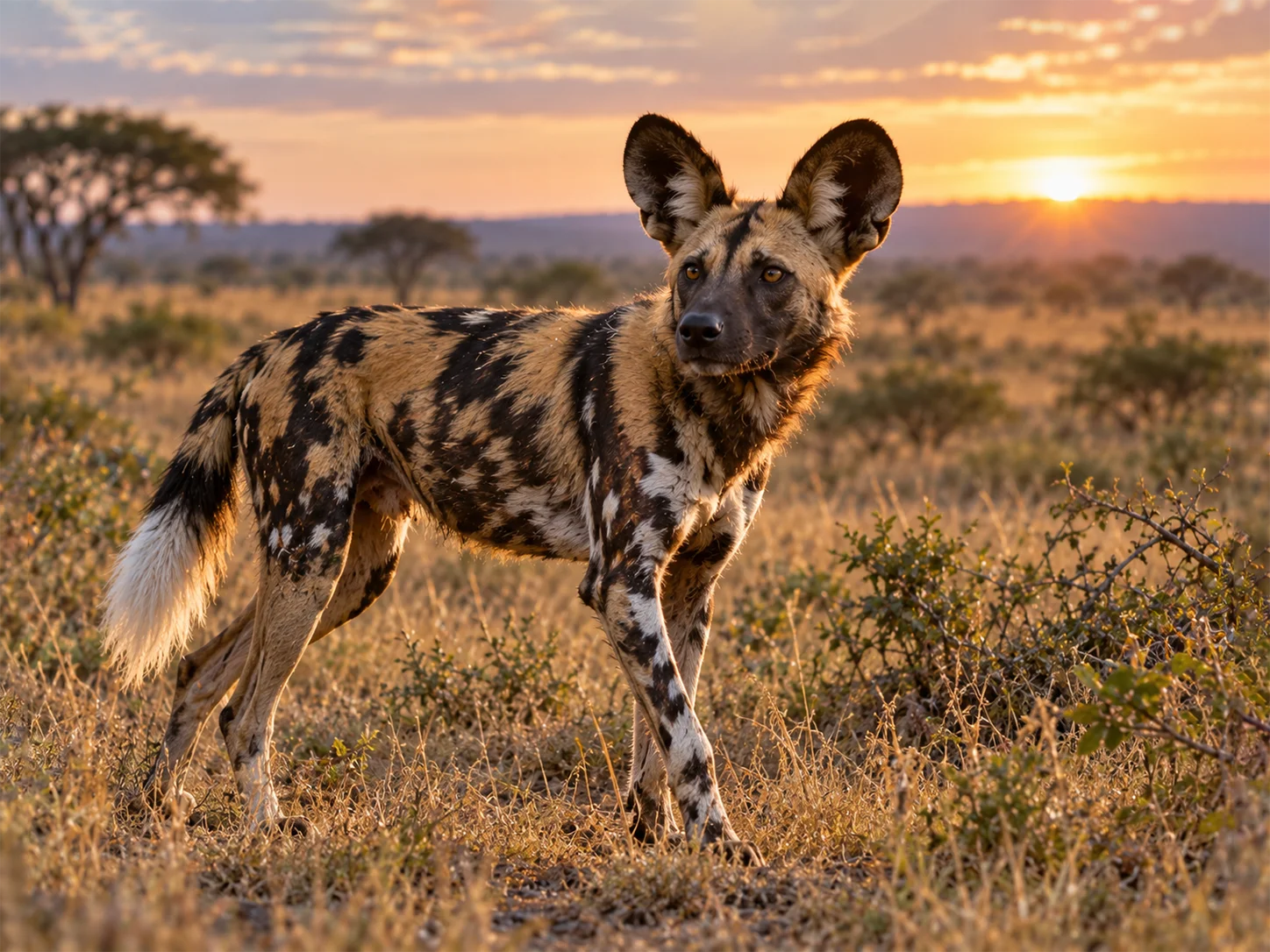
African wild dogs stand 24 to 30 inches at the shoulder, measure 30 to 43 inches in the body, and weigh 40 to 80 pounds. They are lean and long-legged, built entirely for distance.
- Coat. Blotched in black, brown, white and yellow, and unique to every individual. Researchers identify dogs by their markings, as they do with tigers and zebras.
- Ears. Enormous and rounded, which both sharpen hearing and shed heat.
- Four toes. No dewclaw on the front feet, unlike every other canid.
- Legs. Long and slim, for trotting great distances without tiring.
- Teeth. Specialized shearing molars for slicing meat fast, which matters when hyenas are coming.
The tail nearly always ends in a white tip, which acts as a flag for the pack to follow through tall grass.
Habitat and Range
African wild dogs live in sub-Saharan Africa, with the strongest populations in Botswana, Zimbabwe, Tanzania, Zambia, Mozambique and South Africa.
They use savanna, open woodland, scrub and semi-desert, and avoid dense forest and the open plains where lions dominate.
The space they need is the heart of their problem. A single pack ranges over 200 to 1,000 square miles, far more than most reserves contain, so wild dogs constantly cross out of protected areas into farmland.
They once lived across nearly all of sub-Saharan Africa. They are now gone from most of it.
Diet and Feeding
African wild dogs are carnivores, hunting impala, gazelle, springbok, wildebeest calves, warthog and deer-sized antelope.
Their hunting is where they are genuinely exceptional. A pack does not stalk and ambush; it picks a target and runs it down, trotting at 30 miles an hour and sustaining the chase for several miles. They take turns at the front, and they communicate throughout.
The result is a success rate most predators would envy: estimates commonly put it at 60 to 80 percent of hunts, against around 25 percent for lions and under half for cheetahs.
They eat fast, because they have to. Hyenas and lions steal wild dog kills routinely, so a pack strips a carcass in minutes.
Then they do something unusual: they go home and bring food back, regurgitating meat for pups, nursing mothers, and any pack member too old, sick or injured to hunt.
Behavior and Lifestyle
African wild dogs are among the most cooperative mammals on Earth, and the comparison with lions is instructive. Lions squabble at a carcass and the strongest eat first. Wild dogs let the pups eat first.
Packs run from about 6 to 20 animals, led by a breeding pair. Fighting within a pack is rare, and injured members are fed rather than abandoned. There are records of packs supporting a three-legged dog for years.
They are active in daylight, mainly morning and late afternoon, which separates them from the night-hunting carnivores.
They are extremely vocal, with twitters, whines, hoots and a long-distance contact call that carries for over a mile and lets scattered dogs find each other.
Unusually among social mammals, it is the females that leave to find new packs while males tend to stay.
Reproduction and Life Cycle
In an African wild dog pack, normally only the dominant pair breeds, and the whole pack raises the litter.
Litters are large, often 6 to 16 pups and sometimes more, which is the biggest of any dog. Pups are born in a den, frequently an old aardvark burrow.
While the pups are small the pack stays near the den, and adults return from hunts to feed the mother and the babysitter as well as the pups.
When the pups can travel, they are given priority at kills, ahead of the adults that caught the food.
African wild dogs live around 10 to 12 years in the wild.
Predators and Threats
Lions are the main natural enemy and kill wild dogs, including adults, wherever the two overlap. Spotted hyenas steal their kills and kill pups.
Human pressures are what is driving them toward extinction. Habitat fragmentation is the worst of it: an animal needing hundreds of square miles cannot survive in small isolated reserves.
Snares set for bushmeat kill large numbers, often indiscriminately. Farmers shoot them over livestock. Roads crossing their ranges kill whole packs, since wild dogs travel together.
Disease is a particular danger for such a social animal. Rabies and canine distemper caught from domestic dogs can wipe out an entire pack within weeks, because every member is in constant close contact with the others.
Conservation Status
The African wild dog is Endangered, with roughly 6,000 to 7,000 left and only around 1,400 of those mature breeding adults.
That makes it one of the rarest carnivores in Africa, scarcer than the black rhino and far scarcer than the lion, which attracts vastly more attention.
Its social structure works against recovery. A pack needs a minimum number of adults to hunt successfully and defend a kill, so a pack reduced below that size usually fails completely rather than limping on.
What works is scale and connection: large protected landscapes linked by corridors, vaccinating village dogs to stop disease crossing over, removing snares, and compensating farmers. Transboundary parks across southern Africa are the most promising approach, because wild dogs do not recognize borders.
Role in the Ecosystem
Wild dogs hunt differently from every other large African predator, and that matters ecologically. They take mainly healthy medium-sized antelope in open country by daylight, applying a kind of pressure lions and leopards do not.
Because they are chased off their kills so often, they feed a great many other animals. Hyenas, jackals and vultures all live partly on what wild dogs catch and then surrender.
They need enormous connected landscapes, so protecting wild dogs means protecting whole ecosystems rather than single reserves, which benefits everything inside them.
And they are worth knowing about for a reason beyond ecology. A predator that lets its pups eat first and carries food home to an injured packmate is a useful corrective to the idea that nature is simply about the strongest taking what they can.