
Meet the Ibex
There is a dam in northern Italy with a near-vertical concrete wall, and ibex climb it. Not around it. Up the face of it, on a slope of 57 degrees, with nothing to stand on but the joints between the blocks.
They do it for salt. The wall seeps mineral-rich water, and an animal living on mountain grass is short of salt, so the ibex of the Cingino Dam have worked out where to get it.
An ibex is a wild goat, and that is the whole story in three words. Every bit of the animal, from the hooves to the horns to the willingness to go where nothing follows, is a goat taken to its logical conclusion.
Scientific Name and Classification
Ibex are not one species. The name covers several wild goats in the genus Capra, and this page uses the Alpine ibex, Capra ibex, for its figures.
- Kingdom: Animalia
- Phylum: Chordata
- Class: Mammalia
- Order: Artiodactyla
- Family: Bovidae
- Genus: Capra
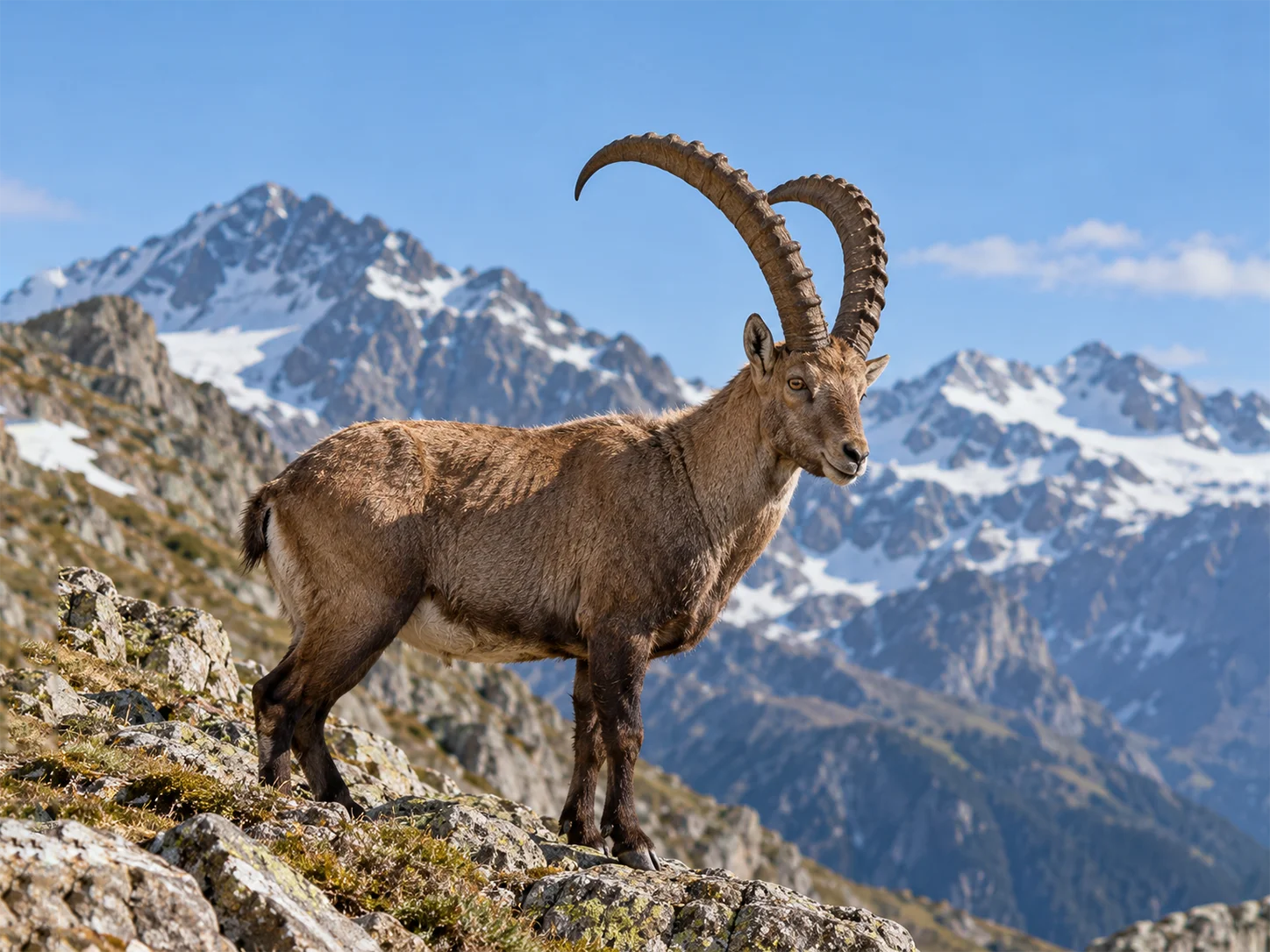
What makes an animal an ibex is the male’s horns: large, curving back over the shoulders, and ridged crossways on the front face. Males are bucks, females are does, young are kids. The markhor and the turs are close relatives that are not usually called ibex.
The Species
- Alpine ibex (Capra ibex), in the European Alps, listed as Least Concern
- Siberian ibex (Capra sibirica), from the Hindu Kush to the Sayan Mountains
- Iberian ibex (Capra pyrenaica), in mountain pockets of Spain and the French Pyrenees
- Nubian ibex (Capra nubiana), in Middle Eastern and northeast African deserts, vulnerable, with fewer than 4,500 left
- Walia ibex (Capra walie), found only in Ethiopia’s Simien Mountains, vulnerable
- Wild goat (Capra aegagrus), also called the West Asian ibex, and the ancestor of the domestic goat
Because each species is assessed separately, the group carries no single conservation status. The Walia ibex is the narrowest case: one mountain range in Ethiopia and nowhere else on Earth.
Appearance and Anatomy
Alpine ibex males stand 35 to 40 inches (90 to 101 cm) at the shoulder and weigh 148 to 258 pounds (67 to 117 kg). Females are much smaller, 29 to 33 inches (73 to 84 cm) at the shoulder and a fraction of the male weight.
- Males: horns 27 to 39 in (69 to 98 cm), ridged across the front
- Females: horns 7 to 14 in (18 to 35 cm), thinner and slower-growing
- Thick brownish-gray coat, heavier in winter
- Short, powerful legs and a deep chest
- Split hooves with sharp rims and a rubbery pad underneath
The hooves are the reason for the dam. Each one splits into two halves that can spread apart to grip an edge, the outer rim is hard and sharp enough to catch on rock, and the pad in the middle is soft and rubbery. It is a climbing shoe: a hard edge for purchase and a soft sole for friction.
The horns start growing at birth and never stop, so an old buck carries a visible record of his age above his head.
Climbing the Cingino Dam
The Cingino Dam in Piedmont is the famous example, and the details are better than the photographs suggest.
Ibex have been recorded scaling slopes of 57 degrees on the dam wall to lick salt from the stonework. Kids have been seen 161 feet (49 m) up. They climb in a zig-zag, which keeps the angle manageable, and come down in straight lines.
Only females and kids do it. Adult males are too heavy and too long in the leg for holds that small, which is a rare case of being big and strong making an animal worse at something.
Habitat and Diet
Alpine ibex live between 5,900 and 10,800 feet (1,800 and 3,300 m), on steep broken ground and open alpine meadow. Siberian ibex go higher still, most often between 3,000 and 5,300 meters.
Rough terrain is a defense, not a preference. A wolf can outrun an ibex on open ground and cannot follow it up a cliff, so the ibex lives where its legs are worth more than a predator’s.
They are strict herbivores. Grass is the year-round staple, with herbs added through summer and dwarf shrubs and conifer shoots in fall and winter, when there is little else.
Social Life
Reproduction and Life Cycle
Gestation averages about five months and usually produces a single kid, occasionally two. Females give birth away from the group on rocky slopes, then gather with other mothers into nursery groups.
Kids nurse for up to five months and reach sexual maturity at eighteen months, though they keep growing well beyond that: females until about five or six, males until nine to eleven.
Males live around 16 years and females around 20, which is a long life for a hoofed animal and reflects how little predation they face.
How the Alpine Ibex Was Nearly Lost
From the early sixteenth century, and increasingly once firearms were common, Alpine ibex were hunted hard, partly for the use of their body parts in traditional medicine.
By the nineteenth century the species was down to fewer than 100 animals, all of them in and around Gran Paradiso in Italy. Every Alpine ibex alive today descends from that remnant.
It survived because one man banned hunting on his land. Charles-Felix, Duke of Savoy and King of Sardinia, prohibited it on his Gran Paradiso estates with effect from 12 September 1821, and later extended the ban across the kingdom. In 1856 Victor Emmanuel II made Gran Paradiso a protected estate with gamekeepers.
The recovery, with reintroductions across the Alps, is one of the great conservation numbers: 3,020 animals by 1914, 20,000 by 1991, and 55,297 by 2015.
Threats to the Ibex
The bottleneck left a mark that protection cannot undo. Passing every living Alpine ibex through 100 animals stripped out genetic variety, including variety in the immune system, which leaves the population vulnerable to inbreeding problems and to disease.
Disease is a real pressure. Eye infections caused by one bacterium have killed up to 30 percent of affected animals, and ibex also carry brucellosis, foot rot, lungworms and gut parasites.
The rest of the list is shorter but not trivial: interbreeding with domestic goats that wander into ibex country, avalanches, limited legal hunting in some countries, and for the young, the golden eagle.
Role in the Ecosystem
As the main large grazer high in the Alps, the ibex shapes alpine meadow, cropping grass and shrubs in country where few other hoofed animals can live at all. Its droppings carry nutrients up the mountain, where soil is thin.
It is also an argument. The Alpine ibex is proof that a species can come back from a hundred animals, which is a genuinely useful thing to be able to point at, and proof that coming back is not the same as being fixed. The genetic cost of that near-miss is still being paid two centuries later.
And it is the animal that climbs the dam. Of all the wild relatives of the domestic sheep and goat, this is the one that went straight up.
Males and females live apart for most of the year and only come together to breed. Female groups hold 5 to 10 animals; male groups usually 2 to 16, sometimes more than 50.
Among males, rank is settled by size, age and horn length, and tested with the horns themselves during the breeding season.
The rut begins in December and runs about six weeks, in two distinct phases. Dominant males aged nine to twelve guard females directly, while younger males of two to six work the edges, trying to slip past the big ones.