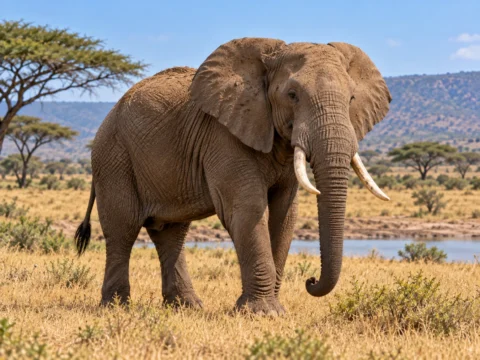
Meet the Elephant
An elephant’s trunk has around 40,000 muscles in it. Your entire body has about 600.
With it an elephant can uproot a tree, or pick up a single blade of grass. It can smell water several miles away, suck up two gallons at a time, and use the trunk as a snorkel while swimming across a river.
Elephants are the largest animals on land, and among the few that recognize themselves in a mirror, use tools, and return again and again to the bones of their dead.
Scientific Name and Classification
Elephants form the family Elephantidae, with three living species, so there is no single two-word name.
- African bush elephant (Loxodonta africana), the largest land animal alive.
- African forest elephant (Loxodonta cyclotis), smaller, confirmed as a separate species in 2021.
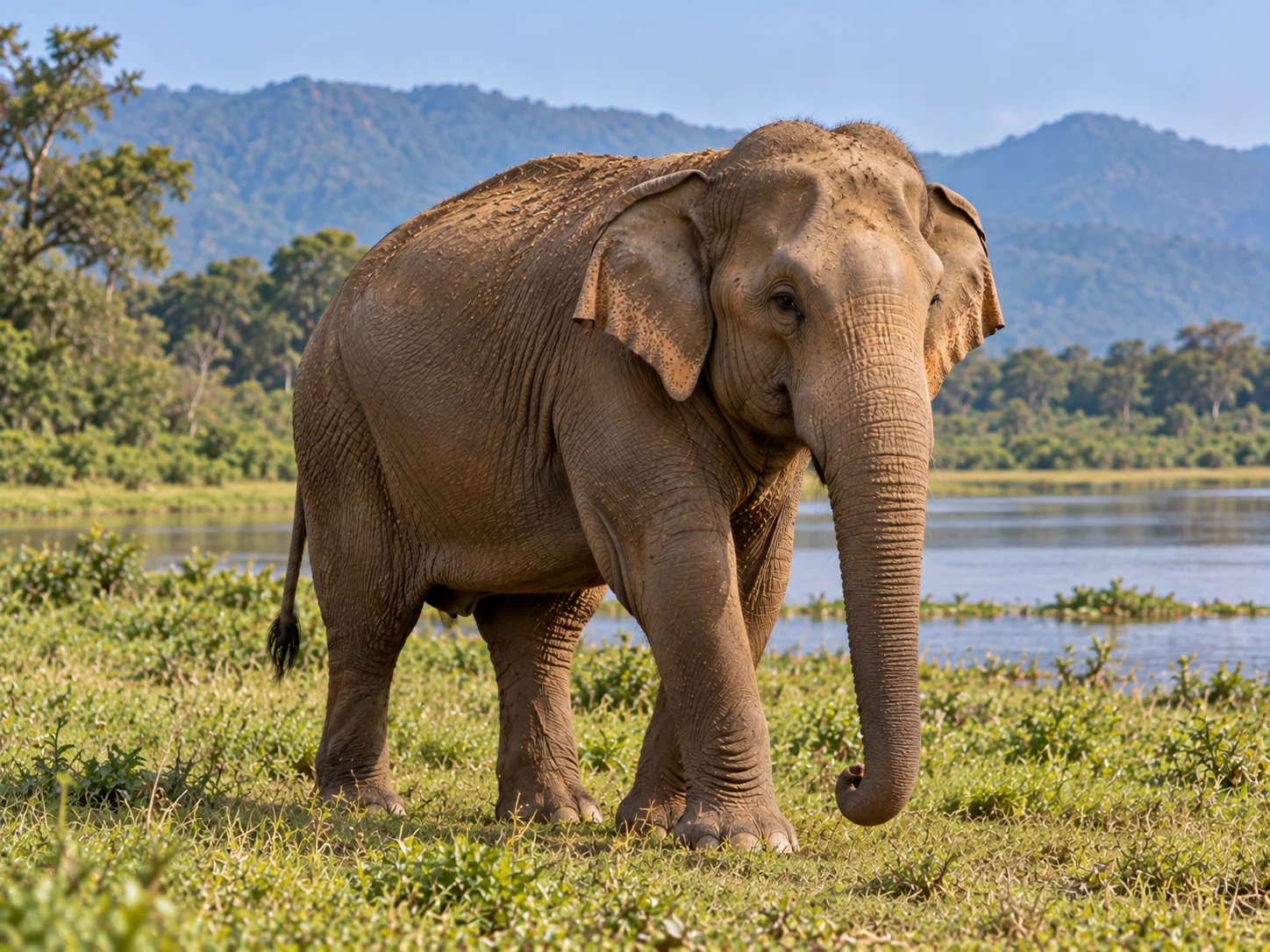
- Asian elephant (Elephas maximus), smaller again, and the one usually seen working with people.
- Kingdom: Animalia
- Phylum: Chordata
- Class: Mammalia
- Order: Proboscidea
- Family: Elephantidae
Their closest living relatives are a genuine surprise: the hyrax, a rabbit-sized animal that sits on rocks in Africa, and the manatee.
Mammoths were elephants too, in the same family, and died out only around 4,000 years ago.
Difference Between African and Asian Elephants
| African | Asian | |
|---|---|---|
| Ears | Huge, shaped rather like Africa | Smaller and rounder |
| Tusks | Both males and females | Usually males only |
| Trunk tip | Two finger-like tips | One |
| Back | Dips in the middle | Humped or level |
| Head | Single rounded dome | Two domes with a dip between |
| Size | Larger, up to 13 ft | Smaller, up to 11 ft |
The two finger-like tips on an African trunk let it pinch objects between them. An Asian elephant has one tip and curls the trunk around things instead.
How Does an Elephant’s Trunk Work?
The trunk is a fused nose and upper lip, and it contains no bone and no joints at all. It works entirely by muscle, roughly 40,000 of them arranged in layers that can shorten, lengthen, bend and twist in any direction.
That is why it can do both ends of the job: lift a 600-pound log, and pick up a single peanut.
It is also an extraordinary nose. Elephants have more genes for smell than any other mammal studied, and can detect water from several miles away and tell apart human groups by scent alone.
Elephants do not drink through the trunk. They suck up water, hold it, then squirt it into the mouth. An adult takes in about 2 gallons per draw.
They also use it as a snorkel, swimming with the body submerged and the trunk tip held above the surface.
Appearance and Anatomy
African bush elephants stand 8 to 13 feet at the shoulder and weigh 5,000 to 14,000 pounds. Asian elephants are smaller, at 6.5 to 11 feet and 4,500 to 11,000 pounds.
- Ears. Laced with blood vessels. Flapping them cools the blood, and an elephant can lose a great deal of heat this way.
- Tusks. Not horns but enormously overgrown incisor teeth, which keep growing through life and are used for digging, stripping bark and fighting.
- Teeth. Six sets of enormous grinding molars over a lifetime. When the last set wears out, usually around 60 or 70, the elephant can no longer chew and starves. That is the natural end for most wild elephants.
- Feet. Padded with a cushion of fat and tissue that spreads the weight, which is why a seven-ton animal walks almost silently.
- Skin. Up to an inch thick, wrinkled to trap moisture and keep the animal cooler.
Those padded feet do something else: they pick up vibrations through the ground, which is how elephants detect each other over long distances.
Habitat and Range
African elephants live across sub-Saharan Africa, in savanna, grassland, forest, marsh and desert edge. Forest elephants are confined to the rainforests of Central and West Africa.
Asian elephants live in forest and grassland across India, Sri Lanka, Nepal, Thailand, Myanmar, Indonesia and parts of China.
They need a great deal of space. A herd may cover hundreds of square miles following water and food, and elephants remember routes and waterholes across decades, which matters enormously in a drought.
Diet and Feeding
Elephants are herbivores, eating grass, leaves, bark, roots, fruit and branches.
An adult eats 300 to 400 pounds a day and spends 16 to 18 hours doing it. They drink 25 to 50 gallons of water daily.
They are inefficient digesters, passing a large share of what they eat only partly broken down. That sounds like a flaw and is ecologically enormous, because it means elephant dung is full of intact seeds.
They also dig. Elephants use tusks and feet to open waterholes in dry riverbeds, reaching water nothing else can get to, and every other animal in the area then uses those holes.
Behavior and Lifestyle
Elephant herds are led by the oldest female, the matriarch, and consist of related females and their young. Her memory is the herd’s most valuable asset: where water was in the last bad drought, which routes are safe, which other elephants are friends.
Adult males leave the herd as teenagers and live alone or in loose bachelor groups.
They talk below our hearing. Much elephant communication is infrasound, too low for people to detect, traveling several miles through air and ground. Those cushioned feet pick up the vibrations, so elephants hear partly through their feet.
Their minds are unusual. Elephants recognize themselves in mirrors, use branches as fly swats and tools, cooperate to solve problems, and appear to comfort distressed herd members by touching them with their trunks.
They also react to death in a way few animals do, standing quietly over the bodies of dead elephants, touching the bones, and returning to the same place over years.
Reproduction and Life Cycle
Elephants have the longest pregnancy of any mammal: about 22 months, nearly two years, for a single calf.
A newborn weighs around 200 pounds and can stand within an hour. It has to; the herd keeps moving.
Calves are raised by the whole herd, with aunts and older sisters helping to guard and guide them. Young females practice on calves that are not their own, which is how they learn to be mothers.
A calf nurses for two to four years and stays close for much longer. Females give birth only every four to five years.
Elephants live 60 to 70 years, and the end usually comes with the last set of teeth.
Predators and Threats
Adult elephants have no natural predators. Lions and tigers occasionally take calves, and the herd defends them fiercely.
The threats are human:
- Ivory poaching. Tens of thousands were killed annually at the height of the crisis. Bans and enforcement have reduced it, but it continues.
- Habitat loss. Land cleared for farming cuts the long routes elephants depend on.
- Conflict with people. Elephants raid crops, and both elephants and farmers are killed as a result.
- Captivity and tourism. Asian elephants are still captured and broken for riding and entertainment.
Poaching has had a strange side effect. In some heavily poached populations, a far higher proportion of elephants are now born without tusks, because tusked animals were the ones killed.
Conservation Status
All three species are threatened.
The African forest elephant is Critically Endangered, having lost more than 80 percent of its population in about 90 years. The African bush elephant is Endangered. The Asian elephant is Endangered, with perhaps 40,000 to 50,000 left.
There is real progress in places. Some southern African populations are stable or growing, ivory markets have been closed in several countries, and community programs that pay people to tolerate elephants have reduced retaliation killings.
The hard part is space. An animal that needs hundreds of square miles cannot be saved in small reserves alone.
Role in the Ecosystem
Elephants are the most powerful landscape engineers on land, and removing them changes everything around them.
They knock over trees and strip bark, which keeps savanna open instead of turning to dense scrub, and that open grassland is what zebra, antelope and the predators that follow them depend on.
They are the best seed dispersers in Africa. Seeds pass through them intact and are deposited miles away in a pile of fertilizer, and some forest trees have seeds so large that only elephants can swallow and move them. Forests losing elephants lose those trees over time.
The waterholes they dig in dry riverbeds keep other animals alive through drought, and the paths they tread through forest become trails for everything else.
Forest elephants even affect the climate. By thinning out smaller trees they help larger, denser, carbon-rich trees grow, so elephant-rich forests store more carbon than elephant-poor ones.