
Meet the Impala
An impala can jump 10 feet straight up. Not onto anything, and not to escape a wall: just up, over a bush or over another impala, for no reason a watching human can see.
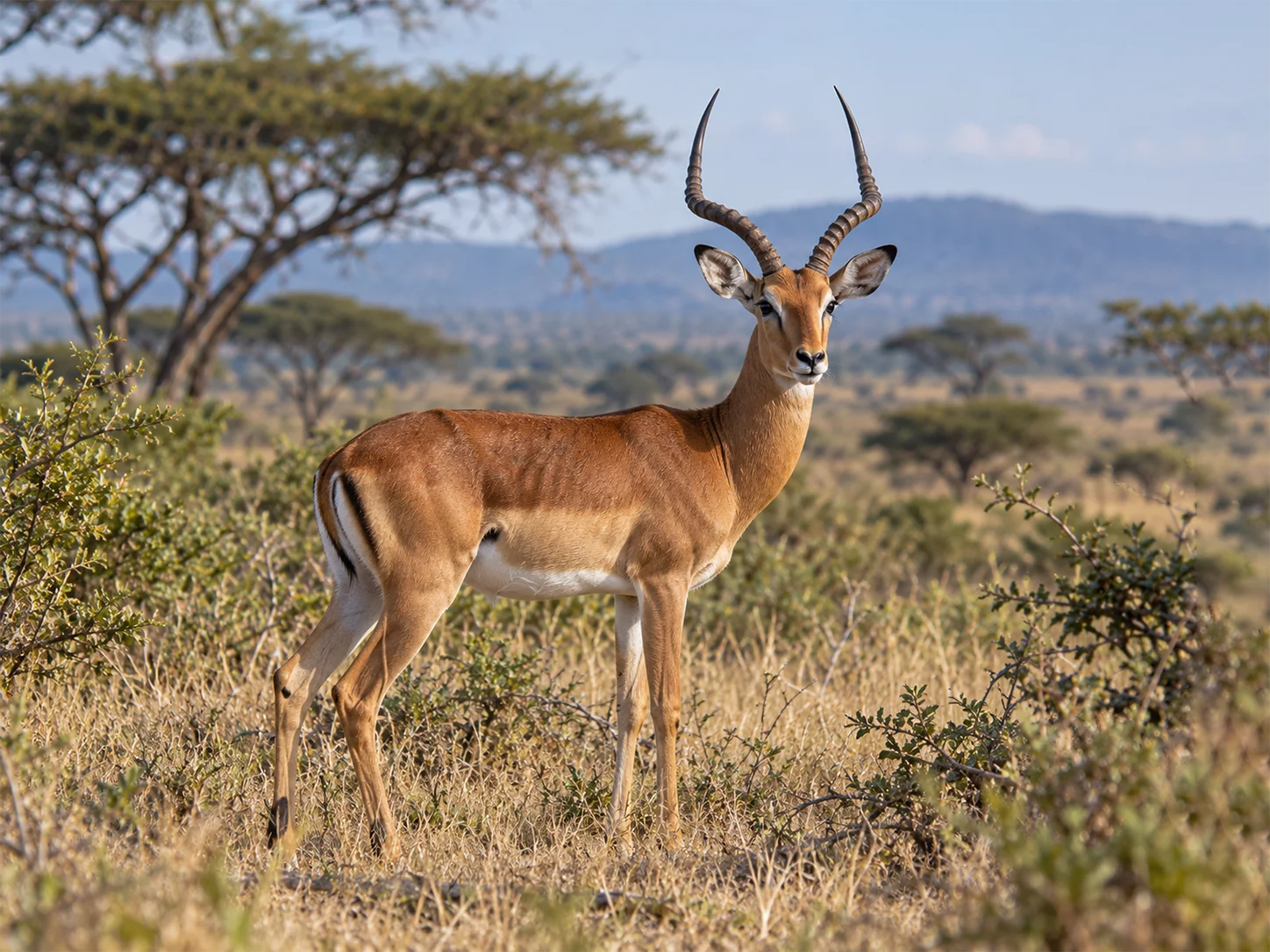
It is a mid-sized antelope, reddish-brown and narrow-legged, and it is one of the most numerous large animals in eastern and southern Africa. Almost everything that hunts in that landscape hunts impala.
Two things about it are genuinely surprising. In the mating season the males roar, and the sound is closer to a lion than to a deer. And impala groom each other in strict turns, which makes them the only hoofed animal known to keep that kind of account.
Scientific Name and Classification
The impala is Aepyceros melampus, and it is the only living species in its genus.
- Kingdom: Animalia
- Phylum: Chordata
- Class: Mammalia
- Order: Artiodactyla
- Family: Bovidae
- Genus: Aepyceros
- Species: Aepyceros melampus
Bovidae is the family of cattle, sheep, goats and antelopes. Having a genus to itself means the impala has no close relatives: it is not a gazelle, and it is not a small deer, though it gets mistaken for both.
There are two subspecies, and their situations are very different. The common impala is abundant. The black-faced impala, A. m. petersi, is classed as vulnerable, with fewer than 1,000 estimated in the wild as of 2008, confined to southwestern Angola and the Kaokoland region of northwestern Namibia. Its numbers have not been properly monitored since the 2000s.
Appearance and Anatomy
Males stand 30 to 36 inches (75 to 92 cm) at the shoulder and weigh 117 to 168 pounds (53 to 76 kg). Females are smaller, 28 to 33 inches (70 to 85 cm) and 88 to 117 pounds (40 to 53 kg). Head and body run about 51 inches (130 cm).
- Glossy reddish-brown above, tan on the flanks, white underneath
- Black stripes on the rump and down the tail
- A black tuft of hair on each hind foot
- Males only: slender ridged horns curving back and up, 18 to 36 in (45 to 92 cm)
- Long legs built for acceleration rather than endurance
The three black stripes on the back of an impala, two on the rump and one on the tail, form a rough M shape when the animal is running away from you. Guides sometimes call it the McDonald’s antelope, which is not scientific but is very hard to forget.
The Jump
An impala can clear 10 feet (3 m) in height and cover 33 feet (10 m) in a single leap. For an animal the size of a large dog, that is close to absurd.
It has a second kind of jump as well, called stotting: a stiff bounding leap off the forelegs with the hind legs kicking out behind. A startled herd will scatter in every direction, leaping over bushes and over each other, and the effect on a predator is thought to be exactly what it looks like. Nothing in that explosion is a predictable target.
It may also be a signal. An animal that can waste energy on a pointless vertical jump is advertising that it is fit enough to outrun whatever is coming, which may persuade a predator to pick someone else.
Habitat and Range
Impala live across eastern and southern Africa, in woodland and along the edge where woodland meets savanna, and they are rarely far from water.
They avoid both extremes. Dense forest gives a predator too much cover, and wide open grassland leaves nowhere to hide, so the impala takes the boundary between the two. They have been reintroduced to Gabon and to parts of southern Africa.
Diet and Feeding
Most hoofed animals are either grazers, which eat grass, or browsers, which eat leaves and shoots. The impala does both, and switches according to what is available.
One analysis put the overall diet at 45 percent grasses, 45 percent broad-leaved plants and 10 percent fruit. After the first rains, grass can climb to as much as 90 percent of what an impala eats. Through the late wet season and the dry season, browsing takes over.
That flexibility is a large part of why there are so many of them. A specialist grazer struggles when the grass dries off, while an impala simply changes menu.
Social Life and the Grooming Ledger
The Rut and the Roar
The rut lasts about three weeks toward the end of the wet season, usually in May. For those weeks the males change completely.
They stake out territory, chase rivals, clash horns, and roar. The roar is the part that surprises people: a deep, snorting bellow that carries up to 1.2 miles (2 km), and visitors who hear it at night in the bush routinely assume they are listening to a lion.
Holding a territory through the rut is exhausting, and a male who spends three weeks roaring and fighting while barely eating is in poor condition by the end of it.
Reproduction and Life Cycle
Gestation runs six to seven months and produces a single calf.
For its first few weeks the calf stays hidden in cover while its mother feeds nearby, which is safer than trying to keep up with a moving herd. It suckles for four to six months. Young males then leave the female group and join a bachelor herd.
Predators and Threats
The list is close to complete: the cheetah, the leopard, the lion, the African wild dog, the spotted hyena, the Nile crocodile and the southern African rock python all take impala.
Against all of that the impala has three defenses and no weapons: eyes and ears tuned for anything approaching, a herd to share the watching, and the leap. It also simply hides in vegetation when that is the better option.
The species itself is listed as Least Concern, and the common impala is doing well. The black-faced subspecies is the part that needs attention.
Role in the Ecosystem
The impala is the animal that feeds the predators. In much of eastern and southern Africa it is the most abundant medium-sized prey species, which means cheetah, leopard and wild dog populations depend heavily on how many impala there are.
Its mixed diet also gives it an unusual effect on vegetation. By grazing grass in the wet season and browsing leaves in the dry, an impala herd spreads its pressure across two plant communities instead of hammering one, and it moves seeds between them in its droppings.
So the ordinary animal turns out to be the important one. Nobody travels to Africa hoping to see an impala, and yet take the impala out and a great deal of what people do travel to see would have nothing to eat.
Impala live in three kinds of group. Female herds run from 6 to 100 animals with no obvious leader. Bachelor herds of young and non-breeding males usually hold fewer than 30. Territorial males hold ground and may keep a harem of females on it.
Within the female and bachelor herds, grooming matters a great deal, and the way it is done is unusual. An impala grooms a partner six to twelve times, then stops and waits to be groomed the same number of times in return before continuing.
It is a simple rule with a clever result. Grooming another animal costs effort and attention, so a system of strict turns means nobody can take the service without paying for it. Impala appear to be the only hoofed animal that both grooms itself and grooms others this way.