Meet the Hippopotamus
The hippopotamus kills more people in Africa than lions, leopards and buffalo. It is also a vegetarian that spends its days dozing in the shallows.
Both things are true, and they fit together once you understand the animal. A hippo is enormous, territorial in water, and will charge anything between it and the river. It does not hunt people; it objects to them.
Its closest living relatives are not pigs, as the shape suggests, but whales and dolphins.
Scientific Name and Classification
The common hippo’s scientific name is Hippopotamus amphibius. The name is Greek for “river horse”, which is wrong about the horse part but fair about the river.
- Kingdom: Animalia
- Phylum: Chordata
- Class: Mammalia
- Order: Artiodactyla
- Family: Hippopotamidae
- Species: Hippopotamus amphibius
Only two hippos survive: this one and the much smaller pygmy hippopotamus of West African forests.
The family tree holds the surprise. Hippos are cetartiodactyls, and their nearest living relatives are whales and dolphins, a line that split from them roughly 55 million years ago. Hippos and whales share a common ancestor more recently than hippos and pigs do.
Why Are Hippos So Dangerous?
Hippos are widely described as the deadliest large land mammal in Africa, and the reasons are structural rather than vicious.
- Territory. Bulls defend a stretch of river and treat anything entering it as a challenge, including boats.
- Size and speed. A 3,000-pound animal that can run about 19 miles an hour on land, faster than a person.
- The mouth. A hippo can open its jaws to around 150 degrees, and the lower canines grow to 20 inches. The bite force is among the strongest of any land mammal.
- Where you meet them. They come ashore to feed at night, and people walking between a hippo and the water are in exactly the wrong place.
- Mothers. A cow with a calf is the most defensive animal on the river.
Those tusks are not for eating. A hippo is a herbivore, and crops grass with its hard lips. The canines are weapons, used on other hippos, and bulls fight savagely over river frontage.
The sensible advice is simple: never get between a hippo and water, and give any hippo on land a very wide berth.
Appearance and Anatomy
Hippos stand 4.5 to 5.5 feet at the shoulder and measure 10 to 16 feet long. Males typically weigh 3,000 to 4,000 pounds and females 2,900 to 3,300, with exceptional bulls much heavier. Only elephants and rhinos outweigh them on land.
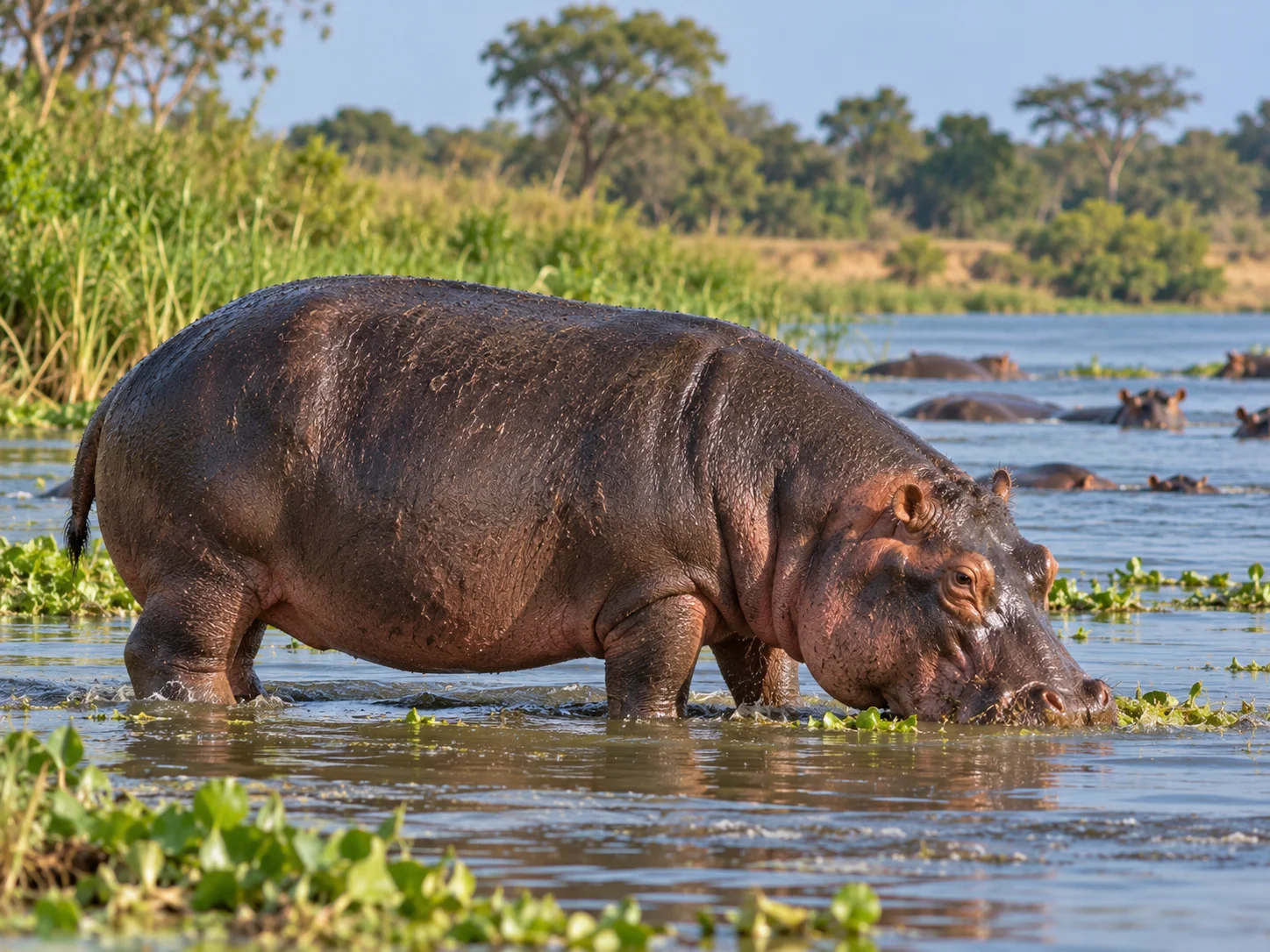
- Eyes, ears and nostrils on top. All three sit high on the head, so a submerged hippo can still see, hear and breathe. The nostrils and ears close when it dives.
- Skin. Up to 2 inches thick, nearly hairless, and it dries and cracks badly out of water.
- Blood sweat. Hippos secrete a thick red fluid often called blood sweat. It is neither blood nor sweat: it is a natural sunscreen and antiseptic that turns red-orange in sunlight.
- Legs. Short and stout, carrying the weight surprisingly fast over short distances.
- Feet. Four webbed toes that spread on soft mud.
Hippos do not actually swim. They are too dense to float, so they walk and push off along the riverbed, surfacing to breathe every three to five minutes. They do this in their sleep, rising and breathing without waking.
Habitat and Range
Hippos live in sub-Saharan Africa, in rivers, lakes, swamps and floodplains with deep enough water to submerge in and grassland nearby for feeding.
Water is not optional. Their skin loses moisture fast and burns easily, so they spend up to 16 hours a day in it, coming out only after dark.
Their range has shrunk a long way. Hippos once lived along the Nile into Egypt and across North Africa, and were wiped out there centuries ago.
Diet and Feeding
Hippos are herbivores, and almost entirely grass eaters.
At dusk they haul out and walk up to 6 miles to graze, cropping grass with wide hard lips and eating around 80 pounds in a night. They follow the same paths so consistently that they wear deep trenches into riverbanks.
That is a modest meal for the size, and it works because hippos spend the day floating and barely moving, which costs almost nothing.
They are not ruminants and do not chew the cud, but ferment food in a chambered stomach, and they rarely eat water plants despite living in them.
Behavior and Lifestyle
Hippos live in groups of 10 to 30, sometimes over 100, called pods or bloats, usually females and young with one dominant bull holding the stretch of water.
They are social in water and solitary on land. Grazing happens alone, and the sociability ends at the waterline.
Bulls settle disputes by yawning hugely to display their tusks, and if that fails they fight, slashing with the lower canines. The wounds can be severe.
They mark territory by spinning the tail while defecating, scattering dung across the bank in a way that advertises their presence.
They are also loud and communicate partly underwater, with calls that carry through water and air at once, letting a submerged hippo answer one on the surface.
Reproduction and Life Cycle
Pregnancy lasts about 8 months and produces a single calf, usually born in water.
A newborn weighs 55 to 110 pounds and can swim before it can walk properly. It nurses underwater, closing its nostrils and ears and surfacing to breathe between mouthfuls.
Mothers keep calves away from the pod at first, and a cow with a calf is formidable. Calves nurse for about eight months and stay close for years.
Hippos live 40 to 50 years in the wild.
Difference Between Hippo and Pygmy Hippo
| Common hippo | Pygmy hippo | |
|---|---|---|
| Weight | 2,900-4,000 lb | 400-600 lb |
| Where | Rivers and lakes across sub-Saharan Africa | Forests and swamps of West Africa |
| Habits | Highly social, large pods | Solitary and secretive |
| Water | Most of the day submerged | Far more time on land |
| Status | Vulnerable | Endangered, around 2,000 left |
The pygmy hippo is not a baby hippo but a separate species, roughly a tenth the weight, with eyes on the side of the head rather than the top because it spends far less time submerged.
Predators and Threats
Adult hippos have almost no natural predators. Lions, hyenas and crocodiles take calves when they can get them away from their mothers, which is rarely.
The threats are human: habitat loss as rivers are dammed and drained, hunting for meat and for the ivory in their teeth, which rose after the elephant ivory trade was restricted, and conflict with farmers whose crops hippos raid at night.
Drought is an increasing danger too. When rivers shrink, hippos crowd into the remaining pools, where disease and fighting spread quickly.
Conservation Status
The common hippopotamus is listed as Vulnerable, with roughly 115,000 to 130,000 left and numbers falling in much of their range.
They have disappeared entirely from several countries where they were once common, and civil conflict has been particularly destructive, since hippos are large, predictable and easy to shoot.
The pygmy hippopotamus is in worse shape, listed as Endangered with perhaps 2,000 remaining in West African forests.
Role in the Ecosystem
Hippos move nutrients from land into water, and it matters more than it sounds. They graze on land at night and defecate in the river by day, carrying grass-derived nutrients into the water. That feeds algae, insects and the fish that eat them, and in some African rivers hippo dung underpins much of the food web.
Their movement shapes the landscape too. The channels they wear through swamp vegetation stay open as waterways that fish and other animals use, and their grazing creates short lawns that smaller grazers follow.
There is a limit to the benefit. Where hippos are crowded into shrinking pools, so much dung concentrates in so little water that oxygen levels crash and fish die, which is a sign of a river under stress rather than a fault in the animal.