Meet the Iguana
An iguana has a third eye. It sits on top of the head, it is pale and roughly the size of a pinhead, and it cannot see pictures. What it can do is notice a shadow passing overhead.
That is useful equipment for a large lizard that spends its life in the branches, where the thing most likely to kill it arrives from above.
Iguanas are also a case study in what happens when a wild animal becomes popular. The green iguana is the most traded reptile on Earth, and escaped pets have built wild populations on several continents, where they are now treated as a pest.
Scientific Name and Classification
Iguanas belong to the family Iguanidae. This page uses the green iguana, Iguana iguana, for its figures, since it is by far the best documented.
- Kingdom: Animalia
- Phylum: Chordata
- Class: Reptilia
- Order: Squamata
- Family: Iguanidae
- Genus: Iguana
- Species: Iguana iguana
The family holds some remarkable animals besides the green iguana, including the marine iguana of the Galapagos, which feeds underwater and sneezes out the salt it swallows. Because Iguanidae covers many species in very different situations, the family carries no single conservation status. The green iguana itself is listed as Least Concern.
Its own taxonomy is unsettled. Some studies argue that certain populations of green iguana are separate species, and the question is not closed.
Appearance and Anatomy
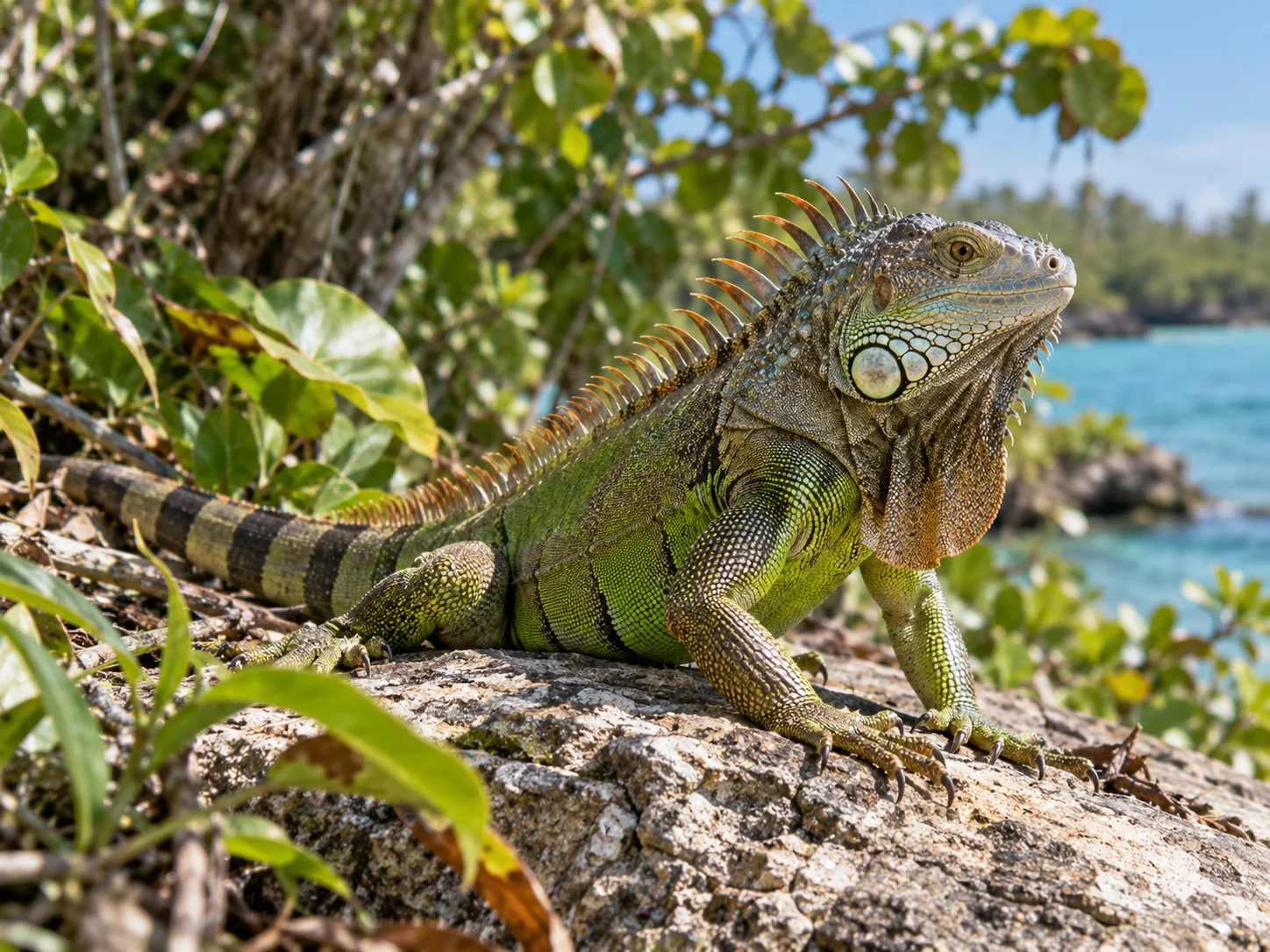
A green iguana measures 3.9 to 5.6 feet (1.2 to 1.7 m) from nose to tail tip. Males typically weigh around 9 pounds (4 kg) and females 2.6 to 6.6 pounds (1.2 to 3 kg), though exceptional males reach 18 pounds (8 kg) and 6.6 feet (2 m). Most of that length is tail.
- A row of spines down the back and tail
- A large throat flap called a dewlap
- The parietal eye, a light-sensing organ on top of the head
- Long claws for gripping bark
- Males: taller crest, thicker spines, heavy jowls
The dewlap does three jobs. It helps the animal shed or absorb heat by changing how much surface it exposes, it gets flashed during courtship and territorial display, and a cornered iguana extends it to look considerably larger than it is.
The tail is both whip and emergency exit. An iguana can lash with it hard enough to hurt, and if something grabs hold the tail breaks off so the lizard can run. It grows back.
The Third Eye
The parietal eye is a genuine eye in miniature, with a rudimentary lens and retina, but it is far too simple to form an image.
It reads light and dark, and it reads movement. For an iguana sitting in a tree, a sudden dimming overhead means something large is passing between it and the sky, and the sensible response is to drop. The third eye is essentially a dedicated early warning system pointed straight up.
Falling on Purpose
An iguana can fall 50 feet (15 m) and walk away unharmed, which is roughly the height of a four-story building.
It is not simply tough. On the way down it uses the claws on its hind legs to catch at branches, slowing and steering the drop rather than plummeting, and it is built to absorb the landing. Iguanas often choose to fall, dropping out of a tree into water and swimming away, with their legs tucked flat against their sides and the tail doing the work.
Habitat and Range
The green iguana is native from southern Mexico through Central America to central Brazil, Paraguay and Bolivia, along with several Caribbean islands.
It is diurnal, arboreal and almost always near water. Despite living in trees it is a capable digger, excavating burrows between 1 and 8 feet (0.3 and 2.4 m) deep, and it will cheerfully move into a burrow something else made.
Diet and Feeding
Iguanas are mostly herbivores, taking leaves, flowers, fruit and shoots from over a hundred plant species. Wild animals occasionally eat grasshoppers, tree snails, bird eggs and chicks, and small amounts of carrion.
Plant food needs the right gut bacteria to break down, and a hatchling is not born with them. Young iguanas get them by eating the droppings of adults, which is unappealing and entirely necessary.
Diet is also where captive iguanas most often go wrong. They need calcium and phosphorus in roughly a two to one ratio, and getting that balance wrong causes serious bone disease.
Reproduction and Life Cycle
Females lay once a year, in a synchronized nesting period, and the clutches are large: 20 to 71 eggs, buried in a dug nest that is sometimes shared with other females. Then they leave. There is no parental care at all.
Hatchlings emerge after 10 to 15 weeks, looking like small adult females and lacking the dorsal spines.
What happens next is more interesting than the abandonment suggests. Juveniles stay together in family groups through their first year, and within those groups young males have been observed positioning themselves between predators and the females. For a reptile with no parenting, that is a surprising amount of social behavior.
Iguanas and People
The green iguana is the most traded reptile in the world. Between 1996 and 2012 it made up 46 percent of the United States reptile trade, and in 1996 annual imports reached a million animals.
That is a lot of lizards in a lot of homes, and iguanas are demanding pets. They need temperatures between 79 and 95 degrees Fahrenheit (26 and 35 Celsius), specialist lighting, a careful diet and a great deal of space for an animal that reaches 5 feet. Many die within a few years of being bought, and ownership is banned outright in some places, including New York City and Hawaii.
Iguanas Where They Do Not Belong
Released and escaped iguanas have established wild populations well outside the native range: Florida, Puerto Rico, Hawaii, Fiji, Taiwan, Singapore, Thailand, southern Texas, Anguilla and Japan among them.
The scale is striking. Puerto Rico’s population was estimated at around 4 million in 2012. Taiwan set a control quota of 120,000 animals for 2025. In Florida they are established from Key West up both coasts, digging up gardens, nesting in attics, and eating rare native plants including a food plant of the endangered Miami blue butterfly.
Florida also produces the strangest consequence. Iguanas cannot cope with cold, and during a sharp cold snap they go torpid and fall out of the trees. It has happened repeatedly, most recently in January 2026, and by early February 5,195 cold-stunned green iguanas had been handed in to state wildlife officials.
One iguana arrived somewhere new without any help from the pet trade. In 1995 a hurricane carried a group from Guadeloupe to Anguilla on a raft of fallen trees, which is how animals have been colonizing islands since long before anyone kept them in a tank.
Role in the Ecosystem
At home, an iguana is a seed disperser and a prey animal. It is eaten by at least 108 different vertebrate species, which is an unusually well-documented figure and tells you most of what you need to know about its place in the food chain.
Away from home it is the opposite: an animal with no predators keeping it in check, eating plants that did not evolve alongside it. Same lizard, entirely different effect, and the only variable is where it was let go.
Which makes the iguana worth knowing about for more than the third eye. Of all the lizards on this site, including the chameleon, the agama lizard and the frilled lizard, this is the one whose story is mostly about human decisions.