Meet the Uakari
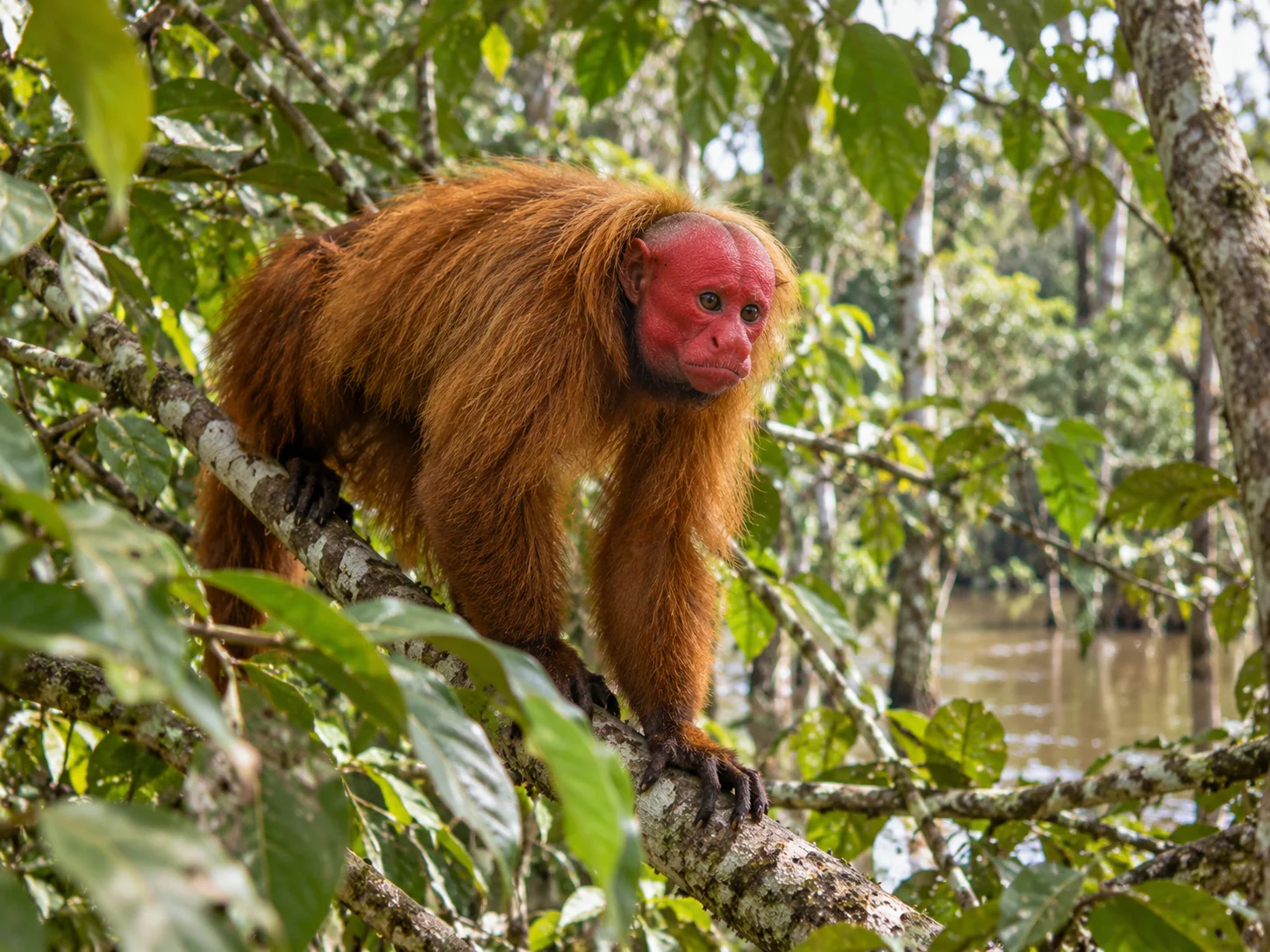
Most monkeys advertise with their fur. The uakari does it with its face, which is bare, hairless and a startling scarlet that looks painted on.
The color is not pigment. Uakari facial skin has almost none. What shows through is blood, running in dense capillaries just under a thin and unpigmented surface, which is why the face flushes so vividly against the pale fur around it.
That makes the face readable. A healthy uakari is bright red and an unwell one fades, and the monkeys appear to use the signal when choosing a mate. It is one of the few places in the animal world where a health certificate is written directly onto the skin.
Scientific Name and Classification
The bald uakari is Cacajao calvus, one of a small group of short-tailed Amazon monkeys in the genus Cacajao.
- Kingdom: Animalia
- Phylum: Chordata
- Class: Mammalia
- Order: Primates
- Family: Pitheciidae
- Species: Cacajao calvus
Four subspecies have traditionally been recognized, including the white bald-headed uakari and the red bald-headed uakari, and a recent review has proposed raising them to full species. The family Pitheciidae also holds the sakis and titis, and the whole group shares a specialty that explains much of the uakari’s anatomy: they eat seeds that other monkeys cannot open.
Why the Uakari’s Face Is Red
Facial skin in most primates carries melanin, the pigment that gives skin its color. The uakari’s carries very little, and the capillary bed beneath it is unusually dense, so oxygenated blood shows straight through.
Because the color depends on blood, it depends on health. Animals in poor condition lose the intensity and turn blotchy or pale, and field researchers in the western Amazon have long reported that washed-out faces tend to belong to sick animals. Malaria is common in the region and has often been suggested as one cause of the fading, though the link is easier to observe than to prove in wild troops.
What is clearer is the consequence. A signal that cannot be faked is useful information, and uakaris of both sexes appear to pay attention to it when pairing off.
Appearance and Anatomy
An adult measures about 17 to 18 inches (44 to 46 cm) in the body and weighs 6 to 7.6 pounds (2.75 to 3.45 kg). The coat is long and shaggy, ranging from creamy white to deep chestnut depending on the subspecies, and it stops abruptly at the neck where the bare red head begins.
The tail is the other oddity. At roughly 6 inches (15 cm) it is about a third of the body length, which is remarkably short for a New World monkey; most of its neighbors carry tails as long as their bodies or longer, and several can hang by them. The uakari cannot. It moves through the canopy by walking along branches and leaping between them.
- Bare scarlet face and forehead, with no fur above the jawline
- Shaggy body coat from white to deep red
- Very short tail, about a third of body length
- Heavy lower jaw and large canines for opening hard fruit
The skull is built around the diet. The jaw is deep, the canines are long and splayed, and the chewing muscles are large for an animal of this size, giving a bite that can crack husks the macaw opens with its beak.
Habitat and Range
Uakaris live in várzea, the seasonally flooded forest of the western Amazon in Brazil and Peru, with some populations reaching into Colombia. For months each year the river rises and the forest floor disappears beneath several meters of water.
That shapes everything. The troop lives in the canopy because for much of the year there is no ground to come down to, and the flood both isolates uakari populations from one another and keeps the habitat narrow. A monkey tied to flooded forest cannot simply move when that forest is cleared.
Diet and Feeding
Seeds make up roughly two thirds of what a uakari eats, with fruit at about a fifth and smaller amounts of flowers, buds and animal prey.
The important detail is timing. Most fruit-eating animals wait for fruit to ripen and soften. The uakari goes in early, while the husk is still hard and green, and forces it open. That puts it ahead of the queue on food nothing else can reach yet, and it is the reason for the heavy jaw.
It also makes the uakari a seed predator rather than a seed disperser. A monkey that swallows soft fruit carries the seeds away and drops them intact somewhere useful. A monkey that cracks and eats the seed itself destroys it. Both roles shape a forest, but they shape it in opposite directions.
Behavior and Lifestyle
Troops usually hold between 5 and 30 animals, though gatherings of over a hundred have been recorded where food is concentrated. The group splits into smaller parties to forage and comes back together, a pattern biologists call fission-fusion and which apes also use.
They are loud. Uakaris call constantly while feeding and moving, and a troop crossing the canopy is usually heard well before it is seen. They are active by day and spend the night high in the trees.
Reproduction and Life Cycle
Gestation runs about six months and produces a single infant. Females usually breed only once every two years, which is slow even by primate standards and matters a great deal for a species under pressure.
The young clings to its mother for the first months, begins taking solid food within the first year, and takes several years to reach breeding age. Uakaris are long-lived, with records approaching 30 years, so a population recovers slowly from losses but can persist where it is left alone.
Predators and Threats
Large raptors are the main natural danger, and the harpy eagle is the one that matters most: it hunts inside the canopy and takes monkeys of exactly this size. Big cats including the jaguar take uakaris that come low, and large constricting snakes such as the anaconda are a risk near water.
Human pressure is heavier. Uakaris are hunted for meat across parts of their range, and because they are noisy, conspicuous and slow to reproduce, hunting removes animals faster than troops can replace them. Logging and clearance of flooded forest shrink what is already a restricted habitat.
Conservation Status
The IUCN lists the bald uakari as Vulnerable, with the population decreasing. The combination behind that listing is a familiar one: a narrow and fragmenting habitat, a slow birth rate, and sustained hunting.
Protected areas in the Brazilian and Peruvian Amazon cover part of the range, and community-managed reserves in flooded forest have had some success where local hunting agreements hold. The species’ reliance on várzea makes it a useful indicator: when uakaris disappear from a stretch of river, the forest there has usually changed in ways that affect much more than one monkey.
Role in the Ecosystem
By destroying seeds rather than scattering them, uakaris act as a filter on which trees succeed. Species whose seeds are regularly eaten are pushed back, and species the uakari ignores gain ground, so a troop working a stretch of flooded forest slowly edits the forest around it.
And the face remains the thing worth remembering. In a forest full of animals signaling with color they grow, this one signals with color it cannot control: an honest advertisement, readable at a distance, that fades the moment its owner stops being well.