Meet the Umbrellabird
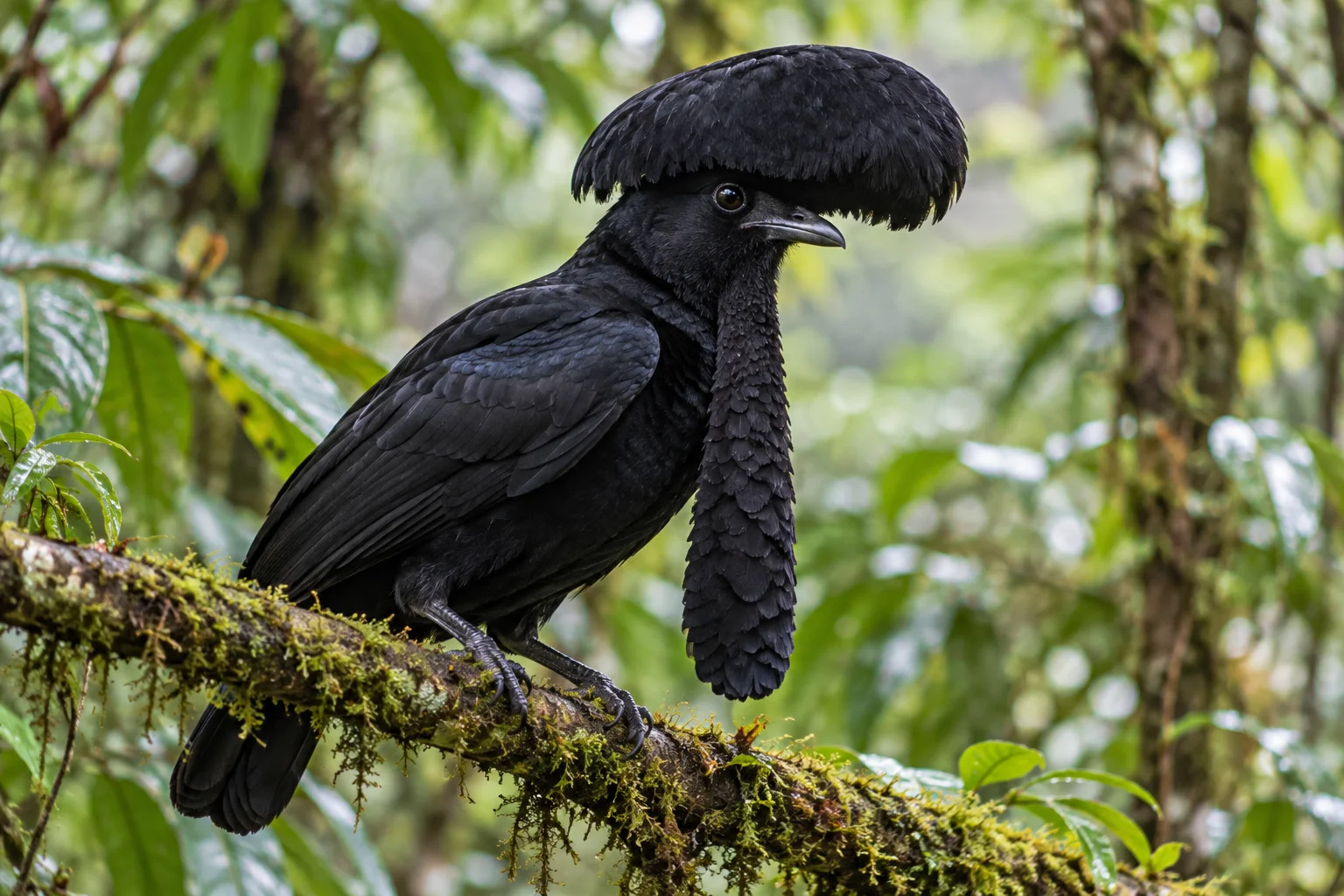
A male umbrellabird wears a crest of feathers spread over his head like a black umbrella, and hanging from his throat is a long feathered wattle that can dangle longer than his entire body.
Both are instruments. He inflates the wattle and produces a deep booming call so low it travels through dense rainforest for more than half a mile, farther than almost any other bird song.
There are three species, all living in the forests of Central and South America, and all of them are remarkably hard to see.
Scientific Name and Classification
Umbrellabirds form the genus Cephalopterus, which means “head wing”, for the crest.
- Kingdom: Animalia
- Phylum: Chordata
- Class: Aves
- Order: Passeriformes
- Family: Cotingidae
- Genus: Cephalopterus
The three species are the Amazonian umbrellabird, the long-wattled umbrellabird of western Ecuador and Colombia, and the bare-necked umbrellabird of Costa Rica and Panama.
They belong to the cotingas, a family of tropical American birds famous for extravagant males, which also includes the cock-of-the-rock and the bellbirds.
They are the largest passerines, or perching birds, in South America.
Why Does It Have an Umbrella and a Wattle?
Because female umbrellabirds choose carefully, and the males have to make a case.
Males gather at display grounds called leks, where several birds perform in the same patch of forest and females come to watch and compare. Nothing else is on offer: the male provides no food, no territory and no help with the young. All the female gets is his genes, so the display is the only information she has.
So he uses everything he has. He spreads the crest forward until it covers his beak entirely, turning his head into a black dome. He inflates the wattle, which in the long-wattled umbrellabird can hang 14 inches or more, and swings it. And he booms.
The call is the cleverest part. It is very low-pitched, and low sounds travel through dense vegetation far better than high ones, because leaves and trunks scatter high notes and let low ones pass. The boom carries over half a mile through thick rainforest.
Carrying all that is a real cost. A wattle longer than the bird is awkward in flight, and males sometimes drape it over the back while flying.
Appearance and Anatomy
Umbrellabirds measure 14 to 20 inches long and weigh 11 to 20 ounces, with males noticeably larger than females.
- Crest. A fan of feathers on the crown that can be raised forward into a dome over the head and beak.
- Wattle. A feathered extension hanging from the throat, inflatable, and longest in the long-wattled species. The bare-necked umbrellabird has a bright red bare throat instead.
- Plumage. Glossy black in all three species.
- Beak. Broad and strong, for swallowing large fruit whole.
- Females. Smaller, with a much reduced crest and little or no wattle. They look like entirely different, plainer birds.
Habitat and Range
Umbrellabirds live in the humid forests of Central and South America, from Costa Rica and Panama south through Colombia, Ecuador and the Amazon basin.
They spend most of their time high in the canopy, which is why so few people ever see one despite their size.
Two species move up and down mountains with the seasons, breeding in foothill forest and moving higher or lower as fruit ripens. That makes them vulnerable in an unusual way: they need connected forest across a range of altitudes, not just one protected patch.
Diet and Feeding
Umbrellabirds are mainly fruit eaters and count as omnivores, taking large insects, spiders and occasionally small lizards and frogs as well.
Palm fruits are a favorite, and they swallow fruit whole, including some too large for most forest birds to manage.
Later they regurgitate the seeds intact, often a long way from the parent tree, which makes them important planters.
They follow fruiting trees through the forest, so where they are at any time of year depends on what is in season.
Behavior and Lifestyle
Umbrellabirds are quiet and unobtrusive for most of the year, moving alone or in pairs through the canopy, and are far more often heard than seen.
The leks change that. In the breeding season males gather at traditional display sites, used year after year, and perform through the morning. A good lek is a known spot that females visit deliberately.
Their flight is heavy and undulating, in short hops between trees rather than long journeys.
Because they are large, slow-moving and gather predictably at known sites, they are easy to hunt, which has mattered a great deal to their survival.
Reproduction and Life Cycle
After mating at the lek, the male takes no further part at all.
The female builds a loose, flimsy-looking nest of twigs high in a tree, lays a single egg, and does everything herself: incubating for around a month, then feeding the chick on fruit and insects.
One egg at a time is very few for a bird, and the chick grows slowly, staying in the nest for weeks.
That slow rate is the heart of their conservation problem. A population losing adults cannot replace them quickly.
Umbrellabirds are thought to live 12 to 20 years.
Predators and Threats
Forest hawks and eagles take adults, and snakes, monkeys and small mammals raid nests for the single egg.
The serious threat is deforestation. Lowland and foothill rainforest in Central America and the western Andes has been cleared heavily for farming, logging and cattle, and these birds need large, connected, undisturbed forest.
Hunting adds to it, since a large bird that gathers at a known lek is easy to find.
Conservation Status
The three species differ. The Amazonian umbrellabird has a large range and is not currently at high risk.
The long-wattled umbrellabird and the bare-necked umbrellabird are both Vulnerable, with small and shrinking populations in forests that have been heavily cleared.
Their altitudinal migration makes them harder to protect than most birds. Saving the forest where they breed is not enough if the forest they move to when fruit ripens elsewhere has been cut down.
Some conservation projects protect corridors of forest running up mountainsides for exactly this reason, and local guides now take birdwatchers to leks, which gives communities a reason to keep the birds around.
Role in the Ecosystem
Umbrellabirds are important seed dispersers, and specifically for large seeds. Because they can swallow big fruit whole, they move seeds that smaller birds simply cannot handle.
Only a handful of animals in these forests can do that job, so losing umbrellabirds means certain large-seeded trees lose one of their few ways to spread.
Their altitudinal movement adds something unusual: they carry seeds up and down mountainsides, moving plants between elevations in a way few other animals manage.
They also work as a flagship. A large, strange, charismatic bird gives conservationists a reason to protect forest corridors that shelter a great many less noticeable species.