Meet the Macaw
In 2000, the last wild Spix’s macaw disappeared from a stretch of dry forest in northeast Brazil. The species survived only in cages, a few dozen birds scattered among private collectors, most of whom had taken them from the wild in the first place.
What followed was unlikely. Those collectors were tracked down, birds were negotiated for or confiscated, a breeding program was built in Germany and Qatar, and in June 2022 Spix’s macaws were released back into the same Brazilian caatinga. Some have since bred in the wild.
It is one of very few cases of a bird going extinct in the wild and being put back. It is also a reminder of what put it there, since the pet trade both destroyed the species and, by accident, preserved the only birds left.
Scientific Name and Classification
Macaws are not a single genus. There are about 18 living species across six genera, with Ara the largest. The scarlet macaw is Ara macao, the blue-and-yellow macaw is Ara ararauna, and the hyacinth macaw is Anodorhynchus hyacinthinus.
- Kingdom: Animalia
- Phylum: Chordata
- Class: Aves
- Order: Psittaciformes
- Family: Psittacidae
- Genera: Ara, Anodorhynchus, Primolius, Orthopsittaca, Diopsittaca, Cyanopsitta
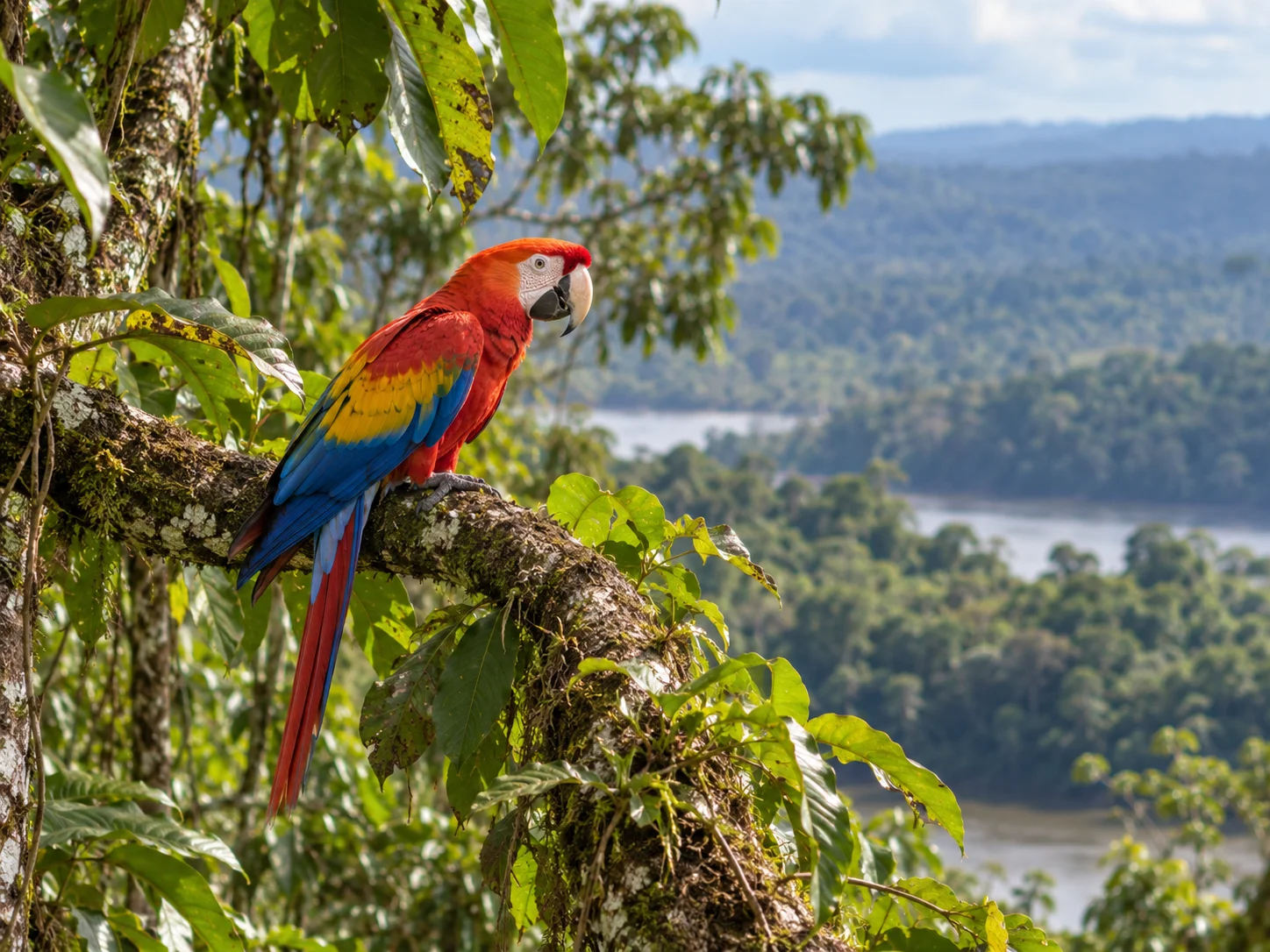
Macaws are the large long-tailed New World parrots, and what separates them from other parrots is size, that tail, and a patch of bare facial skin.
That bare face is individual. The fine lines of tiny feathers across it differ from bird to bird, like a fingerprint, and it can flush pink when a macaw is excited, which is a parrot blushing.
Why Do Macaws Eat Clay?
Along certain rivers in the western Amazon, hundreds of macaws and smaller parrots gather every morning on exposed clay riverbanks and eat the soil. The sites are called clay licks, and the same banks are used for generations.
The old explanation was that the clay binds toxins from the unripe, poisonous seeds macaws eat. It is an appealing idea and it may contribute, but the better-supported answer is simpler: sodium.
The western Amazon is extremely short of sodium, being far from the ocean and behind the Andes, and the clays the birds choose are the ones richest in it. Birds eat most at the licks when they are feeding chicks, when the need is greatest. Parrots in sodium-richer parts of the Amazon barely use licks at all.
It is a good illustration of how a satisfying explanation can hold for years before someone checks it against where the behavior actually happens.
Appearance and Anatomy
Macaws run from the red-shouldered macaw at 12 inches and 4.5 ounces to the hyacinth macaw at 3.3 feet and 3.7 pounds, the longest parrot in the world.
- Beak. Enormously powerful. A hyacinth macaw cracks palm nuts that need a hammer to open, and the bite is strong enough to break a finger.
- Tongue. Dry, muscular and tipped with a bone, used to manipulate a nut against the beak like a hand.
- Feet. Two toes forward, two back, and genuinely used as hands. Macaws hold food up to the beak and climb hand over hand.
- Tail. Can be longer than the body, used as a rudder in tight flight between trees.
The colors are a mix of pigment and structure. Macaws make their own red and yellow pigments, called psittacofulvins, which no other bird group produces, and the blues come from feather microstructure scattering light. Green is the two working together: structural blue over yellow pigment. There is no green pigment in a macaw.
Those psittacofulvins also resist feather-degrading bacteria, so the color may be doing a second job.
Habitat and Range
Macaws live in Mexico, Central America and South America, with the greatest variety in the Amazon basin.
Most are rainforest birds, but not all. The hyacinth macaw lives mainly in the Pantanal wetlands and palm savanna, Spix’s macaw in dry caatinga scrub, and the blue-throated macaw in a small area of seasonally flooded savanna in Bolivia.
What they all need is big old trees with cavities. Macaws cannot excavate their own nest holes, so they depend on hollows that form in large mature trees over decades, and that single requirement is the hinge of their conservation. Logging removes the nest sites long before it removes the forest.
They range widely each day, often flying 15 miles or more between roosting and feeding areas.
Diet and Feeding
Macaws are largely omnivorous in practice but overwhelmingly eat plants: nuts, seeds, palm fruit, flowers, leaves and the occasional insect.
They are specialists in food almost nothing else can open. A macaw’s niche is the hard shell, and a hyacinth macaw dealing with a palm nut is applying several hundred pounds of force in a controlled way.
They also eat unripe seeds that other animals cannot, because they tolerate the toxins ripe-fruit specialists avoid, which gives them food in seasons when little else is available.
The hyacinth macaw has an odd dependency: it eats palm nuts largely after they have passed through cattle or been dropped, and in parts of the Pantanal cattle ranching has inadvertently helped it, which complicates the usual story about ranching and wildlife.
Behavior and Lifestyle
Macaws are loud, social and pair-bonded for life. A pair flies wingtip to wingtip, preens each other, and stays together within a flock, so a flock of macaws is really a flock of couples.
The screaming is communication across distance in dense forest, and it carries for miles. Macaws also mimic, though less skillfully than African gray parrots, and in the wild they appear to use individually distinctive calls, so flock members can tell who is calling.
They are intelligent in the way parrots generally are: problem-solving, tool-using in captivity, capable of learning sequences, and demanding enough that boredom is a genuine welfare issue. A caged macaw with nothing to do will often pluck out its own feathers.
They are also long-lived, which is the single most misunderstood thing about them as pets. A macaw can outlive its owner, and rescue centers are full of birds on their third or fourth home.
Reproduction and Life Cycle
Macaws nest in tree cavities, and in some species in cliff holes or earth banks, with the pair using the same site year after year.
The female lays 1 to 4 eggs and incubates for 24 to 28 days while the male brings food.
Chicks hatch naked and blind and develop slowly, staying in the nest for three months and dependent on their parents for up to a year afterward.
The arithmetic is brutal for recovery. Macaws do not breed until three to seven years old, often raise only one or two chicks that survive, and frequently skip years entirely when food or nest sites are short. Scarlet macaw pairs commonly fledge just one chick because the older chick outcompetes the younger.
Macaws live 30 to 50 years in the wild and 50 to 80 in captivity, with well-documented individuals past 90.
Predators and Threats
Harpy eagles, hawks, jaguars, ocelots, monkeys, snakes and toucans take macaws or raid their nests, and toucans are a serious nest predator that most people would not guess.
The human threats are the ones that count. Habitat loss comes first, and specifically the loss of old cavity trees. Then the pet trade, which has taken macaws in enormous numbers; a nest is often destroyed to get at the chicks, so one capture can cost a nest site permanently.
Hyacinth macaws were also hunted heavily for feathers, with tens of thousands taken in the 1980s alone.
A slow-breeding, long-lived bird that nests only in old trees and is worth a lot of money is close to the worst possible combination.
Conservation Status
The picture varies sharply by species. The scarlet and blue-and-yellow macaws remain reasonably widespread and are Least Concern. Others are in serious trouble.
Spix’s macaw was declared Extinct in the Wild and is now, after reintroduction, the subject of one of the most unusual recovery efforts attempted. The blue-throated macaw is Critically Endangered with a few hundred birds. The glaucous macaw is almost certainly extinct. The hyacinth macaw is Vulnerable but has recovered substantially from its 1980s low.
What has worked is unglamorous. Nest boxes, where old trees are gone, have raised breeding success measurably for hyacinth and blue-throated macaws. Paying local people to guard nests turns the value of a chick from an incentive to steal it into an incentive to protect it. And clay licks and macaw roosts draw enough ecotourism in Peru and Brazil to make live macaws worth more than captured ones.
Role in the Ecosystem
Macaws are both seed predators and seed dispersers, and the balance matters. They destroy a great many seeds, but they also carry large nuts well away from the parent tree and drop a proportion intact, and for some big-seeded palms they are among the few animals that move the seeds at all.
Their beaks open food that then becomes available to other animals, and the shells and fragments they drop feed a queue of smaller species below.
They are also the most commercially valuable birds in the neotropics while alive. A clay lick with 200 macaws on it supports lodges, guides and local employment, which is the most practical argument available for leaving the forest standing.
And the Spix’s macaw story cuts both ways, which is why it is worth telling carefully. The pet trade emptied the forest, and then the only birds on earth were in the collections of the people who had emptied it. Getting them back took twenty years and two continents, and it worked, barely. It is not a model anyone would choose.