Meet the Monkey
There are around 264 species of monkey, living in the forests, mountains, savannas and even the cities of Africa, Asia and the Americas. They range from the pygmy marmoset, light enough to sit in a child’s palm, to the mandrill, which can weigh as much as a large dog.
Monkeys are clever, intensely social animals. They use tools, keep track of complicated friendships and rivalries, teach their young, and in some species pass local customs down through generations.
And there is a catch hiding in the word itself. “Monkey” is not a scientific group at all, for a reason that surprises most people.
Scientific Name and Classification
Monkeys have no single scientific name, and they cannot have one, because they are not one branch of the family tree.
Monkeys fall into two groups that split apart around 40 million years ago:
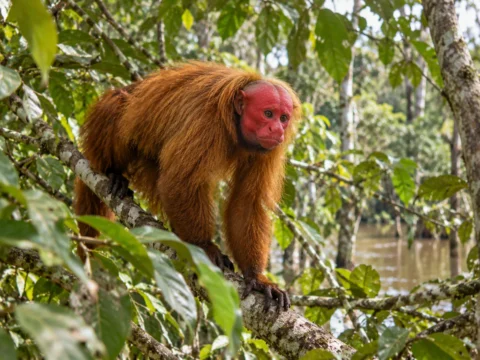
- New World monkeys (parvorder Platyrrhini) live in Central and South America. Around 130 species, including marmosets, tamarins, capuchins, howlers and spider monkeys.
- Old World monkeys (family Cercopithecidae) live in Africa and Asia. About 135 species, including baboons, macaques, mandrills, colobus and langurs.
Here is the surprise. Old World monkeys are more closely related to apes, and therefore to humans, than they are to New World monkeys. Apes sit inside the monkey family tree rather than beside it.
That means “monkey” describes a kind of animal, like “tree”, rather than a single branch of descent. It is a useful everyday word that does not match a scientific group, and biologists are fine with it as long as everyone knows.
- Kingdom: Animalia
- Phylum: Chordata
- Class: Mammalia
- Order: Primates
- Infraorder: Simiiformes
- Groups: Platyrrhini (New World) and Cercopithecidae (Old World)
Difference Between Old World and New World Monkeys
| New World (Americas) | Old World (Africa and Asia) | |
|---|---|---|
| Nose | Flat, nostrils far apart and facing sideways | Narrow, nostrils close together and facing down |
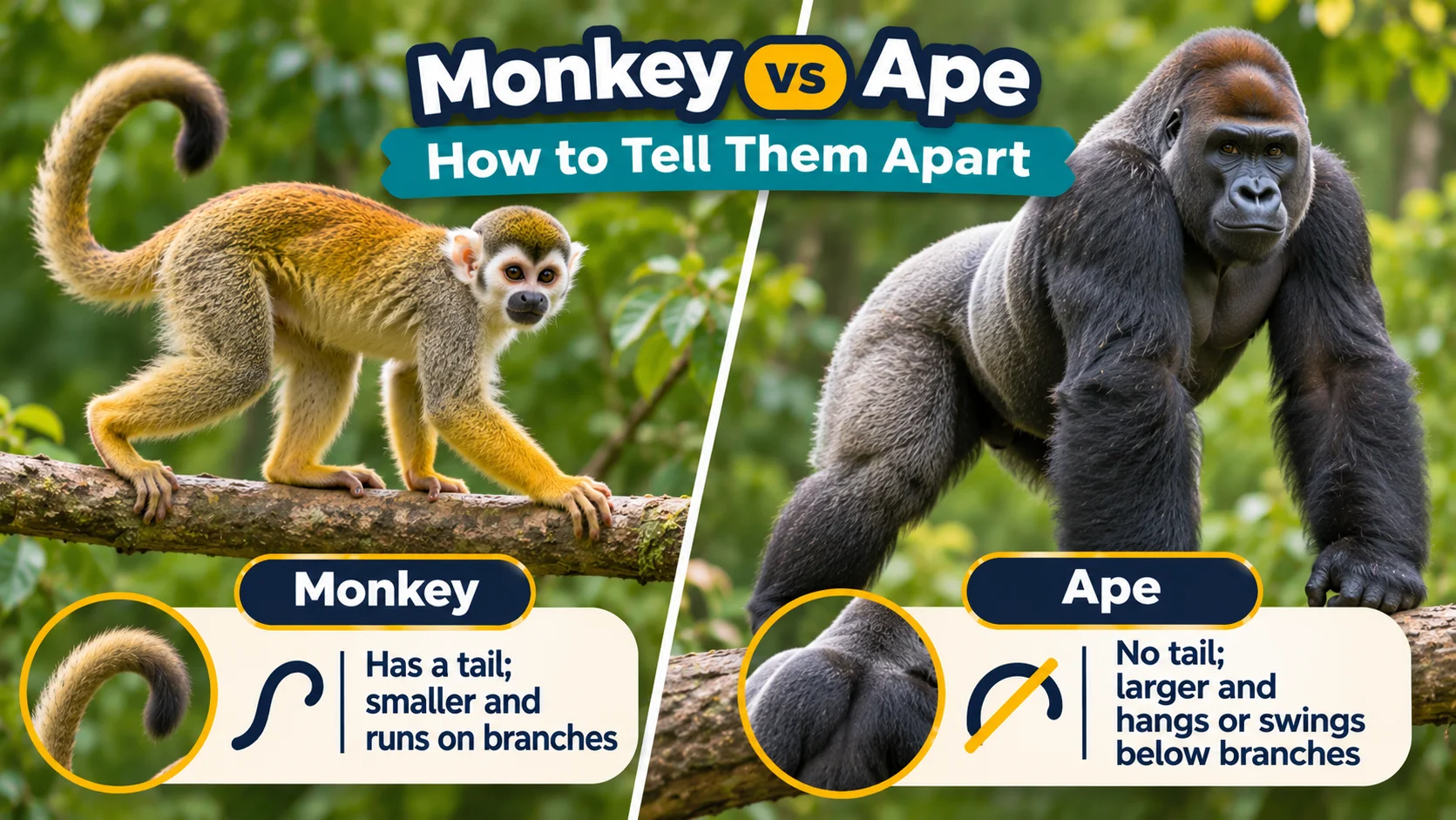
| Tail | Often prehensile, able to grip | Never prehensile, sometimes absent |
| Teeth | Usually 36 | Usually 32, like ours |
| Sitting pads | None | Hard bare pads on the rump |
| Life | Almost entirely in trees | Many spend time on the ground |
The prehensile tail is worth dwelling on. Only some New World monkeys have one, and it is a genuine fifth limb: a spider monkey can hang by its tail alone and pick up a single peanut with the tip. No Old World monkey and no ape can do anything like it.
Appearance and Anatomy
Monkeys range from the pygmy marmoset at about 5 inches and 4 ounces to the mandrill, where a big male reaches 3 feet and 80 pounds.
- Hands and feet. Five fingers and five toes with flat nails rather than claws, and fingerprints. Most have opposable thumbs, so they can pick up small objects precisely.
- Eyes. Forward-facing, giving the overlapping vision needed to judge the distance to the next branch.
- Color vision. Old World monkeys see color much as we do. Many New World monkeys do not, and in some species females see more colors than males.
- Tail. Used for balance in most species, and for gripping in some New World monkeys.
- Cheek pouches. Many Old World monkeys can stuff food into pouches inside the cheeks and carry it somewhere safe to eat.
Habitat and Range
Monkeys live across Central and South America, Africa and Asia. Tropical rainforest holds the most species, but the family is far more adaptable than that suggests.
Baboons live on open African savanna. Japanese macaques survive snowy winters in the mountains and famously bathe in hot springs. Gelada monkeys graze Ethiopian grassland at high altitude. Rhesus macaques thrive in Indian cities, living on temples, rooftops and whatever people leave out.
Europe has exactly one wild monkey population: the Barbary macaques of Gibraltar.
Diet and Feeding
Most monkeys are omnivores, eating fruit, leaves, seeds, flowers, nuts, insects, eggs, and sometimes small animals.
Fruit is the staple for many, which makes monkeys important seed dispersers. Some specialize: colobus monkeys live mainly on leaves and have a multi-chambered stomach to ferment them, rather like a tiny cow.
Several species use tools to eat. Capuchins crack nuts by placing them on a stone anvil and hammering with a rock, choosing stones of the right weight and carrying them to the job. Long-tailed macaques in Thailand use stones to open shellfish. These are learned skills, passed on by watching.
Behavior and Lifestyle
Monkeys are social, and their groups are complicated. Troops range from a handful of animals to several hundred, with ranks, alliances and long-running rivalries that individuals remember for years.
Grooming is the glue. Picking through another monkey’s fur removes parasites, but it mostly maintains relationships: who grooms whom, and for how long, tracks the social map of the troop.
They communicate constantly through calls, faces and posture. Vervet monkeys have separate alarm calls for leopards, eagles and snakes, and the troop responds correctly to each one: up a tree, into cover, or stand and look at the ground. Young vervets have to learn which call means what, and they make mistakes while learning.
Local customs exist too. A troop of Japanese macaques began washing sweet potatoes in the sea after one young female started doing it, and the habit spread through the group and down the generations.
Reproduction and Life Cycle
Monkeys invest heavily in very few young. Pregnancy runs about four to eight months depending on species, and almost always produces a single infant. Marmosets and tamarins are the exception and usually have twins.
A newborn clings to its mother’s fur from the first day, riding on her belly and later her back. Weaning takes months to over a year, and full independence much longer.
In many New World species the father does much of the carrying, handing the infant back only to nurse. Among Old World monkeys, care is usually the mother’s job, often helped by related females.
Monkeys live 15 to 30 years depending on species, and longer in captivity.
Predators and Threats
Monkeys are hunted by big cats, eagles, large snakes and crocodiles, and in some places by chimpanzees. Harpy eagles take monkeys straight out of the canopy.
Their defenses are numbers, alarm calls, sentries and speed through the trees.
Human pressures are far heavier: forest clearance above all, plus hunting for bushmeat, capture for the pet trade, and conflict where monkeys raid crops. Living close to people also exposes them to our diseases, and us to theirs.
Conservation Status
There is no single status for monkeys, because the group holds 264 species in very different situations.
Some are doing well, sometimes too well for their neighbors: rhesus macaques are abundant across South Asia and live comfortably alongside people in cities.
Many others are in trouble. Primates are among the most threatened mammal groups on Earth, and a large share of monkey species are classed as threatened, almost always because their forest is being cleared. Species confined to one island or one patch of forest are the most exposed.
Role in the Ecosystem
Monkeys are among the most important seed planters in tropical forests. A fruit-eating troop swallows seeds and drops them far from the parent tree, often in the dung that will feed the seedling. Many rainforest trees depend on primates to spread at all, and forests that lose their monkeys slowly change which trees grow in them.
They also prune vegetation, control insect numbers, pollinate some flowers while feeding on nectar, and feed the predators above them.
Because they need large connected areas of forest, monkeys work as an indicator too. A forest that still holds healthy monkey troops is usually a forest that is still working.