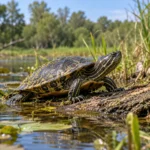
Meet the Turtle
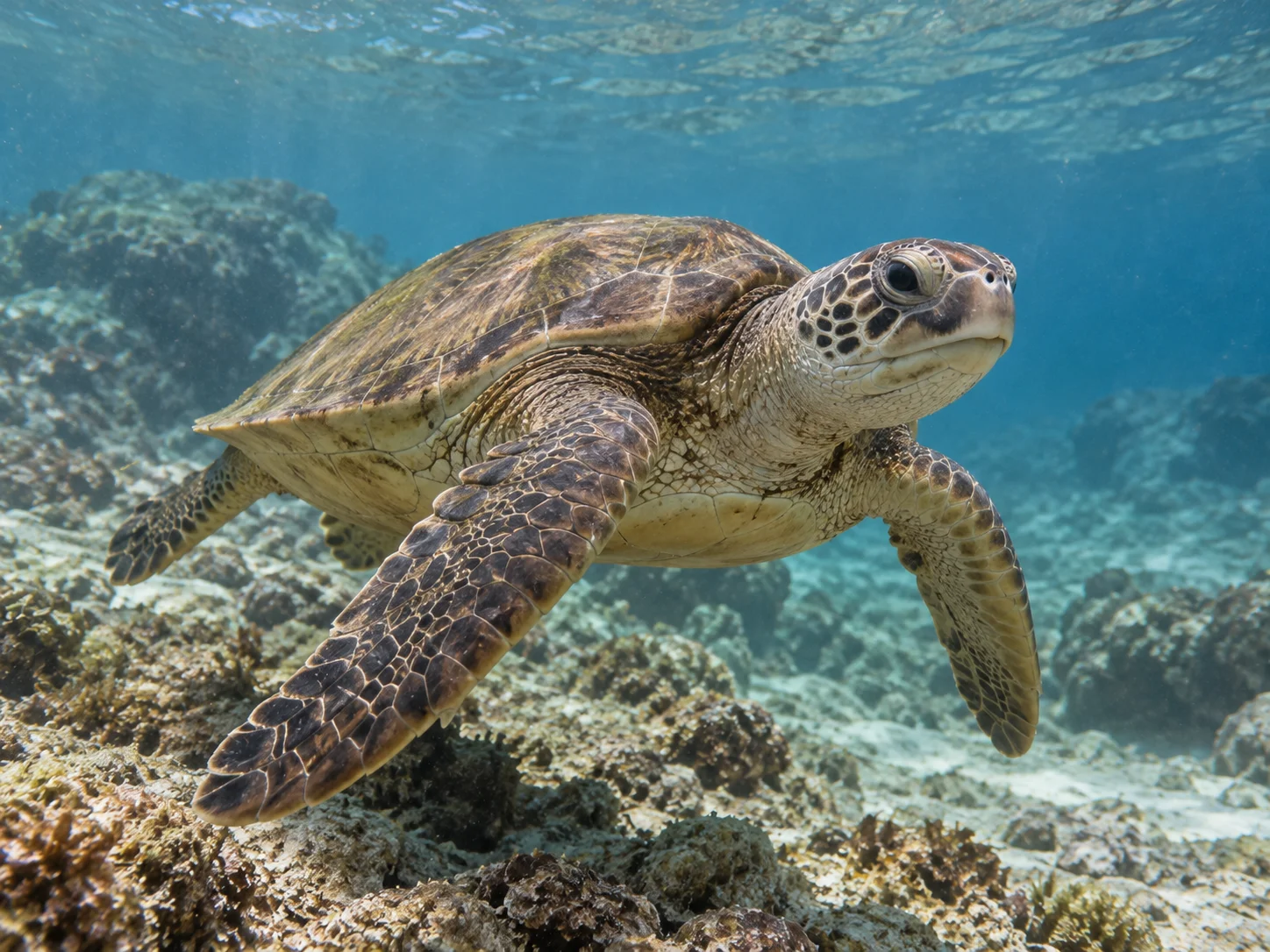
A sea turtle hatchling scrambles down a beach, swims out into the open ocean, and disappears for years. When she is grown, she comes back to lay her eggs on the beach where she hatched, having navigated thousands of miles of featureless water to find it. Turtles are an order of shelled reptiles, the Testudines, with around 360 species living in oceans, in rivers and on land.
She does it using Earth’s magnetic field, which varies slightly from place to place. The beach has a magnetic signature, and she memorized it as a hatchling.
Turtles have been doing this for over 200 million years. They were here before the dinosaurs finished arriving and they outlasted them.
Scientific Name and Classification
Turtles form the order Testudines, with around 360 species, so there is no single two-word name.
- Kingdom: Animalia
- Phylum: Chordata
- Class: Reptilia
- Order: Testudines
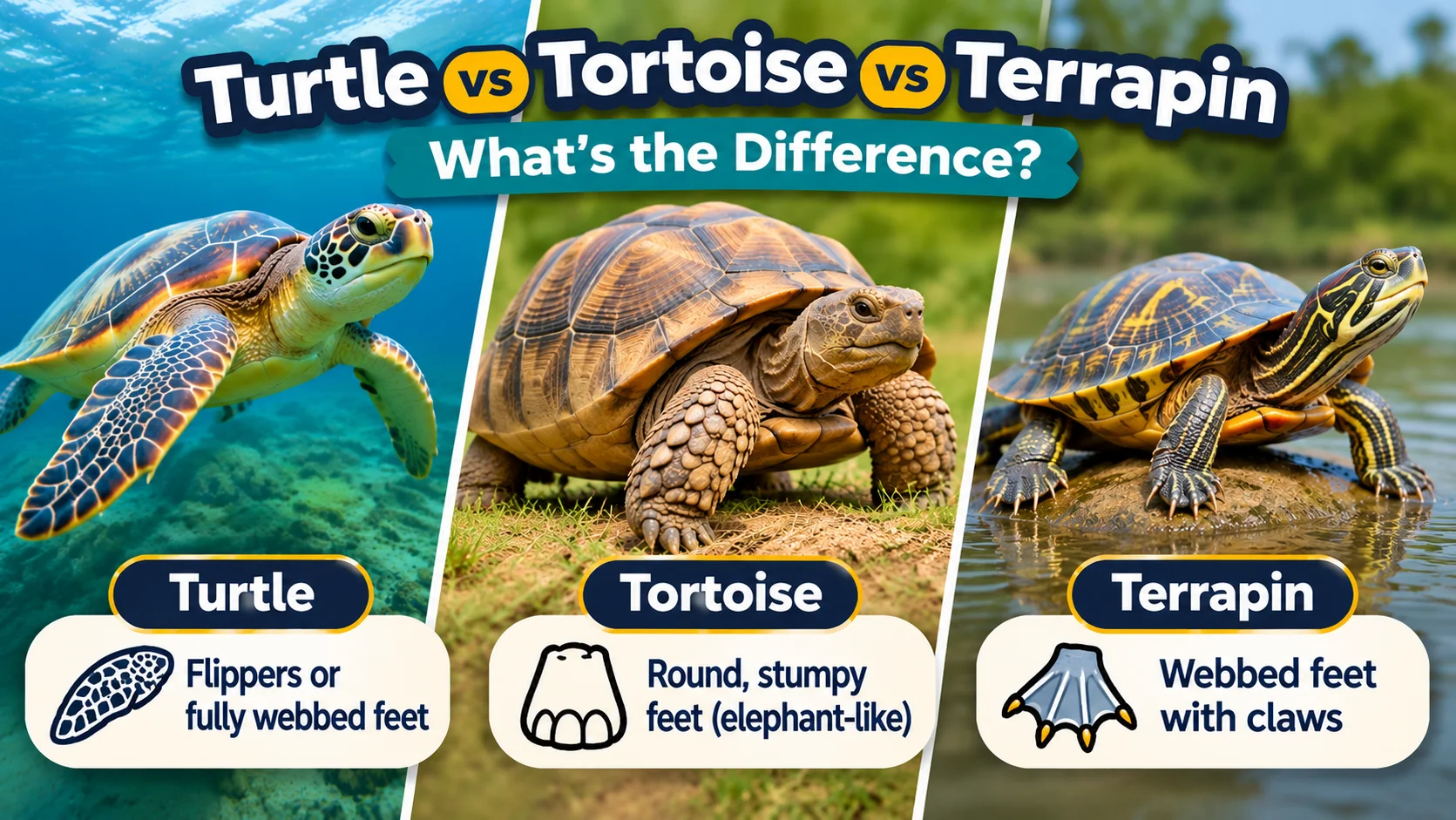
The order covers sea turtles, freshwater turtles, terrapins and tortoises. So every tortoise is technically a turtle, which is why the naming confuses people, and the words are used differently in different countries.
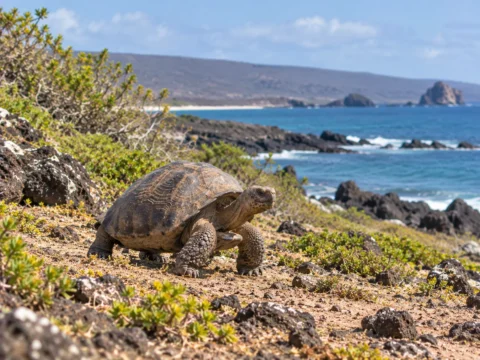
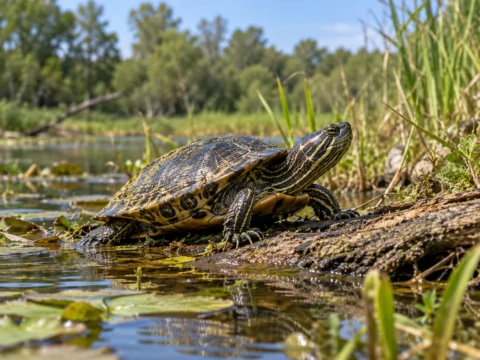
The rough convention: turtles live in water, tortoises live on land, and terrapins live in brackish or fresh water in between.
Their closest living relatives are birds and crocodilians, not lizards and snakes.
How Does a Turtle’s Shell Work?
A shell is not armor the turtle wears. It is part of its skeleton.
The upper shell, the carapace, is formed from the ribs and backbone, flattened and fused together, covered by plates of keratin. The lower shell, the plastron, comes from bones of the shoulder girdle and belly.
So a turtle cannot leave its shell any more than you could step out of your ribcage. Cartoons showing an empty shell with the turtle beside it are impossible.
The shell is alive, with nerves and blood supply running through it. A turtle feels a touch on its shell, and shell injuries bleed and heal.
Building ribs into a shell created a problem. Most animals breathe by expanding the ribcage, and a turtle’s cannot move, so turtles pull air in and out using muscles attached to the shell instead.
Sea turtles paid a price for speed: they cannot pull their heads into their shells at all.
Types of Turtle and Their Characteristics
| Turtle | Size | Notable for |
|---|---|---|
| Leatherback | Up to 7 ft, 2,000 lb | Largest turtle; dives over 3,000 ft; eats jellyfish |
| Green sea turtle | Up to 5 ft | The only sea turtle that mostly eats plants as an adult |
| Hawksbill | Up to 3 ft | Eats sponges; Critically Endangered for its shell |
| Snapping turtle | Up to 2 ft | Powerful bite; lies buried in mud |
| Alligator snapping turtle | Up to 250 lb | Has a worm-shaped lure on its tongue to fish with |
| Bog turtle | About 4 in | One of the smallest turtles in the world |
Appearance and Anatomy
- No teeth. Turtles have sharp beaks instead, shaped to their diet: serrated for plants, hooked for meat.
- Limbs. Sea turtles have flippers; freshwater turtles have webbed feet with claws; tortoises have stumpy legs.
- Salt glands. Sea turtles excrete excess salt through glands behind the eyes, which is why nesting females appear to weep.
- Vision. Good underwater, poor in air.
- Cloacal breathing. Some freshwater turtles absorb oxygen through tissues at the rear end, letting them stay underwater all winter without surfacing.
The tears are not emotion and the rear-end breathing is not a joke. Both are real solutions to real problems.
Habitat and Range
Turtles live on every continent except Antarctica and in every ocean except the polar seas.
Sea turtles cross entire oceans. Leatherbacks migrate over 10,000 miles between feeding and nesting grounds, and range further into cold water than any other reptile, because they generate and retain enough body heat to manage it.
Freshwater turtles live in ponds, rivers, swamps and lakes, and many spend winter buried in mud at the bottom.
Diet and Feeding
Turtles are omnivores as a group, with individual species specializing enormously.
Leatherbacks eat almost nothing but jellyfish, and their throats are lined with backward-pointing spines to stop the slippery prey escaping. Hawksbills eat sponges that are toxic to nearly everything else. Green turtles start out eating meat and switch to seagrass as adults, which is unusual.
The alligator snapping turtle fishes. It lies on the bottom with its mouth open, wiggling a pink worm-shaped lure on its tongue, and closes when a fish comes to investigate.
The jellyfish diet creates a deadly modern problem: a floating plastic bag looks exactly like a jellyfish to a leatherback.
Reproduction and Life Cycle
All turtles lay eggs on land, including sea turtles that otherwise never leave the water.
A female hauls herself up the beach at night, digs a chamber with her back flippers, lays around 100 eggs, covers them and returns to the sea. She does this several times a season and never sees her young.
The sand temperature decides their sex. Warmer nests produce females, cooler ones males, which is why climate warming is producing dangerously female-biased hatchling populations on some beaches.
Hatchlings emerge together at night and run for the sea, guided by the brightest horizon. Artificial lights from buildings and roads send them the wrong way, which kills large numbers.
Roughly one hatchling in a thousand reaches adulthood. Those that do may live 50 to 100 years or more.
Behavior and Lifestyle
Most turtles are solitary, though some bask together in large numbers on logs and banks.
Basking is essential rather than idle. Turtles are cold-blooded and need the sun to raise their body temperature enough to digest food, and it helps control shell parasites and algae.
Sea turtles sleep underwater, wedged under ledges or floating at the surface, surfacing to breathe without fully waking.
The magnetic navigation is the most remarkable behavior. Hatchlings learn the magnetic signature of their home beach and use it to return decades later, an ability researchers are still working to understand fully.
Predators and Threats
Eggs and hatchlings are eaten by crabs, birds, raccoons, foxes, dogs and fish, which is why a female lays hundreds. Adults have few predators besides sharks and large crocodiles.
The human threats are many and serious: fishing nets and longlines that drown turtles as bycatch, plastic and balloons mistaken for food, beachfront development destroying nesting sites, lights disorienting hatchlings, boat strikes, and hunting for meat, eggs and shell.
Hawksbills were hunted almost to extinction for tortoiseshell, which came from their shells rather than any tortoise.
Conservation Status
Turtles are one of the most threatened groups of vertebrates on Earth. Over half of all turtle and tortoise species are threatened with extinction.
Six of the seven sea turtle species are threatened, and the hawksbill is Critically Endangered.
Their biology makes recovery slow. Turtles take decades to mature, so protecting a beach today shows results twenty or thirty years later.
Some measures work well. Escape hatches fitted to shrimp nets let turtles out, protected nesting beaches have raised hatchling numbers, and turning off or shielding beachfront lights is cheap and immediately effective.
Role in the Ecosystem
Each turtle does a job nothing else quite does.
Green turtles graze seagrass meadows and keep them healthy, in the way grazing animals keep a lawn growing rather than going to seed. Hawksbills eat sponges that would otherwise smother coral, so reefs with hawksbills have more coral. Leatherbacks are among the few animals that eat jellyfish in quantity, helping keep blooms in check.
Nesting turtles move nutrients from the sea onto land. Thousands of eggs laid on a barren beach, most of which never hatch, fertilize dune plants that hold the beach together.
Freshwater turtles clean up carrion and keep waterways healthy, and the shells themselves provide surfaces for barnacles and algae that feed small fish.