Meet the Jaguar
Almost every big cat kills the same way. A lion, a tiger or a leopard takes the throat and holds on, and the prey suffocates. The jaguar (Panthera onca) is the largest cat in the Americas, ranging from Mexico to northern Argentina.
The jaguar bites through the skull. It drives its canines into the back of the head, between the ears, and punctures the braincase, which kills instantly.
No other cat does this routinely, and the reason is force. Relative to its size, the jaguar has the most powerful bite of any big cat, and it is built around that single capability: a shorter, stockier, heavier animal than a leopard, with an oversized head and jaw muscles to match.
Scientific Name and Classification
The jaguar is Panthera onca, and it is the only member of the genus Panthera living in the Americas.
- Kingdom: Animalia
- Phylum: Chordata
- Class: Mammalia
- Order: Carnivora
- Family: Felidae
- Species: Panthera onca
That makes it a true big cat, one of the five species with the voice-box ligament that allows a roar, alongside the lion, tiger, leopard and snow leopard. The jaguar’s roar is a series of hoarse, coughing grunts rather than the lion’s sustained bellow.
Genetic work indicates jaguars descend from an ancestor that crossed from Eurasia into North America and then moved south, which is why their closest living relative is the leopard despite living on a different continent.
The name comes from the Tupi-Guarani yaguara, usually translated as something like the one that kills with a single leap.
Appearance and Anatomy
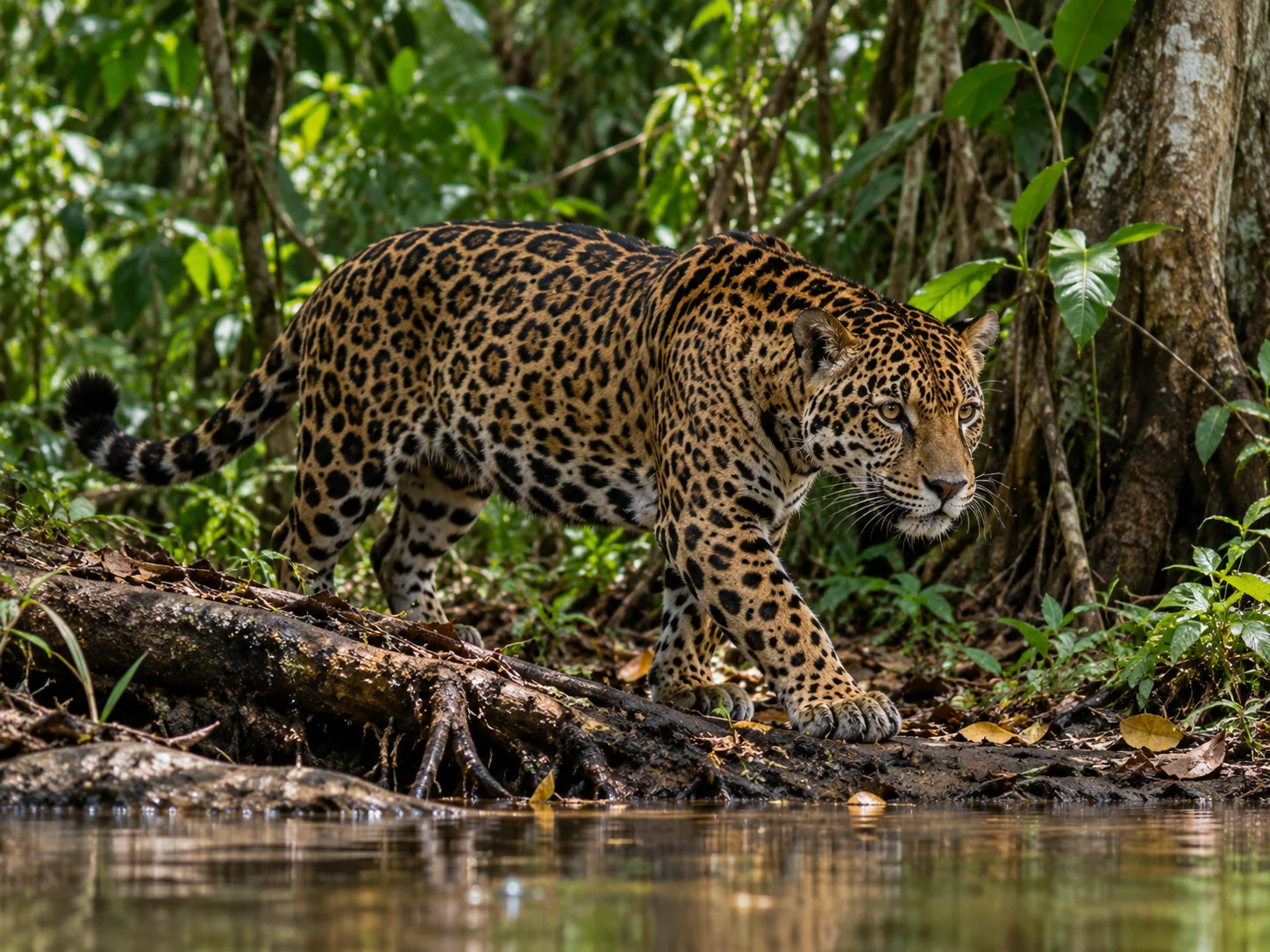
Jaguars measure 3.5 to 6 feet in body length with a 1.5 to 2.5 foot tail, and weigh 100 to 250 pounds (45 to 113 kg), with exceptional males heavier. They are the largest cat in the Americas and the third largest in the world after the tiger and lion.
Size varies enormously by region, and the pattern is instructive: jaguars in the Pantanal wetlands of Brazil are nearly twice the weight of those in Central American forest, because the Pantanal has large prey and open ground.
- Jaw. Short jaws with enormous muscle attachment, giving the strongest bite relative to body size of any big cat and enough force to pierce bone and shell.
- Canines. Thick and conical rather than blade-like, built to punch through rather than slice.
- Legs. Short and heavily muscled, excellent for climbing, swimming and dragging, poor for long pursuit.
- Tail. Comparatively short for a big cat, since a jaguar does not need the balance a leopard needs in trees.
Some jaguars are born almost black. This melanism occurs in perhaps 6 to 10 percent of jaguars and is more common in dense forest, and the rosettes still show under the black in good light. There is no black puma, so a large black cat in the Americas is a jaguar or a misidentification.
They are ambush specialists rather than runners. A jaguar can manage around 50 miles an hour in a short burst and has very little stamina, so a hunt that is detected early simply ends.
Habitat and Range
Jaguars live from northern Mexico through Central America and across northern South America to northern Argentina, in rainforest, swamp, flooded grassland, dry forest and scrub.
The Amazon holds the largest population, and the Pantanal holds the densest and the biggest individuals.
What they need is water and cover. Jaguars are strongly associated with rivers, lakes and wetlands, and unlike most cats they are genuinely aquatic in habit: they swim across wide rivers, hunt from the water’s edge, and will take prey while swimming.
Their range has roughly halved. Jaguars once reached the southwestern United States, and they were effectively eliminated there by the mid-twentieth century. A small number of individual males have been recorded crossing into Arizona and New Mexico in recent decades, and one, known as El Jefe, was photographed repeatedly in Arizona before being recorded again later in Mexico.
Diet and Feeding
Jaguars are carnivores with an unusually broad diet, and more than 85 prey species have been recorded.
Capybara, peccary, deer, tapir, armadillo, agouti, monkeys, birds and fish all feature. But the two that show what the bite is for are reptiles.
Caiman. In the Pantanal, jaguars hunt caiman regularly, stalking along the bank and ambushing them in shallow water, and footage of a jaguar swimming a caiman back to shore in its jaws is one of the more startling things in wildlife filming. They are among the very few predators that routinely take large crocodilians.
Turtles. A jaguar bites straight through the shell of a river turtle, which almost nothing else can do.
They also eat armadillos, shell and all. An animal that can open a turtle has access to food that is effectively protected from every other predator in the forest, which is the real payoff of that jaw.
Behavior and Lifestyle
Jaguars are solitary and territorial, with males holding ranges of 20 to 50 square miles or considerably more in poor habitat, overlapping the smaller ranges of several females.
They are most active at dawn, dusk and night, and they mark territory with scrapes, scent and scratched trees.
They climb well and swim better, and they are comfortable in water in a way that separates them from almost every other cat. They have been recorded crossing rivers more than a mile wide.
The solitary picture has softened slightly with better data. Camera-trap and tracking work in the Pantanal has recorded unrelated males traveling and even hunting together for extended periods, which was not expected and suggests jaguar social behavior is more flexible than the textbook version allows.
Attacks on people are very rare. A jaguar will almost always withdraw, and the recorded incidents overwhelmingly involve cornered, wounded or captive animals.
Reproduction and Life Cycle
Jaguars breed year-round in the tropics, and females signal readiness with calls that carry through forest.
After a gestation of about 95 to 105 days, one to four cubs are born, usually two, blind and weighing around 2 pounds. They open their eyes at about two weeks.
The mother raises them entirely alone and will not tolerate the male anywhere near them, because males kill cubs that are not theirs.
Cubs stay with her for one and a half to two years, learning to hunt, and the skull-bite technique is part of what has to be learned. They then disperse, with young males traveling furthest.
Jaguars live 12 to 15 years in the wild and over 20 in captivity. A female produces a litter roughly every two years, which is slow enough that a population losing adults does not recover quickly.
Predators and Threats
An adult jaguar has no natural predators. Cubs are vulnerable to adult male jaguars, large snakes and caiman.
The pressures that matter are human:
- Deforestation. Clearing for cattle pasture, soy and mining removes habitat and, more damagingly, cuts the remaining forest into fragments too small to hold a breeding population.
- Retaliatory killing. Jaguars take cattle, and ranchers shoot them. This is the leading direct cause of jaguar deaths across much of the range.
- Loss of prey. Bushmeat hunting removes the peccary, deer and capybara jaguars live on, so a protected jaguar in an emptied forest still starves.
- Trade in parts. Jaguars were hunted heavily for skins in the twentieth century, and in recent years there has been renewed demand for teeth, bones and skins, some of it linked to markets that previously used tiger products.
- Roads, which kill jaguars directly and fragment territory further.
Conservation Status
The jaguar is listed as Near Threatened, with a population usually estimated at around 170,000, most of it in the Amazon. That figure sounds reassuring and conceals the real problem, which is fragmentation: many smaller populations outside the Amazon are isolated and declining, and several Central American populations are in serious trouble.
The most interesting conservation response is built around that specific problem. The Jaguar Corridor Initiative aims to maintain and restore connected habitat from Mexico to Argentina, so that jaguar populations stay linked rather than becoming islands. It is an unusually ambitious idea, and it suits the animal: jaguars disperse long distances, so a corridor they can actually use keeps the gene pool working across a continent.
What works on the ground is familiar from other big cats: better livestock protection so ranchers lose fewer animals and retaliate less, compensation schemes, protecting prey species as seriously as the predator, and giving local communities a financial stake through jaguar tourism, which has become a significant industry in parts of the Pantanal.
Role in the Ecosystem
The jaguar is the apex predator of the neotropics, and its influence runs down through the whole system. By limiting peccary, capybara and deer numbers it affects how much vegetation gets browsed, which shapes forest regeneration.
It also suppresses smaller predators, so where jaguars disappear, ocelots, pumas and foxes change in abundance and behavior.
Because it needs large, connected, prey-rich territory, the jaguar works well as an umbrella species: protecting enough land for jaguars protects almost everything else that lives there, which is the logic behind the corridor approach.
Its cultural weight in the Americas is hard to overstate. The jaguar was central to Maya and Aztec belief, where balam meant both jaguar and priest or protector, and Aztec jaguar warriors were an elite military order. Jaguar imagery runs through Olmec, Maya, Moche and Inca art, and it appears on the coats of arms and currency of several modern Latin American countries.
And the bite remains the thing worth remembering. Every other big cat strangles its prey; this one goes through the skull. It is also the only big cat that will swim out and bring back a caiman, and the only one that can open a turtle. For an animal so often described simply as the American leopard, almost nothing about how it works is the same.