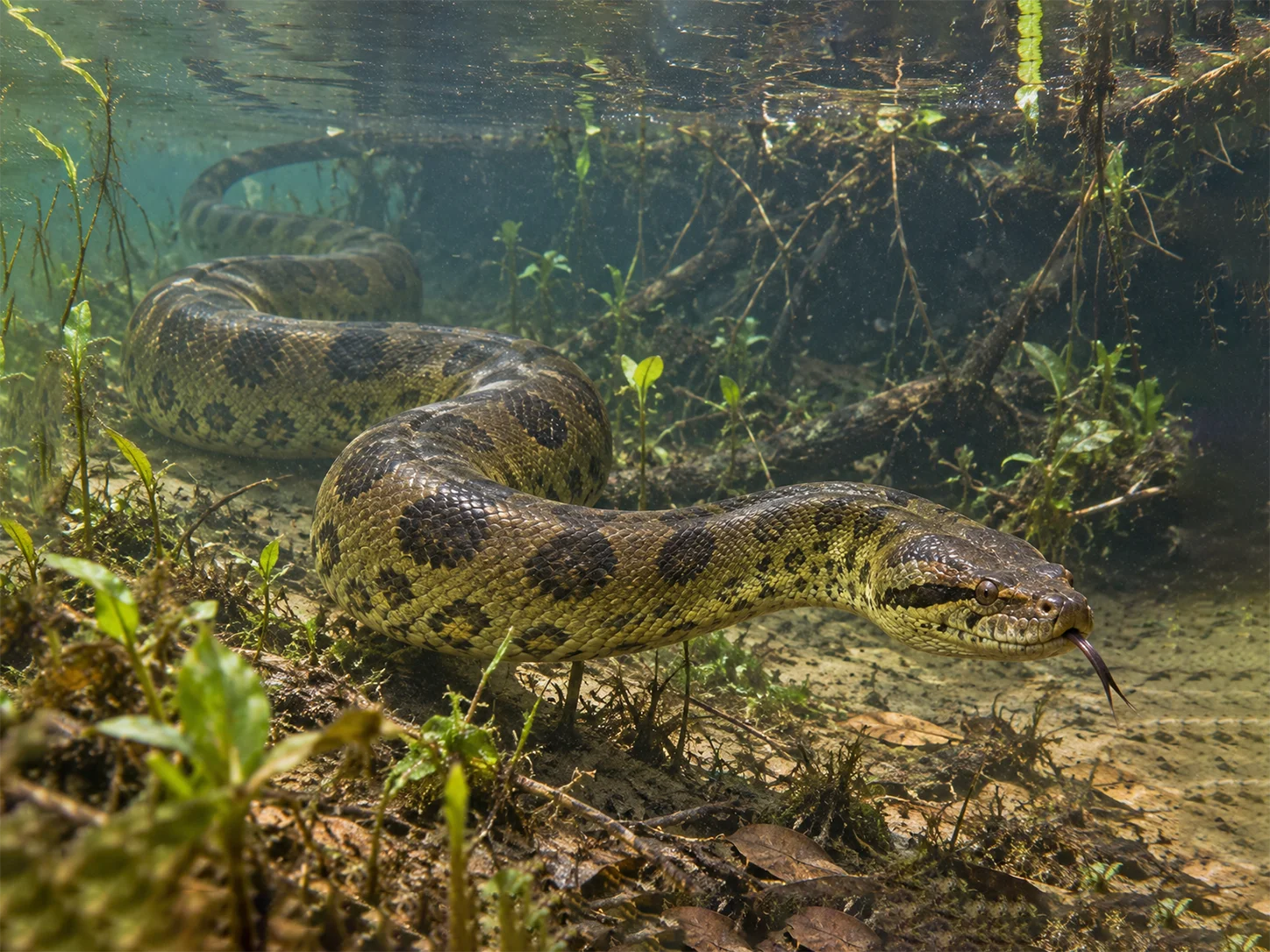
Meet the Anaconda
The green anaconda is the heaviest snake in the world. A big female can weigh over 200 pounds, which is more than two reticulated pythons of the same length.
She is not the longest. That title belongs to the reticulated python. The anaconda is the bulkiest, and there is a reason: it spends most of its life in water, where its own weight costs it nothing.
Females are far larger than males, sometimes five times heavier, one of the biggest size differences of any snake.
Scientific Name and Classification
The green anaconda’s scientific name is Eunectes murinus. Eunectes means “good swimmer”, which is the whole animal in one word.
- Kingdom: Animalia
- Phylum: Chordata
- Class: Reptilia
- Order: Squamata
- Family: Boidae
- Genus: Eunectes
There are several anacondas, including the yellow, Bolivian and dark-spotted, but the green anaconda is much the largest and the one people mean.
Anacondas are boas, which means they kill by constriction and give birth to live young rather than laying eggs.
How Big Do Anacondas Really Get?
This is worth being careful about, because anaconda sizes are exaggerated more than almost any other animal’s.
A typical adult female green anaconda is 15 to 20 feet long and 70 to 150 pounds. Males are much smaller, often around 9 to 10 feet.
Exceptional individuals reach around 25 feet and over 220 pounds. Reliable measurements beyond that are very rare, and the honest position is that anything over 25 feet is unusual enough to be remarkable.
Claims of 35, 40 and even 50-foot anacondas have circulated for centuries. A long-standing cash prize for proof of a snake over 30 feet has never been claimed. Measuring a live snake is genuinely hard, since they stretch, and a skin can be stretched by a third beyond the animal’s real length.
What is not exaggerated is the weight. A 20-foot anaconda is vastly heavier than a 20-foot python, with a body that can be as thick as a grown person’s torso.
Appearance and Anatomy
- Eyes and nostrils. Both set high on top of the head, so the snake can lie almost entirely submerged and still see and breathe.
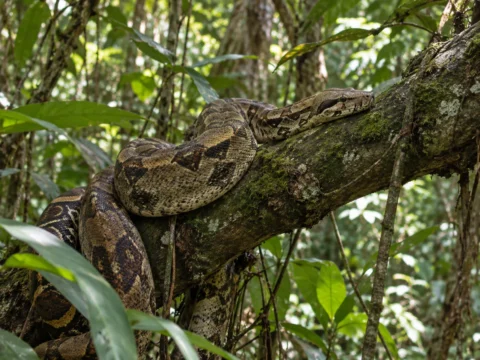
- Color. Olive green with black oval blotches, which breaks up its outline completely in murky, weed-filled water.
- Scales. Smooth and tight, reducing drag when swimming.
- Jaws. Connected by stretchy ligaments rather than fused, so the mouth opens far wider than the head. The jaw does not unhinge or dislocate, which is a common misconception.
- Teeth. Backward-curving and non-venomous, used to grip rather than kill.
Anacondas can hold their breath for around 10 minutes, and they are clumsy and slow on land where their bulk works against them.
Habitat and Range
Green anacondas live in tropical South America, east of the Andes: the Amazon and Orinoco basins, the Llanos grasslands and the Guianas.
They need water: swamps, marshes, slow rivers, flooded grassland and oxbow lakes.
In the dry season, when wetlands shrink, anacondas bury themselves in mud and wait, sometimes becoming dormant until the rains return.
They are very rarely seen, despite their size, because they spend their lives in water choked with vegetation.
Diet and Feeding
Anacondas are carnivores, eating capybara, caiman, deer, peccaries, large birds, turtles, fish and other snakes.
They ambush, lying submerged until an animal comes to drink, then striking, seizing it with those backward-curving teeth and coiling around it.
Here is the correction worth making: constrictors do not crush their prey, and they do not suffocate it either. Research measuring what actually happens found the pressure cuts off blood circulation, and the animal loses consciousness within seconds from lack of blood to the brain. It is far faster than crushing would be.
The snake then swallows it whole, head first, walking its jaws over the body. A large meal may take hours to swallow and weeks or months to digest, and an anaconda that has eaten a capybara may not need to feed again for months.
Behavior and Lifestyle
Anacondas are solitary, and they are slow, secretive animals rather than active hunters. Most of life is spent waiting.
They are mostly active at night and in the cooler hours.
In water they are startlingly agile for their size, moving quietly and quickly. On land they are slow and reluctant.
Young anacondas climb trees. Adults are far too heavy and stay on the ground and in the water.
Reproduction and Life Cycle
Breeding produces one of the strangest sights in nature: the breeding ball.
Several males, sometimes more than a dozen, find a single large female and wrap around her in a writhing mass that can stay together for weeks. They are competing, not fighting, and the largest female attracts the most.
Anacondas do not lay eggs. The young develop inside the mother for about six to seven months and are born live, usually 20 to 40 of them, each already 2 feet long.
They are independent immediately, and most are eaten young by caiman, birds and other anacondas.
Anacondas live around 10 years in the wild and up to 30 in captivity.
Do Anacondas Eat People?
Essentially no, despite a century of films suggesting otherwise.
A large anaconda is physically capable of killing and swallowing a person, and that is why the story persists. But verified cases are extraordinarily rare, and there is no well-documented modern record of an anaconda eating an adult human.
Anacondas avoid people. They are ambush predators that rely on going unnoticed, and a human is a large, unfamiliar, difficult target with no advantage over a capybara.
Far more anacondas are killed by people than the reverse, by an enormous margin.
Predators and Threats
Adults have few natural enemies, though jaguars, caiman and large anacondas take them, and a hunt can go badly for either side. Young anacondas are eaten by a great many animals.
The pressures from people are habitat loss as wetlands are drained for agriculture, killing out of fear, and hunting for skins and for the pet trade.
Pollution and mercury from gold mining in Amazon rivers also accumulate in large predators like these.
Conservation Status
The green anaconda has not been formally assessed in detail by the IUCN, and it is not currently considered at high risk across its range.
Local declines are real, however, particularly where wetlands have been converted to farmland or where snakes are killed on sight.
Research published in 2024 proposed splitting the green anaconda into two species, northern and southern. If that holds, each would have a smaller range than the single species was thought to, and each would need assessing on its own.
Role in the Ecosystem
The anaconda is an apex predator of South American wetlands, and one of very few animals that controls capybara and caiman numbers.
Capybara are prolific breeders, and without large predators their numbers rise sharply, with consequences for the vegetation they graze.
Because they eat infrequently and go long periods without food, anacondas are efficient in a way warm-blooded predators are not. A jaguar needs to hunt constantly; an anaconda does not.
They are also a useful indicator of wetland health. A system still supporting large anacondas has enough water, enough cover and enough prey to work.