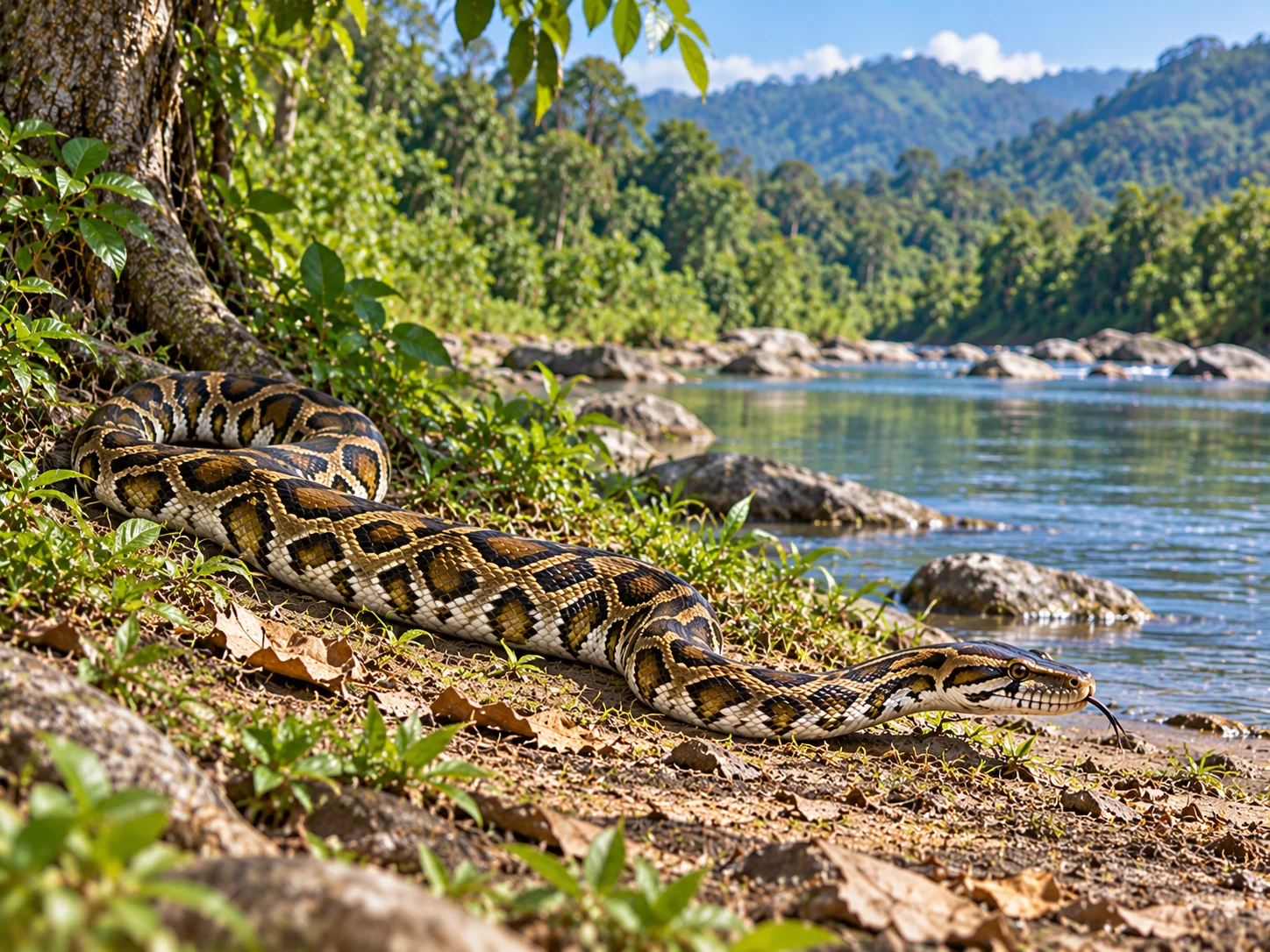
Meet the Python
A female python coils around her eggs and shivers to keep them warm. She twitches her muscles for weeks, generating heat, without eating. Pythons are a family of non-venomous constricting snakes, the Pythonidae, with around 40 species across Africa, Asia and Australia.
That should not be possible. Snakes are cold-blooded and cannot normally make their own heat at all, and almost no other snake broods its eggs this way.
Pythons also see heat. Pits along the lips detect infrared radiation, so a python can strike accurately at a warm animal in total darkness.
Scientific Name and Classification
Pythons form the family Pythonidae, with around 40 species, so there is no single two-word name. The reticulated python is Malayopython reticulatus and the Burmese python is Python bivittatus.
- Kingdom: Animalia
- Phylum: Chordata
- Class: Reptilia
- Order: Squamata
- Family: Pythonidae
The reticulated python is the longest snake in the world, reaching over 20 feet and exceptionally around 25. It is not the heaviest; the green anaconda holds that record.
Pythons are not venomous. They kill by constriction.
How Does a Python Kill Its Prey?
By constriction, and not in the way the word suggests.
A python does not crush bones, and it does not suffocate its prey either. Research measuring what actually happens found the coils stop blood circulating. The animal loses consciousness within seconds from lack of blood to the brain, which is far faster than suffocation would be.
The snake tightens each time the prey breathes out, so the chest can never expand again.
Then it swallows the animal whole, head first. A snake’s jaw does not unhinge, despite the common claim: the two halves of the lower jaw are joined by a stretchy ligament instead of being fused, and the whole jaw is loosely attached to the skull, so it stretches and the halves move independently.
Digestion is a serious undertaking. A large python’s gut and organs grow temporarily to cope with a big meal, then shrink back, and the animal may not eat again for months.
Appearance and Anatomy
Pythons range from the pygmy python at around 20 inches to the reticulated python at over 20 feet, and from a few ounces to 250 pounds.
- Heat pits. Small openings along the lips containing membranes that sense infrared, letting a python locate warm-blooded prey in complete darkness.
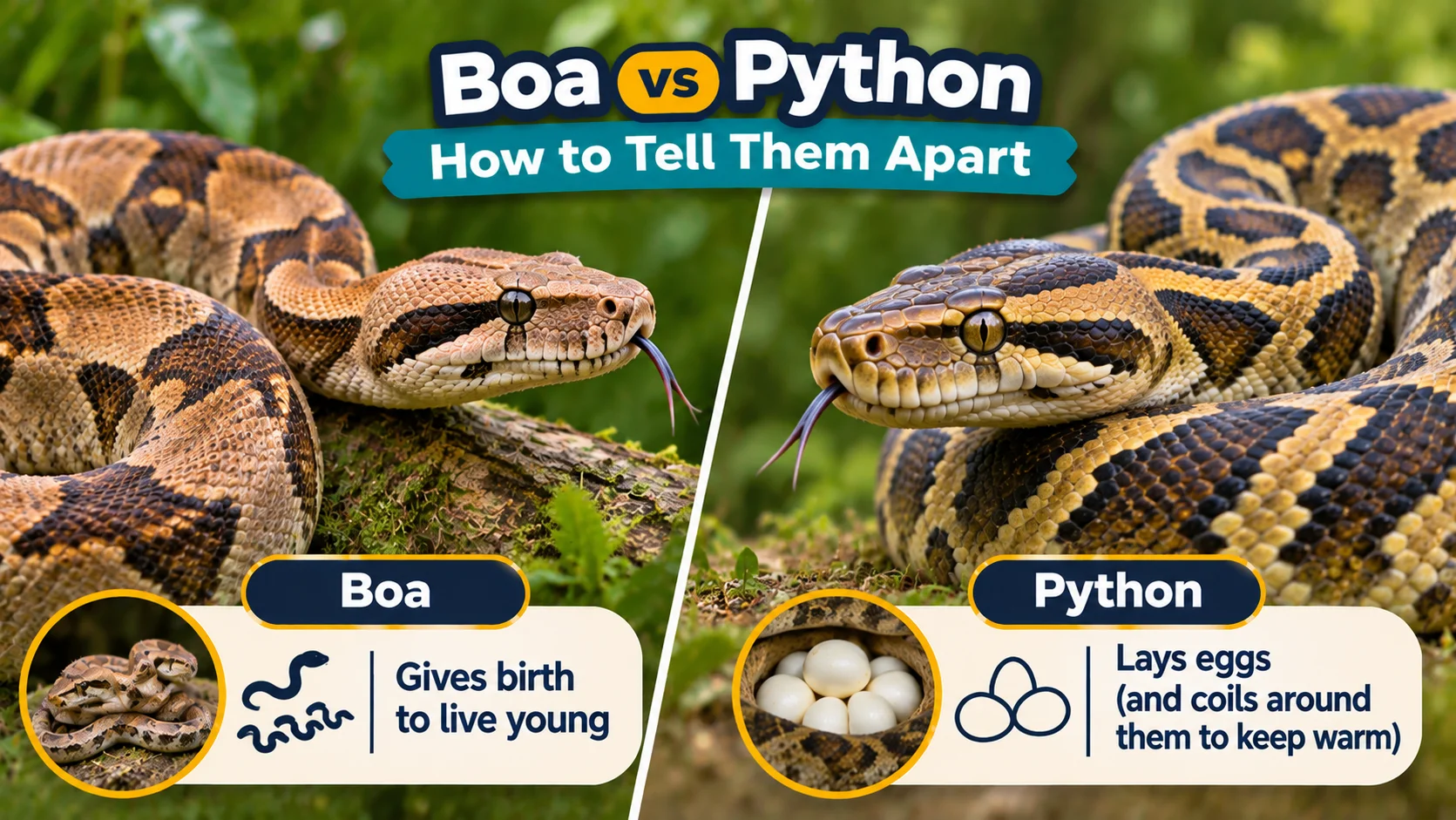
- Teeth. Sharp, backward-curving and non-venomous, built to grip. Pythons also carry teeth on the premaxillary bone at the very front of the upper jaw, which boas lack.
- Pelvic spurs. Two small claws near the tail, the leftovers of hind legs, which pythons use during courtship. They are direct evidence that snakes descend from legged ancestors.
- Patterning. Complex blotches and net-like markings that break up the body outline on a forest floor.
- Jaw. Loosely attached and elastic rather than hinged.
They are good swimmers and surprisingly capable climbers, particularly when young.
Habitat and Range
Pythons are native to Africa, Asia and Australia, in rainforest, grassland, swamp, scrub and rocky hillside.
They are absent from the Americas natively, which is where the boas live.
One population is somewhere it should not be. Burmese pythons released or escaped from the pet trade have established themselves in the Florida Everglades, where they have no natural predators and have caused a severe collapse in native mammals. Surveys in some areas have recorded falls of over 90 percent in raccoons, opossums and rabbits.
It is one of the clearest invasive-species disasters anywhere, and it began with pet snakes that outgrew their owners.
Diet and Feeding
Pythons are carnivores, eating rats, birds, bats, lizards, monkeys, antelope, pigs and deer depending on their size.
They are ambush predators, lying still for days along a trail or beside water, relying on camouflage and those heat pits rather than pursuit.
Being cold-blooded makes them extremely economical. A python needs a tiny fraction of the food a mammal predator of the same weight would require, which is why one large meal can last months.
Small pythons eat rodents almost exclusively, which makes them useful around farmland.
Behavior and Lifestyle
Pythons are solitary and mostly nocturnal, and they spend a remarkable amount of time doing nothing at all. Waiting is the strategy.
They shed their skin in one piece, several times a year, and the eyes cloud over beforehand as the old skin loosens.
The ball python has a defense that gave it its name: it curls into a tight ball with its head tucked in the middle, and will stay like that rather than bite. It is one of the calmest snakes there is, which is why it became the most widely kept pet snake in the world.
Larger pythons are not aggressive toward people, but a big constrictor is genuinely dangerous and should never be handled alone.
Reproduction and Life Cycle
Pythons lay eggs, which separates them from the boas, and then do something almost no other snake does.
The female coils around the clutch, often 20 to 100 eggs, and stays there for the whole incubation, two to three months. She does not leave to feed.
If the eggs get cold she shivers. Rapid muscle contractions generate heat, warming the clutch above the surrounding air temperature. It is a feat of physiology for a cold-blooded animal, and it costs her a great deal of stored energy.
Once the eggs hatch, that is the end of the care. Hatchlings are 1 to 2 feet long and entirely independent.
Pythons live 15 to 30 years, and captive animals have passed 40.
Predators and Threats
Young pythons are eaten by birds of prey, monitor lizards, crocodiles, big cats and other snakes. Adults of the larger species have few enemies.
Human pressures are serious. Pythons are hunted in large numbers for skins for the fashion trade, for meat and for traditional medicine, and taken live for the pet trade.
Habitat loss reduces both shelter and prey, and pythons are killed on sight in many places out of fear.
Conservation Status
There is no single status across around 40 species.
Several are doing reasonably well, and the ball python is extremely numerous, though its wild populations in West Africa are under pressure from collection for the pet trade.
Others are in trouble. The Indian python is Near Threatened, and some island species have small, declining populations. The skin trade removes very large numbers of snakes each year.
And in Florida the Burmese python needs controlling rather than protecting, which is an unusual position for a snake to be in.
Role in the Ecosystem
In their native range pythons are important predators of rodents, and that is worth more than it sounds: rats damage crops and spread disease, and a python in a field is effective, free pest control.
Larger pythons control medium-sized mammals and keep those populations in balance.
Being cold-blooded, they do that job on remarkably little food, so a given area supports more predator biomass in snakes than it could in mammals.
Florida shows the other side of the same coin. Put an efficient ambush predator somewhere its prey has never learned to fear it, and the result is not balance but collapse. The animal has not changed; only its address has.