Meet the Quahog
A quahog is a clam. It has no head, no brain to speak of, and no way of going anywhere in a hurry. And one of them turned out to be the oldest animal anybody has ever accurately aged.
It was 507 years old. It had been alive since before Shakespeare was born, through the entire history of modern science, sitting in the mud off Iceland filtering seawater.
Two different clams share the name quahog, and they are worth keeping apart: the hard clam of American shores, which is the one people eat, and the ocean quahog of deep North Atlantic water, which is the one that lives for centuries.
Scientific Name and Classification
The two quahogs are not close relatives. They are both bivalves (animals with a shell in two hinged halves) but they sit in different families.
- Kingdom: Animalia
- Phylum: Mollusca
- Class: Bivalvia
- Northern quahog, or hard clam: Mercenaria mercenaria, family Veneridae
- Ocean quahog: Arctica islandica, family Arcticidae
The word itself is older than either scientific name. Quahog comes from poquauhock in Narragansett, a language of what is now Rhode Island, and it first appears in English writing in 1781.
Appearance and Anatomy
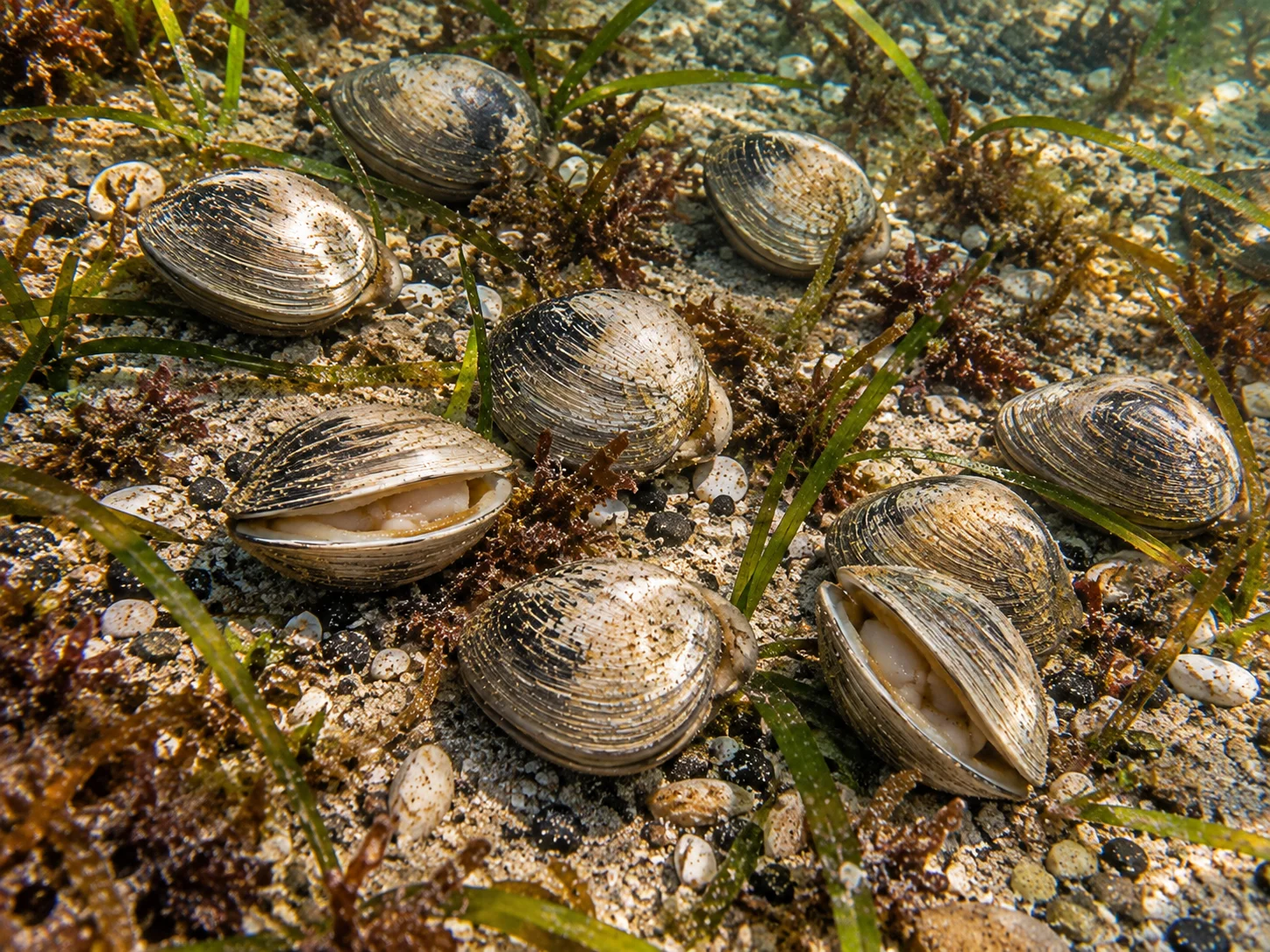
A quahog is a thick, heavy, roughly oval shell in two halves, held shut by strong muscles and marked on the outside with fine growth lines. Hard clams reach around 4 inches (10 cm) across; ocean quahog shells grow past 2 inches (5 cm) in height.
- Two hinged shell halves, thick and chalky white or gray outside
- Often a band of deep purple inside the hard clam shell
- A muscular foot used for digging
- Two siphons: one draws water in, the other pushes it out
- Gills that both breathe and strain food from the water
The purple is the famous part. Native nations along the Atlantic coast cut the colored portion of the shell into small beads called wampum, which were strung into belts, worn as ornaments, used to record agreements, and later traded through the North American fur trade: a currency grown by a clam.
Habitat and Range
The hard clam lives along the eastern shores of North and Central America, from Prince Edward Island down to the Yucatán, and is especially abundant between Cape Cod and New Jersey. It has also been introduced to the Pacific coast, Britain and mainland Europe.
The ocean quahog is a North Atlantic animal and lives below the tide line, deep enough that collecting it means dredging the seabed rather than walking out and digging.
Both bury themselves. A quahog uses its muscular foot to work down into sand or mud, leaving only its siphons reaching up into the water, which is all it needs, because its food arrives on the current.
Diet and Feeding
A quahog is a filter feeder. It draws seawater in through one siphon, strains out the tiny drifting plants and animals in it, and sends the cleaned water back out through the other.
Ocean quahogs seem to time this by light, using how bright the water is as a signal for when food is likely to be there. At the northern edge of the range that produces a stark schedule: real feeding for about eight months of the year, and in the remaining months only a few days each.
Filtering has a downside near shore. When a bloom of toxic algae drifts past, a hard clam takes it in along with everything else and the toxin builds up in its body, which is why shellfish beds get closed during a red tide, and why the clams themselves are unharmed while people who eat them are not.
The Clam That Lived 507 Years
In 2006 a research expedition dredged up ocean quahogs off Iceland. One of them, later nicknamed Ming, was found to have been 507 years old, the longest-lived animal of its kind whose age has been accurately established.
Its age was read from its shell. A quahog adds a layer every year, so the shell carries a stack of growth bands like the rings of a tree, and counting them gives an age. The study of those records is called sclerochronology.
There is an uncomfortable detail. Ming was alive when it was collected, and opening the shell to count the bands is what killed it, so the oldest known animal died in the act of being measured, and because it was still living, nobody knows how much longer it would have gone on.
Not every quahog manages anything like this. Lifespans vary enormously with conditions: clams in the Bay of Kiel typically reach about 30 years, those in the German Bight around 150. A specimen collected near Iceland in 1868 was 374.
A Shell That Records the Weather
Because each band forms in a particular year, and because the chemistry locked into it depends on the water the clam was living in, an old quahog shell is a dated record of past ocean conditions.
The 374-year-old Icelandic clam showed it clearly. Its growth was erratic through the worst of the Little Ice Age around 1550 to 1620, and steadier as conditions eased near 1765 to 1780. Its shell even registered the enormous eruption of Mount Tambora in 1815.
That makes these clams genuinely useful to climate science. They are among the few animals that keep an annual written record of the sea, going back centuries before anyone was taking measurements.
Reproduction and Growth
Quahogs spawn into open water. Males and females release sperm and eggs, fertilization happens in the sea, and the young spend their first days as drifting larvae before settling to the bottom and starting to dig.
Growth is slow, especially in the ocean quahog, which takes an average of nearly six years to mature and in cold regions grows only during summer. That patience is thought to be part of the secret: the animal spends very little on maintaining and repairing itself, and ages extremely slowly as a result.
Quahogs and People
Hard clams are a serious food. They are sold under names that are purely about size, from smallest to largest: countnecks or peanuts, then littlenecks, topnecks, cherrystones, and finally the big ones called quahogs or chowder clams.
Rhode Island has made the connection official. The quahog is the state shellfish, and the state has supplied a quarter of the entire annual commercial quahog catch in the United States.
Ocean quahogs are fished commercially too, by dredge. Because they grow so slowly and live so long, a dredged bed can take a very long time to come back. The arithmetic of a 500-year animal does not suit a yearly harvest.
Role in the Ecosystem
A bed of quahogs is a water treatment plant. Every clam is pulling particles out of the sea all day, and in a bay with enough of them that filtering measurably clears the water.
They are food as well as filter. Crabs, starfish, gulls, bottom-feeding fish and the sea otter all break into clams, and a buried quahog with a thick shell is simply making that as difficult as possible.
Which is the quiet lesson in this animal. A quahog does nothing dramatic; it sits in the mud and filters. By doing only that, for long enough, it cleans the water, feeds a coastline, carried a currency, and kept a written record of five centuries of ocean weather that no human was there to write down.