Meet the Raccoon
A raccoon’s front paws are so sensitive that it can identify an object underwater, in the dark, without looking at it. Roughly two thirds of the part of its brain that handles touch is devoted to those hands. The raccoon (Procyon lotor) is a masked, omnivorous mammal native to North America and now established across parts of Europe and Asia.
That is why raccoons appear to wash their food, and the real explanation is better than the myth.
They are also one of the few wild animals that has got noticeably better at life since people arrived. Urban raccoons solve problems faster than country ones, and they get into everything.
Scientific Name and Classification
The common raccoon’s scientific name is Procyon lotor. Lotor means “the washer”, after the behavior described below.
- Kingdom: Animalia
- Phylum: Chordata
- Class: Mammalia
- Order: Carnivora
- Family: Procyonidae
- Species: Procyon lotor
Raccoons belong to their own family, Procyonidae, alongside coatis, kinkajous and ringtails. They are not related to bears, despite the resemblance, though both are in the order Carnivora.
The name comes from a Powhatan word recorded by English settlers, meaning roughly “animal that scratches with its hands”, which is a better description than most scientific names manage.
Why Do Raccoons Wash Their Food?
They are not washing it. They are feeling it.
A raccoon’s front paws are extraordinarily sensitive, with roughly four to five times more touch receptors than its back feet, and about two thirds of the sensory part of its brain handling information from them. A raccoon effectively sees with its hands.
Water makes this better. Wetting the paws softens a tough outer layer on them and makes the nerve endings more responsive, so a raccoon handling food in water is getting far more information than it would dry.
In the wild they naturally hunt by feeling along stream beds for crayfish, frogs and shellfish under rocks they cannot see. The rolling and rubbing looks like washing, and is really a careful examination.
Raccoons in captivity do it even with food that is already clean, and even with no water, which gave the game away.
Appearance and Anatomy
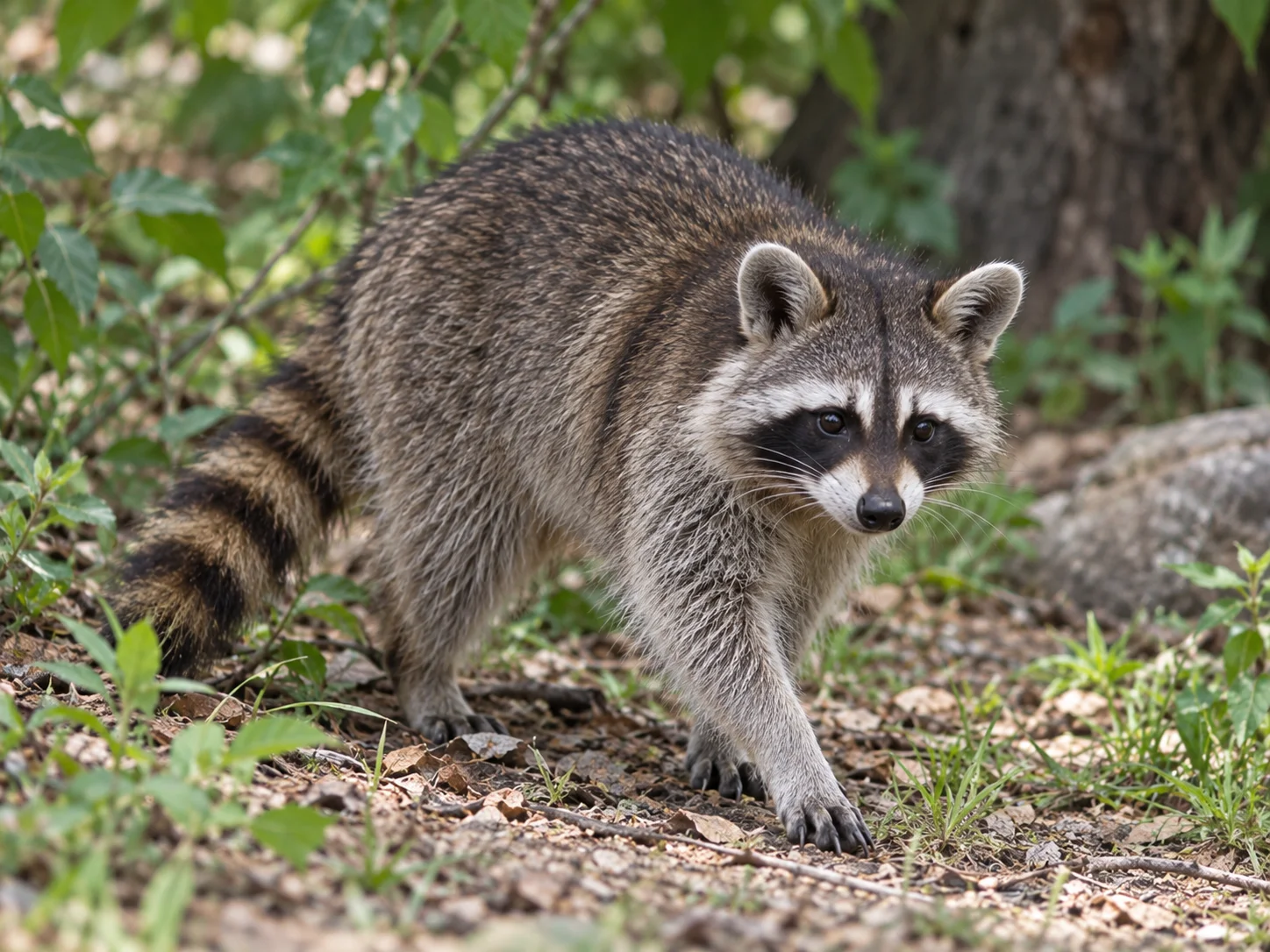
Raccoons measure 16 to 28 inches in the body with a 8 to 12 inch tail, and weigh 8 to 35 pounds. City raccoons are often noticeably heavier than rural ones.
- Front paws. Five long, dexterous fingers with no opposable thumb, yet capable of turning doorknobs, undoing latches and opening jars.
- Mask. The black band across the eyes is thought to cut glare, like a footballer’s eye black, which helps a night-active animal.
- Tail. Ringed, used for balance and as a fat store for winter.
- Eyes. Good night vision, with a reflective layer behind the retina.
- Teeth. Forty, suited to a genuinely mixed diet rather than specialized for meat.
They are excellent climbers and can descend a tree head-first by rotating their hind feet backwards, which few mammals manage.
Habitat and Range
Raccoons are native to North America and Central America, from southern Canada down to Panama.
They were introduced to Europe and Asia, partly through fur farming and partly as escaped pets, and are now established across Germany, France and Japan, where they are treated as an invasive species.
Originally animals of woodland near water, they now thrive in cities. Urban raccoon densities can be many times higher than in the forest, because towns offer food, warm roof spaces and very few predators.
Diet and Feeding
Raccoons are omnivores and about as unfussy as an animal gets.
They eat crayfish, frogs, fish, insects, worms, eggs, nestling birds, mice, fruit, nuts, acorns, grain, pet food and anything edible in a bin.
Much of their foraging is done by touch, feeling under rocks and into crevices rather than looking.
In the fall they eat heavily and can nearly double their weight, laying down fat for winter. Raccoons do not truly hibernate, but in cold regions they sleep for long stretches, living off that fat and emerging on milder nights.
Behavior and Lifestyle
Raccoons are mostly nocturnal and largely solitary, though related females sometimes share feeding areas and dens.
They are seriously clever. In classic experiments raccoons opened complex locks, remembered the solutions for up to three years, and solved them again when the locks were turned upside down, meaning they understood the mechanism rather than memorizing a movement.
Urban raccoons outperform rural ones on problem-solving tests, and bolder individuals do better in cities, so towns appear to be selecting for exactly the traits that make them so hard to keep out of a bin.
They are vocal too, with over 50 different sounds including purrs, chitters, growls and a startlingly loud scream.
Reproduction and Life Cycle
Pregnancy lasts about 65 days and produces two to five kits, born in a den in a hollow tree, a burrow, an attic or a chimney.
Kits are born blind, opening their eyes at around three weeks. The mother raises them alone; males take no part.
They start following her out at about two months, learning what to eat and where to find it, and usually stay through their first winter before dispersing.
Most wild raccoons live only 2 to 3 years, mainly because of traffic, hunting and disease, though individuals have reached 16 and captive animals over 20.
Predators and Threats
Coyotes, bobcats, eagles, large owls, alligators and large dogs kill raccoons, and kits are vulnerable to much more.
In towns the leading causes of death are cars and disease.
Disease matters both ways. Raccoons are a major carrier of rabies in parts of North America, and raccoon roundworm, spread in their droppings, can seriously harm people. That is a practical reason to keep distance and never handle a raccoon or clear its droppings without protection.
Conservation Status
Raccoons are listed as Least Concern, abundant, and expanding both their range and their numbers.
They are one of the clearest examples of a wild animal that benefited from human settlement, having moved from woodland into suburbs and cities and thrived there.
Where they have been introduced the concern is reversed. European and Japanese raccoons prey on native birds and amphibians, compete with local species and spread disease, and several countries run control programs.
Role in the Ecosystem
In their native range raccoons are useful middle-sized predators, controlling insects, rodents and crayfish, and they spread seeds in their droppings after eating fruit.
They also clean up carrion and waste, which is genuinely valuable in a city.
They have a cost too, even at home: raccoons raid the nests of ground-nesting birds and turtles, and in places where those species are already struggling that pressure is significant.
Perhaps their most interesting role is as a subject of study. Because urban raccoons are measurably better at solving problems than rural ones, researchers use them to study how cities change animal behavior and intelligence in real time.