Meet the House Lizard
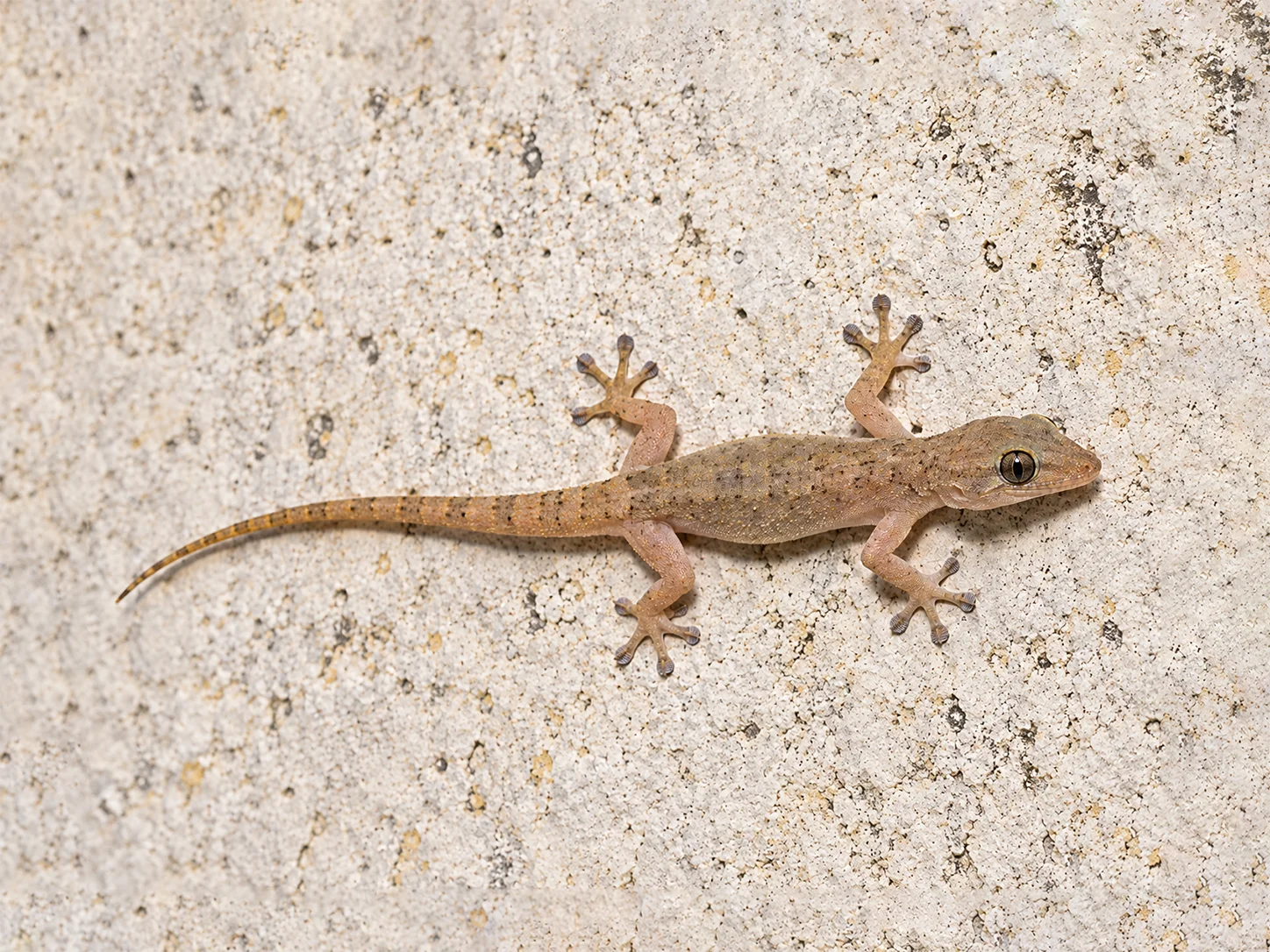
If you have lived anywhere warm, you have shared a house with these. The common house gecko sits near a ceiling light after dark, waiting for insects, and makes a chirping call that sounds like a tiny clicking laugh. The house lizard (Hemidactylus frenatus) is a small gecko that lives alongside people across the tropics, hunting insects on walls and ceilings.
It walks across a ceiling upside down. Not with suction, not with glue, but with a force that works at the scale of individual molecules, using hairs so fine they are measured in billionths of a meter.
And if something grabs it, it throws away its own tail and grows a new one.
Scientific Name and Classification
The common house gecko’s scientific name is Hemidactylus frenatus. It is also called the Asian house gecko, the chit-chat lizard, or in South Asia simply the chipkali or house lizard.
- Kingdom: Animalia
- Phylum: Chordata
- Class: Reptilia
- Order: Squamata
- Family: Gekkonidae
- Genus: Hemidactylus
- Species: Hemidactylus frenatus
“House lizard” is used loosely for several gecko species that live in buildings, but this is the one most people mean, and it is now the most widespread of them all.
The genus name means “half finger”, for the partly expanded toe pads.
How Do House Lizards Walk on Ceilings?
This is one of the best pieces of engineering in the animal world, and the answer surprised scientists for decades.
It is not suction, and it is not stickiness. A gecko’s toes are covered in millions of microscopic hairs called setae, each splitting into hundreds of even finer tips. That gives an enormous number of points of contact.
At that scale, a weak attraction between molecules called the van der Waals force becomes significant. Each tip contributes almost nothing. Billions of them together hold the whole animal up.
The grip is extraordinary. A gecko could in principle hang from one toe, and the combined force would support many times its own weight.
The clever part is letting go. A gecko peels its toes off by curling them up from the tip, which breaks contact instantly, and it can do this fast enough to run across a ceiling.
Engineers have copied this to make reusable dry adhesives and climbing robots. Gecko feet also stay clean by themselves, shedding dirt as the lizard walks.
Why Do House Lizards Drop Their Tails?
To stay alive. The ability is called autotomy, and the tail is designed to come off.
There are weak points built into the tail bones and muscles. When a predator grabs it, the tail snaps at one of these points, and muscles clamp the blood vessels so the lizard barely bleeds.
The detached tail then thrashes violently for several minutes. That is the point: the predator is left holding something wriggling while the gecko escapes.
It regrows over weeks to months, but not perfectly. The new tail is supported by a rod of cartilage rather than bone, and usually differs in color and shape from the original.
It is also costly. Geckos store fat in their tails, so losing one means losing a food reserve, and a tailless gecko ranks lower socially and is less successful at breeding. It is an emergency measure, not a trick.
Appearance and Anatomy
House geckos measure 3 to 6 inches including the tail and weigh only a few grams. They are far lighter than they look.
- Skin. Pale gray, tan or near-translucent, and it changes shade: lighter at night, darker by day.
- Eyes. Large, with vertical pupils, and no eyelids at all. A gecko cannot blink, so it licks its own eyes clean with its tongue.
- Toes. Expanded pads covered in the microscopic hairs that do the climbing.
- Tail. Stores fat, aids balance, and detaches under attack.
- Ears. Open holes on the sides of the head. Look through a gecko’s head from the right angle in bright light and you can see daylight through them.
They have excellent night vision, estimated at hundreds of times more sensitive than ours, and can see colors in light so dim that people see only gray.
Habitat and Range
The common house gecko originally came from South and Southeast Asia.
It now lives across the warm parts of the world, having traveled in cargo, shipping containers, luggage and house plants. It has reached Africa, Australia, the Pacific islands, Central and South America and the southern United States.
It is one of the most successful stowaway animals on Earth, and it thrives specifically because of us: buildings give shelter, and outdoor lights gather insects every night.
Where it arrives, it tends to displace native geckos, which is a real concern on islands.
Diet and Feeding
House geckos are insectivores, eating mosquitoes, moths, flies, ants, cockroach nymphs, spiders and termites.
They have learned to hunt at lights. A gecko positions itself near a lamp and waits for insects to come to it, which is far less effort than searching, and is why they are always in the same spots each evening.
They are ambush hunters: still for long periods, then a sudden dash and snap.
A single house gecko eats a substantial number of mosquitoes over a year, which makes it a genuinely useful houseguest.
Behavior and Lifestyle
House geckos are active at night and hide in cracks, behind pictures and under furniture by day.
Unusually for lizards, they are vocal. The chirping chuck-chuck-chuck call is used by males to hold territory and attract mates, and in parts of Asia it is such a familiar household sound that the lizard is named after it.
Males are territorial and will chase and bite each other, often resulting in dropped tails.
They shed their skin regularly in patches, and usually eat it afterward, which recovers the nutrients and leaves no trace for predators.
Reproduction and Life Cycle
Females lay two eggs at a time, several times a year, tucked into a crack, behind a picture frame or under loose bark.
The eggs are soft and sticky when laid and harden quickly into tough white shells glued in place.
They hatch after about six to eight weeks, and the young are fully independent, perfect miniatures of the adults, with no parental care whatsoever.
House geckos live around 5 years, and sometimes considerably longer indoors where it is warm and food is reliable.
Predators and Threats
Snakes, birds, larger lizards, spiders and domestic cats all eat house geckos.
Their defenses are speed, hiding in cracks too narrow to follow, and the tail trick.
Insecticides are the main human danger, both directly and by poisoning the insects they eat.
Worth saying clearly: house geckos are completely harmless to people. They are not venomous, they do not carry anything dangerous in ordinary circumstances, and the folk belief that their touch is poisonous has no basis.
Conservation Status
The common house gecko is abundant and in no danger at all. It is one of the few reptiles that has clearly benefited from human expansion.
The concern runs the other way. As an introduced species it outcompetes native geckos in many places, particularly on Pacific islands, where local species have declined sharply after it arrived.
It is an odd situation: a harmless, useful animal in its home range, and an invasive problem elsewhere, spread entirely by accident.
Role in the Ecosystem
Around houses, geckos are free pest control. They eat mosquitoes, flies, moths and cockroach nymphs night after night, including insects that spread disease.
They are also food for snakes, birds and cats, which puts them in the middle of the food chain even in a city.
Scientifically they have been unusually valuable. Studying gecko feet opened up a whole field of adhesives research, and their ability to regrow a tail is studied by scientists interested in how tissue regenerates.
For a great many people, this is also the first wild animal they ever watched closely, which is not nothing.