
Meet the Tortoise
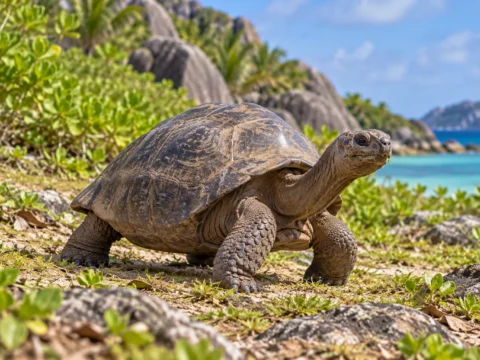
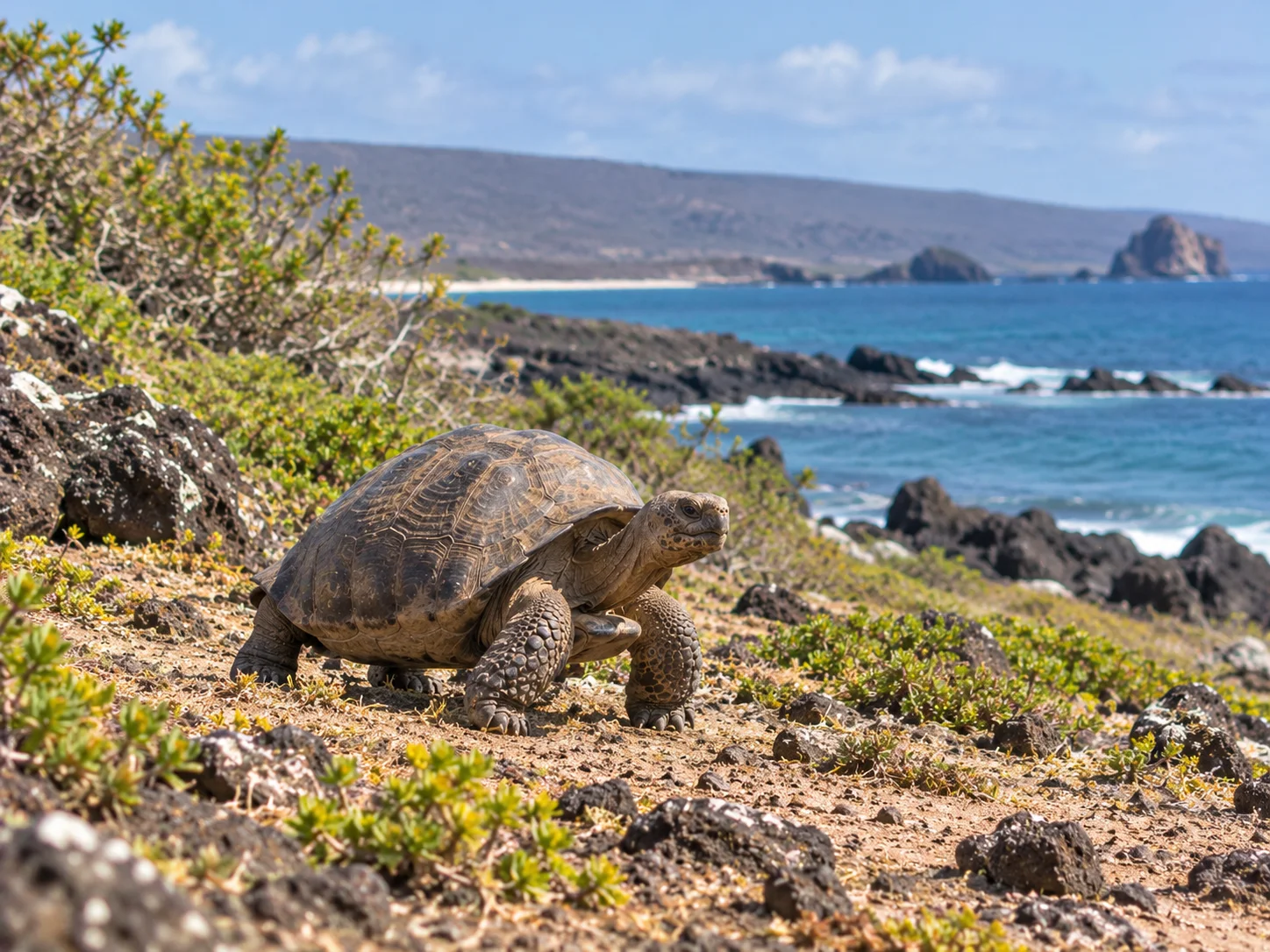
Jonathan, a Seychelles giant tortoise living on St Helena, hatched around 1832. He was already an adult when he arrived on the island in 1882, and he is still alive.
That means he was alive before the telephone, the light bulb, the airplane and both world wars, and he is the oldest known living land animal.
The part worth understanding is why. Tortoises do not simply live long; they appear to age very slowly, with little of the rising death rate that sets in with age in most animals. Biologists call this negligible senescence, and it is one of the genuinely open questions in the study of aging.
Scientific Name and Classification
Tortoises are the family Testudinidae, with about 50 species. The Galapagos giant tortoises are the genus Chelonoidis, and the common Mediterranean spur-thighed tortoise is Testudo graeca.
- Kingdom: Animalia
- Phylum: Chordata
- Class: Reptilia
- Order: Testudines
- Family: Testudinidae
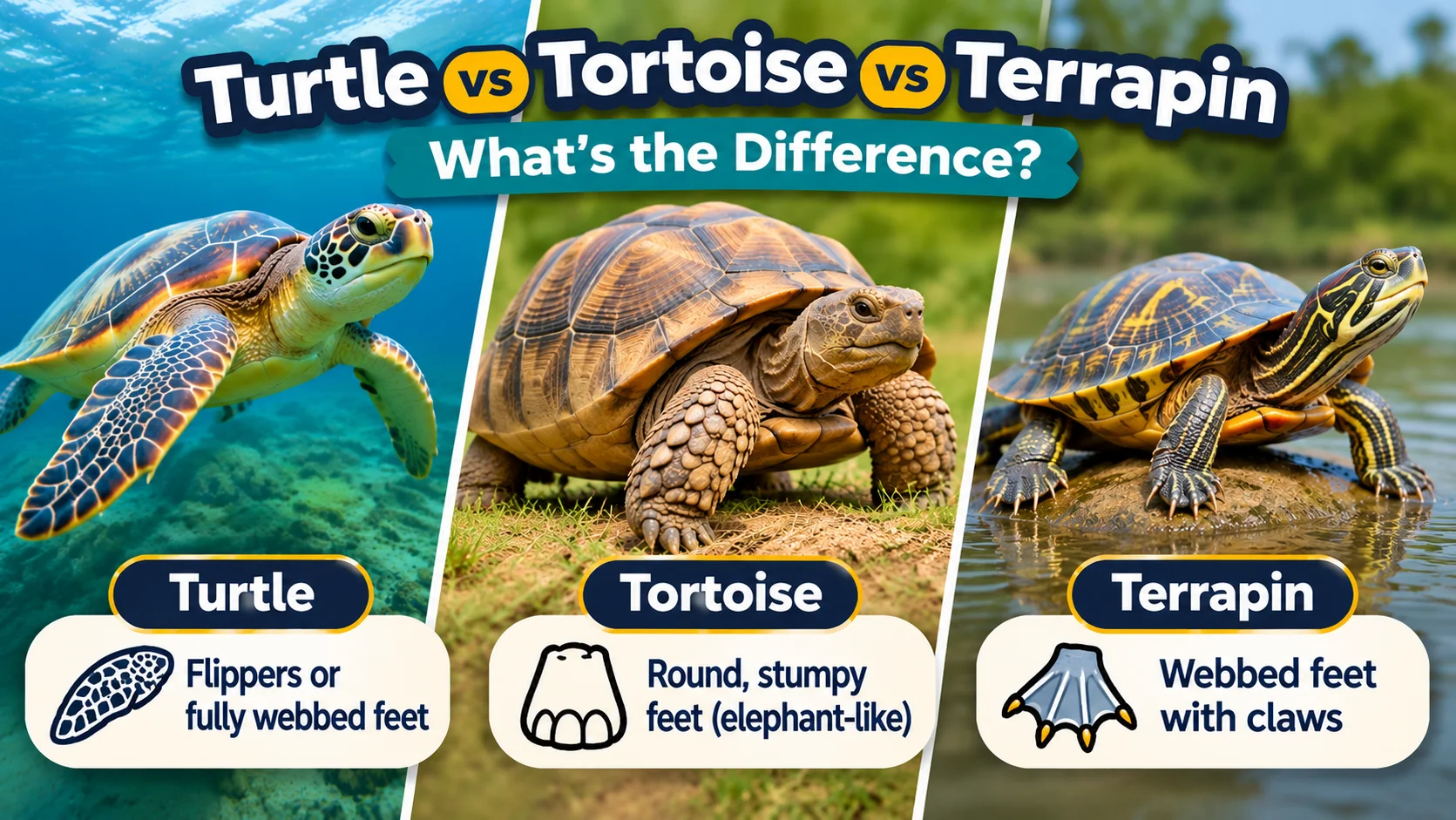
The terminology confuses almost everyone, and the useful distinction is habitat:
- Tortoises live on land, have domed shells and stumpy elephant-like feet with claws, and cannot swim.
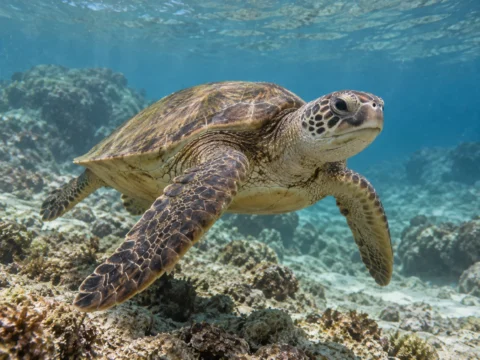
- Turtles are aquatic, with flatter shells and flippers or webbed feet.
- Terrapins are the freshwater middle ground.
All of them are turtles in the broad scientific sense, which is why American usage calls the whole group turtles and British usage separates them. A tortoise is a turtle that gave up on water entirely.
How the Shell Really Works
A tortoise cannot be taken out of its shell, and it is not wearing one. The shell is its skeleton, turned outward.
- It is bone. The upper shell, the carapace, is built from about 50 fused bones including the ribs and parts of the spine, which are attached to the inside of it.
- It is alive. Blood vessels and nerves run through it. A tortoise feels its shell being touched, and a cracked shell is a broken bone that bleeds and can be repaired.
- It is covered in scutes of keratin, the same material as your fingernails, which grow at the edges and add rings.
- It grows with the animal. The tortoise never changes shell, because the shell is part of it.
One consequence of having your ribs fused to a box is that a tortoise cannot expand its chest to breathe. It uses sheets of muscle to pump the organs in and out instead, which is why a tortoise’s limbs move slightly as it breathes.
And a warning about shell rings: you cannot reliably age a tortoise by counting them. Rings reflect periods of growth, not years, and a well-fed captive tortoise adds them faster than a wild one.
Appearance and Anatomy
Tortoises run from the padloper of South Africa at 3 inches and 3 ounces to the Galapagos giant at over 4 feet and 900 pounds.
Shell shape tells you how a tortoise lives. On the Galapagos, tortoises on lush islands have domed shells, while those on dry islands have a saddleback shell raised at the front, which lets the animal stretch its neck up to reach cactus. Darwin was told by the vice-governor that he could identify which island a tortoise came from by its shell, an observation that fed directly into his thinking.
They have no teeth, using a sharp horny beak to shear through plants, and their legs are columnar with heavy claws for digging rather than running.
Many can store water in a bladder for months, which is why a Galapagos tortoise can survive long dry seasons, and historically why whalers could keep them alive in a ship’s hold for a year as fresh meat.
Habitat and Range
Tortoises live in Africa, southern Europe, Asia, South and North America and on islands in the Indian Ocean and the Pacific, mostly in dry habitats: desert, scrub, savanna and dry grassland.
Africa has the greatest diversity. The Galapagos and Aldabra giants are island species, and island isolation is why they got so large, a pattern called island gigantism.
Many are serious diggers. The gopher tortoise of the southeastern United States excavates burrows up to 40 feet long, and the desert tortoise shelters underground through the hottest and coldest parts of the year.
Diet and Feeding
Tortoises are herbivores, eating grass, leaves, weeds, flowers, succulents, cactus and fallen fruit, with some occasionally taking a snail or carrion.
They are built for poor food. The diet is high in fiber and low in energy, so a tortoise eats steadily, digests slowly with the help of gut microbes, and moves slowly because it has no energy to spare. The famous slowness is a consequence of the diet, not laziness.
This is also the single thing most often got wrong by pet owners. Tortoises should not be fed lettuce, fruit or dog food; too much protein and sugar causes a lumpy, pyramided shell and kidney damage. They need coarse, fibrous plants and a calcium source.
They can also go a remarkably long time without eating, living on fat reserves for months.
Behavior and Lifestyle
Tortoises are mostly solitary and almost entirely silent except during mating, when males grunt and bellow.
Being reptiles, they manage temperature by moving: basking in the morning sun to warm up, retreating to shade or a burrow when it gets hot. Temperate species hibernate through winter, and tropical ones may go dormant in the dry season.
They are more capable than they look. Tortoises learn routes and the locations of food and water, remember them for years, and in experiments have learned to navigate mazes and still remembered the solution three months later. Giant tortoises on Aldabra have been observed walking long distances to specific feeding areas at particular times of year.
They also cannot right themselves easily. A tortoise on its back may struggle for a long time, and in hot sun that can be fatal.
Reproduction and Life Cycle
Females dig a nest with their hind legs, lay from 1 to 30 hard-shelled eggs depending on species, cover them, and leave. There is no parental care at all.
Incubation takes 90 to 200 days, and the temperature of the nest decides the sex of the hatchlings, with warmer nests producing females in most tortoises. This makes them unusually exposed to a warming climate, because a few degrees can skew a whole generation.
Hatchlings cut their way out with an egg tooth and are entirely on their own, with soft shells, and most are eaten.
Tortoises mature slowly, at 5 years in small species and 20 to 25 in giants, and then keep breeding for decades. Lifespans run 50 to 100 years for most species, and over 150 for the giants.
Predators and Threats
Adult tortoises have few predators, though eagles are known to drop them onto rocks to break the shell, and hyenas and large cats can crush smaller ones. Eggs and hatchlings are eaten by almost everything: ravens, foxes, mongooses, snakes, monitor lizards, ants and fire ants.
The human list is longer. Habitat loss to farming and development, collection for the pet trade, which remains a major illegal business, hunting for meat, road deaths, and introduced goats, pigs, rats and dogs on islands, which eat the eggs and strip the vegetation.
Island tortoises were devastated by sailors, who took them by the hundreds of thousands as fresh meat that stayed alive in a hold. Several Galapagos populations were lost entirely.
Long life hides the damage. A population of old adults with no surviving young looks healthy for decades while being functionally finished.
Conservation Status
Tortoises are among the most threatened groups of vertebrates on earth. More than half of all species are threatened, and several are down to a few hundred animals.
The worst case is the ploughshare tortoise of Madagascar, Critically Endangered, with a few hundred left and a shell so prized by collectors that conservationists engrave the shells to make them worthless on the black market.
Lonesome George, the last Pinta Island tortoise, died in 2012 after years of failed breeding attempts, and his species went with him.
But the Galapagos also hold the best success. The Espanola tortoise was down to 14 animals. A captive breeding program, including a famously prolific male known as Diego, has returned over 2,000 tortoises to the island, and the program was wound up in 2020 because the population was breeding on its own again.
Role in the Ecosystem
Tortoises are seed dispersers and gardeners. Seeds pass through them intact and germinate better afterward, and on islands where giant tortoises were lost, certain plants stopped spreading, which is why tortoises have been introduced to some islands specifically to restore that function.
The gopher tortoise is a textbook keystone species. Its burrows shelter more than 350 other species, including snakes, frogs, owls, mice and invertebrates, several of which have nowhere else to go, so protecting one tortoise protects an entire community.
Their grazing shapes vegetation, keeping grassland open in a way that suits many other animals.
And they are a standing argument against measuring worth by speed. The tortoise strategy is to be armored, to eat cheaply, to move only as much as necessary and to simply outlast every problem, and it has worked for over 200 million years, through the event that killed the dinosaurs. It is being defeated now only by something that happens faster than a tortoise can respond to.