Meet the Scorpion
Shine an ultraviolet light into the desert at night and the scorpions light up. They glow a vivid blue-green, bright enough that researchers find them by walking around with a UV lamp.
Every scorpion does it. The glow comes from a compound in the hyaline layer of the cuticle, and it appears only after the scorpion’s first molt, so the very newest skin does not fluoresce.
Nobody knows why. The suggestions include using their whole body as a light sensor to judge when it is dark enough to hunt, protection from sunlight, confusing prey, or finding each other. It is a conspicuous property of a very well-studied animal that remains unexplained.
Scientific Name and Classification
Scorpions are the order Scorpiones, with around 2,500 species, so there is no single scientific name. The emperor scorpion, common in the pet trade, is Pandinus imperator, and the deathstalker is Leiurus quinquestriatus.
- Kingdom: Animalia
- Phylum: Arthropoda
- Class: Arachnida
- Order: Scorpiones
Scorpions are arachnids, so they are relatives of spiders, ticks and mites, with eight legs and two body sections. They are not insects.
They are also extremely old. Scorpion fossils go back more than 430 million years, to a time before there were trees, and some of the earliest were aquatic with gills. A scorpion today looks remarkably like one from the Silurian, which is the usual sign of a design that needed very little revision.
How Dangerous Is a Scorpion Sting?
Far less dangerous than the reputation, with a few genuine exceptions.
Of around 2,500 species, roughly 25 to 30 have venom capable of killing a healthy adult human. For the rest, a sting is painful, like a bad wasp sting, and otherwise not serious.
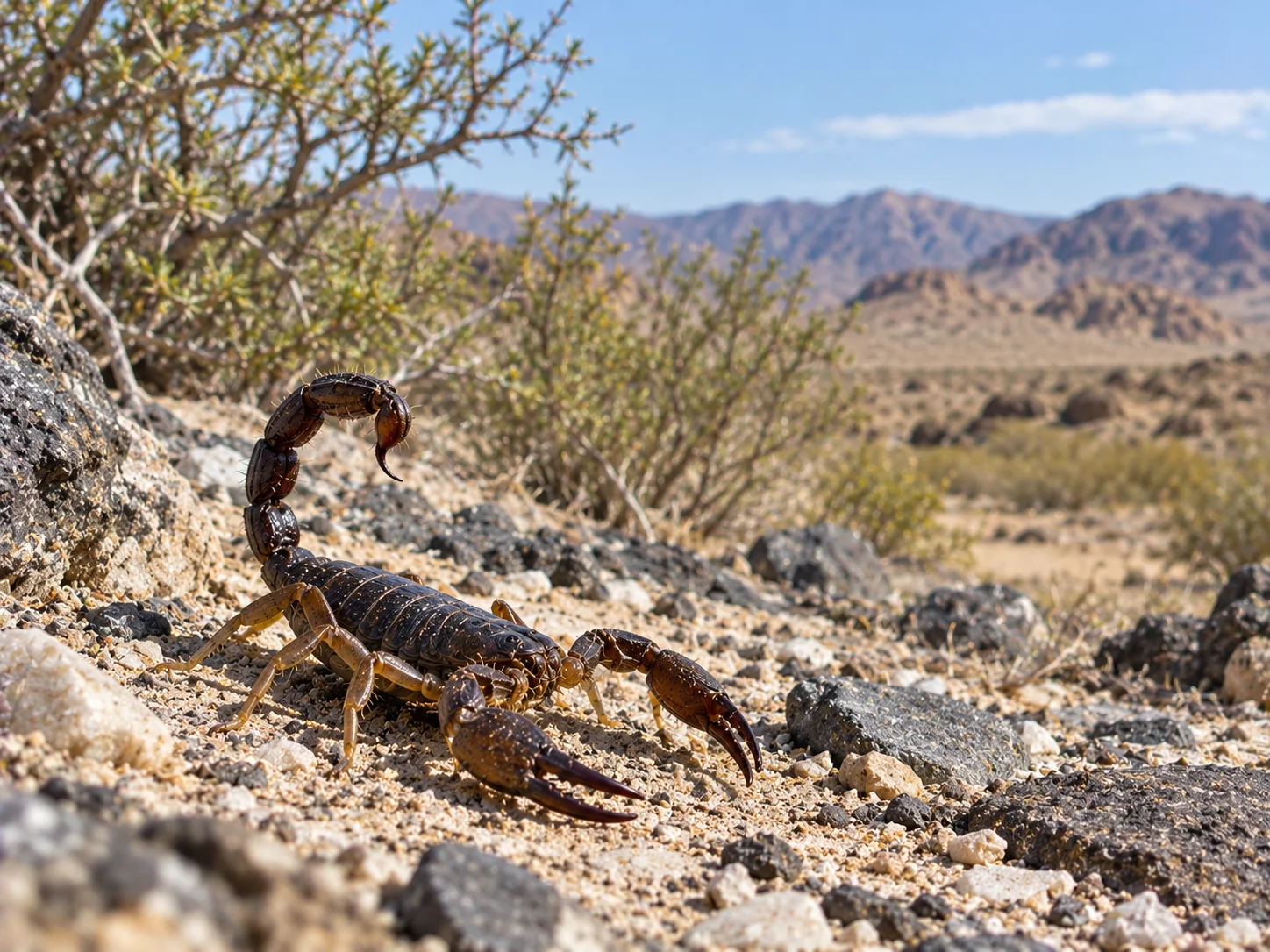
There is also a useful rule of thumb that works surprisingly well. In general, the bigger the pincers, the milder the venom:
- Heavy pincers, thin tail. The scorpion subdues prey mechanically and barely needs venom. The emperor scorpion, one of the largest in the world, has a sting roughly comparable to a bee.
- Slender pincers, thick tail. The scorpion relies on venom instead, and these are the dangerous ones.
The species that cause deaths are mostly in the family Buthidae, in North Africa, the Middle East, India, Mexico and parts of South America. Deaths are concentrated among small children and the elderly, and antivenom is effective where it is available.
Scorpions can also meter their venom, giving a dry sting or a small dose when they only mean to warn, because venom is expensive to produce. A defensive sting is often much weaker than a hunting one.
Appearance and Anatomy
Scorpions range from under half an inch to the 9-inch emperor and giant forest scorpions, and weigh a fraction of an ounce up to about 2 ounces.
- Pincers. Properly called pedipalps, used for grabbing, holding and sensing.
- Tail. Not really a tail but the end of the abdomen, five segments ending in the telson, which holds the venom glands and the sting.
- Eyes. Two in the middle plus two to five pairs along the edge of the head, and despite all that, poor eyesight. Some scorpion eyes are among the most light-sensitive in the animal kingdom, good for navigating by starlight.
- Pectines. Comb-like organs on the underside that are swept across the ground to detect texture, chemicals and vibration.
- Leg sensors. Slit organs that pick up vibration through the sand, letting a scorpion locate a moving insect it cannot see.
They have an exoskeleton and must molt to grow, splitting the old one and emerging pale and soft, which is the most dangerous period of a scorpion’s life.
Habitat and Range
Scorpions live on every continent except Antarctica, and they are not only desert animals, which is the common assumption.
They are found in rainforest, grassland, savanna, caves, high mountains and snowy regions. Some live above 16,000 feet in the Andes and Himalayas, and others survive winters where the ground freezes.
What nearly all of them share is a need for shelter during the day, under rocks, bark, leaf litter or in a burrow, and a tolerance for conditions that would finish most animals. Scorpions have survived being frozen overnight and thawed, and can go a year without food, slowing their metabolism to a fraction of normal.
They lose water extremely slowly, which is the real reason they do well in deserts.
Diet and Feeding
Scorpions are carnivores, mainly eating insects, spiders, centipedes and other scorpions, with the largest species taking lizards, small snakes and mice.
Most are ambush hunters, sitting at a burrow entrance and waiting for the vibration of something walking past, then grabbing it with the pincers and stinging only if it struggles.
They cannot eat solid food. A scorpion tears the prey apart with small appendages at the mouth, floods it with digestive fluid, and sucks up the liquid, discarding the dry remains.
Their efficiency is remarkable. A scorpion’s resting metabolic rate is a fraction of a comparable insect’s, which is how it survives on a handful of meals a year.
Behavior and Lifestyle
Scorpions are nocturnal and mostly solitary, and most species will attack another scorpion on sight, including their own kind.
There are exceptions. Emperor scorpions tolerate groups, and some species overwinter communally in large numbers.
Courtship is a long and careful business. The male grips the female’s pincers and the pair perform a prolonged walk together, sometimes for hours, while he maneuvers her over a sperm packet he has deposited on the ground. He then usually retreats quickly, because females do sometimes eat the male, though it is less routine than with some spiders.
They avoid trouble when they can. The sting is a last resort, and a cornered scorpion will usually try to run or hide first.
Reproduction and Life Cycle
Scorpions do not lay eggs. They give birth to live young, which is rare among arthropods, and gestation runs from several months to over a year and a half depending on species.
A litter of 10 to 100 young is born one at a time, white and soft, and they climb straight onto the mother’s back.
They ride there for one to several weeks, until their first molt, and she carries the whole litter and defends them. This is real maternal care in an animal most people assume has none, and the young cannot survive without it, because they cannot regulate water loss until that first molt.
A few species reproduce without males at all, by parthenogenesis, with females producing daughters that are clones of themselves.
Scorpions molt five to seven times to reach maturity in one to three years, and live 3 to 8 years, with some species reaching 25, which is extraordinarily long for an arthropod.
Predators and Threats
Owls, bats, shrews, mongooses, meerkats, lizards, centipedes, tarantulas and other scorpions all eat them. The grasshopper mouse is a specialist that has evolved resistance to bark scorpion venom, and it kills and eats them routinely.
Meerkats teach their young to handle scorpions, bringing them live prey with the sting removed and gradually increasing the difficulty, which is one of the few clear cases of teaching in a non-human animal.
Human threats are habitat loss, pesticides, and collection for the pet trade and for traditional medicine. A few species are collected heavily for venom, which is valuable: deathstalker venom is one of the most expensive liquids in the world by volume, because milking a scorpion yields a tiny quantity at a time.
Conservation Status
Most scorpions have never been assessed, which is the honest position. Of the roughly 2,500 species, only a small fraction appear on the IUCN Red List at all.
Those assessed as threatened tend to be cave species or others restricted to a single small area, where one quarry or one development can remove the entire population.
The emperor scorpion is listed under CITES because of the pet trade, which collected it in very large numbers.
Scorpions are also a reminder of how much is simply unknown. New species are described regularly, including from well-explored countries, and nobody can say how many there really are.
Role in the Ecosystem
Scorpions are significant predators of insects and spiders, especially in deserts where they can be the most abundant large invertebrate predator, and they are food for a long list of birds, mammals and reptiles.
Their burrowing turns over soil in dry places where few other animals dig.
Their venom is the most valuable thing about them scientifically. It contains hundreds of distinct peptides, each targeting a specific ion channel, and that precision has made it a rich source for medicine. A compound from deathstalker venom binds to certain brain tumour cells and has been developed into a dye that makes tumour edges glow during surgery, so a surgeon can see what to remove. Other scorpion peptides are being investigated for autoimmune disease and pain.
Which is a fair summary of the animal. The scorpion has been doing essentially the same thing for 430 million years, it glows under ultraviolet light for reasons nobody has established, it carries its children on its back, and its venom is being used to show surgeons where a tumour ends.