Meet the Rabbit
A rabbit can see almost all the way around its own head without turning, has a blind spot directly in front of its nose, and sleeps with its eyes open. Rabbits are small plant-eating mammals of the family Leporidae, around 30 species including the European rabbit (Oryctolagus cuniculus) that every pet rabbit descends from.
Everything about a rabbit is built around one fact: a great many things want to eat it.
There are around 30 species of rabbit worldwide. Every domestic rabbit on Earth, from a dwarf to a Flemish giant, descends from one of them: the European rabbit.
Scientific Name and Classification
Rabbits belong to the family Leporidae, which also contains hares. The European rabbit, ancestor of all pet breeds, is Oryctolagus cuniculus.
- Kingdom: Animalia
- Phylum: Chordata
- Class: Mammalia
- Order: Lagomorpha
- Family: Leporidae
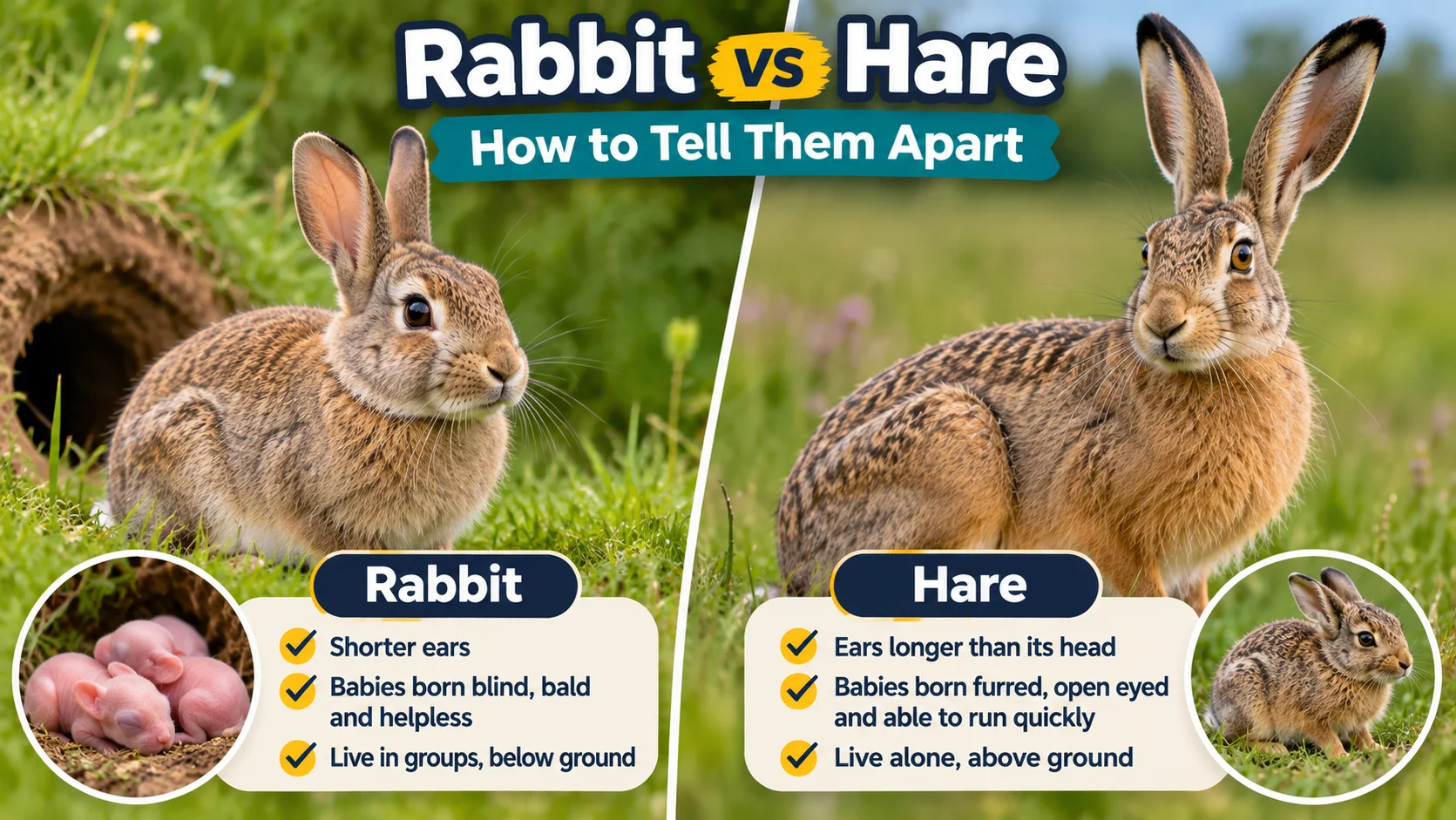
Here is a common mistake: rabbits are not rodents. They were classed as rodents until 1912, then moved into their own order, Lagomorpha, along with hares and pikas.
The giveaway is the teeth. A rodent has two upper front teeth. A rabbit has four: a second small pair sitting directly behind the first, called peg teeth. Nothing in the rodent family has those.
Appearance and Anatomy
Wild European rabbits measure 15 to 20 inches and weigh 3 to 5 pounds. Domestic breeds vary enormously, from dwarfs under 2 pounds to Flemish giants over 20.
- Eyes. Set high on the sides of the head, giving nearly 360-degree vision. The cost is a blind spot right in front of the nose, which is why a rabbit may fumble for food held directly in front of it.
- Ears. Up to 4 inches on a wild rabbit, swiveling independently, and full of blood vessels that shed heat as well as collect sound.
- Teeth. All of them grow continuously, up to 5 inches a year, worn down by constant chewing. A rabbit that stops eating develops serious dental problems fast.
- Hind legs. Long and powerful; a wild rabbit runs at 25 to 35 miles an hour and turns sharply.
- Feet. Thickly furred with no pads, which gives grip on loose soil.
Rabbits sleep with their eyes open, and often while sitting upright, which makes it very hard to tell when one is resting.
Habitat and Range
Rabbits live on every continent except Antarctica, in grassland, woodland edge, meadow, desert and farmland.
European rabbits dig extensive tunnel systems called warrens, with multiple entrances, sleeping chambers and escape routes, dug and maintained by generations of the same colony.
Their spread by people has been catastrophic in places. Twenty-four rabbits released in Australia in 1859 multiplied into hundreds of millions within fifty years, stripping vegetation, causing erosion and pushing native species toward extinction. It is one of the worst invasive animal disasters ever recorded.
Diet and Feeding
Rabbits are herbivores, eating grass, leaves, herbs, bark and roots. Grass and hay make up most of it.
Now for the part that surprises everyone. Rabbits eat their own droppings, and they must.
A rabbit cannot digest grass thoroughly in one pass. So it produces two kinds of dropping. The familiar dry pellets are waste. But it also produces soft, moist ones called caecotrophs, usually at night, and eats those straight from the body. The second pass extracts the vitamins and proteins the first missed.
It sounds unpleasant and it is essential. A rabbit prevented from doing it becomes malnourished.
And despite the cartoons, carrots are not a natural rabbit food. They are high in sugar and should be an occasional treat. Grass and hay are what a rabbit actually needs, partly because chewing them wears the teeth down.
Behavior and Lifestyle
European rabbits are highly social, living in colonies with a clear pecking order. This is why a pet rabbit kept alone is often an unhappy one.
They are most active at dawn and dusk, which is when predators see worst.
They communicate mostly in silence, by posture, ear position and scent. The famous signal is the thump: a hard stamp of the hind foot that warns the whole warren, felt through the ground as much as heard.
A happy rabbit performs a binky, leaping into the air and twisting its body sideways for no reason except that it feels like it.
Rabbits scream only when terrified or badly hurt, and the sound is startlingly like a human child.
Reproduction and Life Cycle
Rabbits breed famously fast, and the numbers justify the reputation.
Pregnancy lasts only about 31 days and produces 4 to 12 kits. A female can become pregnant again within hours of giving birth, and may raise several litters a year.
Kits are born blind, deaf and furless in a nest lined with grass and fur the mother pulls from her own chest.
She visits only once or twice a day, for a few minutes, which looks like neglect and is not. A mother sitting by the nest would advertise it to every predator around, so she stays away deliberately. The milk is extremely rich, so brief feeds are enough.
Wild rabbits live only 1 to 2 years on average; well-kept pet rabbits reach 8 to 12.
Predators and Threats
Almost every meat-eater takes rabbits: foxes, stoats, weasels, badgers, eagles, hawks, owls, snakes, domestic cats and dogs.
Their defenses are vigilance, speed, the warren and sheer numbers. Rabbits survive as a species by being eaten in enormous quantities and replacing themselves faster.
Disease matters enormously. Myxomatosis, deliberately introduced to control rabbits in Australia and Europe, killed well over 90 percent of some populations, and rabbit haemorrhagic disease has had a similar effect.
Conservation Status
Here is a genuine surprise. The European rabbit, the most numerous rabbit on Earth and a pest across several continents, is listed as Endangered in its native range in Spain and Portugal.
Disease and habitat loss have devastated it where it originally comes from, even as introduced populations overrun other countries.
That matters beyond rabbits. The Iberian lynx and the Spanish imperial eagle both depend on rabbits as their main prey, and the collapse of rabbit numbers nearly took both of them with it.
Several other rabbit species are threatened too, including the riverine rabbit of South Africa and the volcano rabbit of Mexico.
Role in the Ecosystem
In their native range rabbits are a keystone species, and the Iberian example shows exactly how much rests on them. Over twenty predator species there eat rabbits, and several cannot survive without them.
Their grazing keeps grassland short and open, which suits many wildflowers, insects and ground-nesting birds, and some rare plants depend on rabbit-grazed turf.
Their burrows shelter other animals, including lizards, insects and burrowing owls, and their digging turns and aerates the soil.
Where they do not belong, all of this reverses. In Australia the same grazing causes erosion and strips native plants, which is the clearest demonstration there is that no animal is simply good or bad for an environment: it depends entirely on where it evolved.