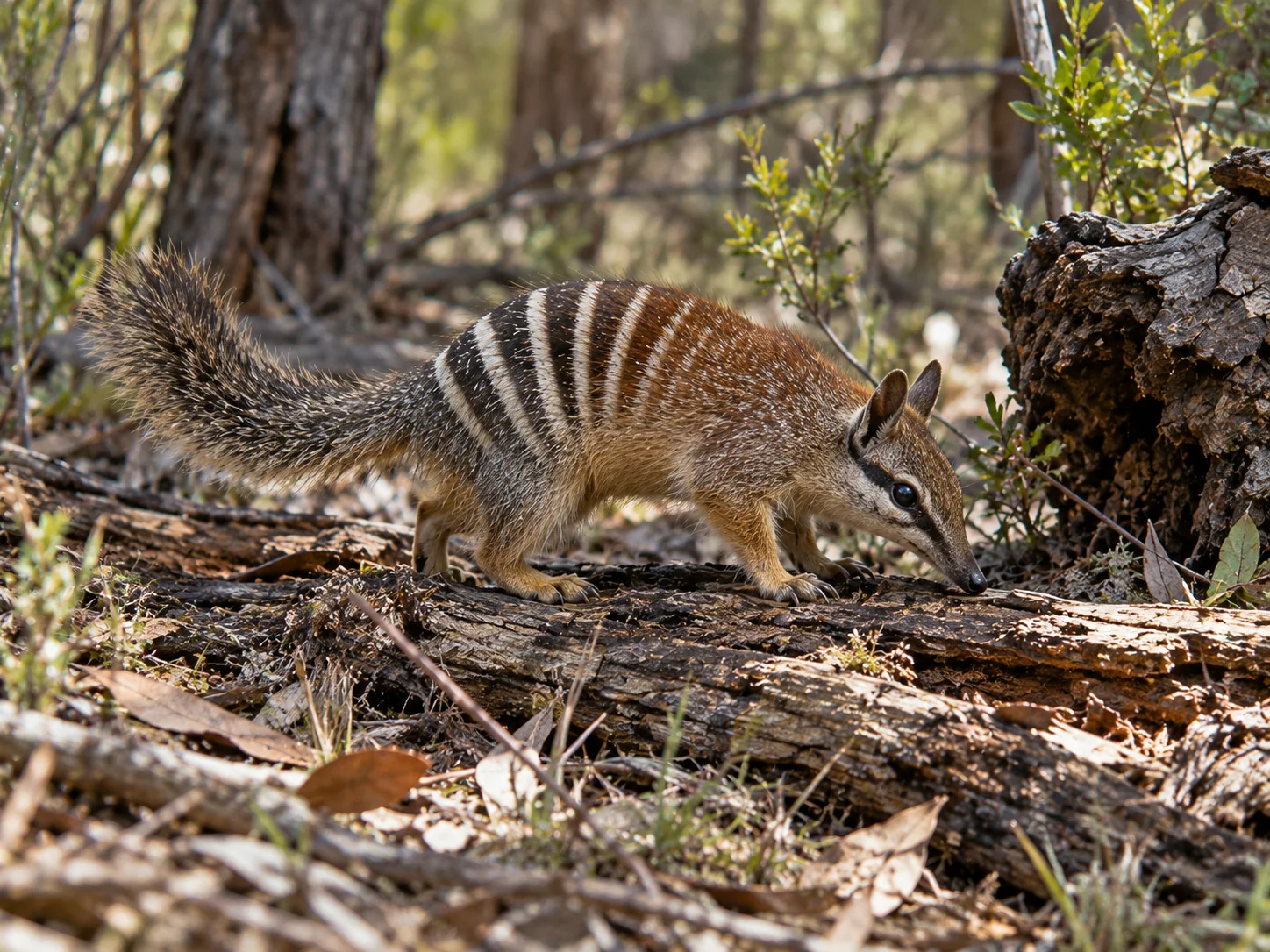
Meet the Numbat
A numbat eats up to 20,000 termites a day. That is its entire job: find termites, lick them up, and keep doing it for as long as the sun is warm enough.
It is a small striped marsupial from Western Australia, the only member of its family, and the only marsupial that is fully active by day. Everything about it is built around one food.
There are fewer than a thousand left in the wild. The animal that did that was a European red fox, released in Australia in the nineteenth century for sport.
Scientific Name and Classification
The numbat is Myrmecobius fasciatus, and it is the sole living member of the family Myrmecobiidae.
- Kingdom: Animalia
- Phylum: Chordata
- Class: Mammalia
- Order: Dasyuromorphia
- Family: Myrmecobiidae
- Genus: Myrmecobius
- Species: Myrmecobius fasciatus
Being the only species in its family means it has no close relatives anywhere. Its nearest kin are the quolls and the Tasmanian devil, which are carnivores, so the numbat is the branch of that group that gave up hunting for insects.
It is sometimes called the banded anteater, which is doubly misleading. It is not related to the anteater of the Americas, and it does not eat ants if it can help it. The resemblance between the two animals is the result of two unrelated mammals solving the same problem.
Appearance and Anatomy
A numbat is 14 to 18 inches (35 to 45 cm) long including the tail, and weighs 10 to 24.5 ounces (280 to 700 g), about the weight of a squirrel.
- Reddish-brown fur with four to eleven white stripes across the rump
- Pointed snout and a dark eye stripe
- Bushy tail often carried upright like a bottle brush
- Long, narrow, sticky tongue
- Strong front claws for opening termite galleries
The tongue is the main tool. It is long and narrow and coated with sticky saliva from unusually large glands under the jaw, and the roof of the mouth is ridged so the numbat can scrape the termites off the tongue on the way back in.
Fifty Teeth That Do Nothing
Here is the oddity. A numbat has up to 50 teeth, more than almost any other land mammal, and they barely work.
They are tiny, set in a weak jaw, and described in the literature as degenerate. A numbat hardly ever chews, because termites are soft and there is nothing to chew, so the teeth have been left to drift out of usefulness without disappearing.
It also carries an extra cheek tooth between its premolars and molars, which no other land mammal has. Nobody is certain what it is for, and the honest answer is that it may not be for anything.
A Marsupial with No Pouch
Numbats are marsupials, but a female has no pouch at all: not a shallow one, not a fold, nothing.
What she has instead is four teats on her belly, protected by a patch of crimped golden hair, with the surrounding abdomen and thighs swelling during nursing to shelter the young. The babies simply hang on.
Four teats and four young per litter is not a coincidence. The number she can raise is set by the number of places there are to feed, which is the same arithmetic that governs the quoll.
Habitat and Range
Numbats once lived across southern, central and western Australia, east as far as the New South Wales and Victorian borders and north into the Northern Territory, across woodland, semiarid scrub, spinifex grassland and sand dunes.
Almost all of that is gone. Wild numbats now survive in a few patches of Western Australia, chiefly Dryandra Woodland and the Tone-Perup Nature Reserve.
They need hollow logs. A numbat sleeps in one, and it uses them as emergency cover when something comes, so forest that has been cleared of fallen timber is no use to a numbat even if the termites are still there.
Why a Numbat Works Day Shifts
Nearly every small marsupial is nocturnal. The numbat is the exception, and the reason is its food.
Termites move through their shallow galleries according to soil temperature, which means they are reachable at particular times of day and not at others. A numbat tracks that schedule, shifting its active hours through the year to match when the termites are closest to the surface.
Being out in daylight has a cost. It makes the numbat visible to every bird of prey in the district, which is why it never strays far from a log it can dive into.
Reproduction and Life Cycle
Breeding happens in February and March, and the pregnancy is extraordinarily short: about 15 days. Four young are born, each barely formed, and crawl to a teat where they stay attached.
A female normally raises one litter a year, with a second possible if the first is lost.
Predators and Threats
Native predators are mostly birds and reptiles: the wedge-tailed eagle, little eagle, brown goshawk and collared sparrowhawk from above, and the carpet python and sand goanna on the ground.
The collapse was caused by something else. The deliberate release of the European red fox in the nineteenth century is believed to have eliminated numbats from the overwhelming majority of their range, and feral cats continue the work.
A daytime animal that weighs under a pound and depends on hollow logs for cover is close to defenseless against either.
Conservation Status
The IUCN moved the numbat to Near Threatened in 2026, though it is still classed as endangered within Australia, and the wild population is under a thousand animals.
The recovery work shows exactly what the problem is, because removing the predators works almost immediately. At Dryandra, numbat numbers went from 5 in 2018 to 10 in 2019 and 35 by November 2020 once cats were excluded, and fox baiting there multiplied sightings forty-fold.
Reintroductions have put numbats back at Yookamurra and the Eyre Peninsula in South Australia, Scotia and Mallee Cliffs in New South Wales, and Mount Gibson in Western Australia. Attempts at Roxby Downs and Newhaven failed, and a Yorke Peninsula project is planned, which is a fair picture of how this work actually goes.
Role in the Ecosystem
Twenty thousand termites a day, animal after animal, adds up to real pressure on termite colonies, and a numbat turning over soil and opening galleries as it feeds disturbs the ground in ways that help it breathe and absorb water.
It is also the faunal emblem of Western Australia, and that is not a trivial detail. The numbat was chosen because people liked it, and being liked is a large part of why the money and effort to save it exist at all.
Which makes it a useful thing to know about. An animal with no close relatives, no pouch, fifty useless teeth and one food source is exactly the kind of species that disappears quietly, and this one has not, because enough people decided it mattered.