Meet the Quoll
Australia is famous for marsupials that eat plants. The quoll is the other kind: a marsupial that hunts.
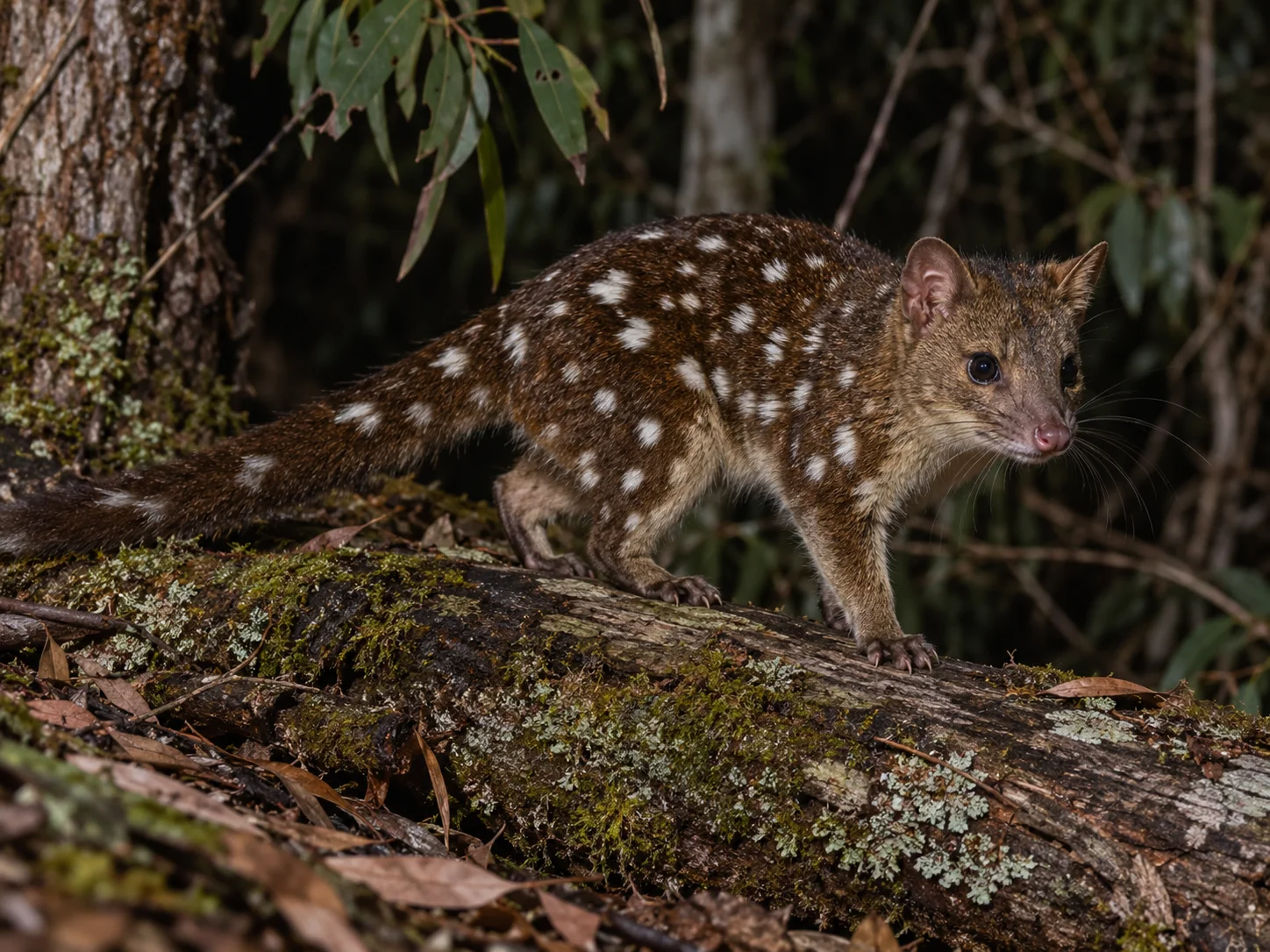
It looks a little like a cat crossed with a possum, covered in white spots, with a long tail and a pointed, whiskery face. It comes out at night, stalks its prey, and climbs well enough to raid a nest high in a tree.
There are six species, and most of them are in difficulty. Two are endangered, one has already vanished from mainland Australia, and one is being killed by a poisonous frog that was brought to the continent on purpose.
Scientific Name and Classification
Quolls make up the genus Dasyurus, which means hairy tail, named in 1796.
- Kingdom: Animalia
- Phylum: Chordata
- Class: Mammalia
- Order: Dasyuromorphia
- Family: Dasyuridae
- Genus: Dasyurus
Dasyuridae is the family of carnivorous marsupials, which also contains the Tasmanian devil and the small mouse-like dunnarts. Being a marsupial puts the quoll closer to a kangaroo than to any cat, however much it resembles one.
The word quoll comes from dhigul, a word in the Guugu Yimithirr language of far north Queensland, written down after Captain Cook’s crew collected the animals in 1770. It then fell out of use in English for nearly two centuries until the naturalist David Fleay brought it back in the 1960s.
The Six Species
Four quoll species live in Australia and two in New Guinea, and they differ enormously in size.
- Spotted-tailed quoll, or tiger quoll (Dasyurus maculatus): the largest, up to about 15 lb; southeastern Australia; Near Threatened
- Eastern quoll (Dasyurus viverrinus): Tasmania only, gone from the mainland since the 1960s; Endangered
- Northern quoll (Dasyurus hallucatus): the smallest, from 11 oz; northern Australia; Endangered
- Western quoll or chuditch (Dasyurus geoffroii): southwestern Australia; Near Threatened
- New Guinean quoll (Dasyurus albopunctatus): New Guinea; Near Threatened
- Bronze quoll (Dasyurus spartacus): southern New Guinea; Near Threatened
Because each species is assessed separately, the genus as a whole carries no single conservation status, though not one of the six is listed as being of least concern.
Appearance and Anatomy
Across the genus, quolls run from 10 to 30 inches (25 to 75 cm) in the body with tails of 8 to 14 inches (20 to 35 cm), and weigh anywhere from 11 ounces (300 g) to 15 pounds (7 kg).
- Brown to black fur scattered with white spots
- Pointed snout with long whiskers
- Sharp teeth built for cutting meat
- Long tail, spotted only in the spotted-tailed quoll
- Ridged pads on the feet for grip when climbing
The spots are the easy way to know a quoll. No other Australian marsupial has white spots scattered over its body, and only one quoll, the spotted-tailed, carries them onto the tail as well, which is the quickest way to tell that species from the rest.
Diet and Hunting
Quolls are carnivores that hunt by stalking, and what they catch depends on how big they are.
The smaller species take insects, birds, frogs, lizards and some fruit. The larger ones go after real prey: birds, reptiles and mammals including possums, rabbits and hares, and a spotted-tailed quoll will tackle an echidna, spines and all. When hunting is poor they will eat carrion rather than go hungry.
Like several Australian animals, a quoll can get all the water it needs from its food, which lets it live in dry country with no reliable drinking source.
Behavior and Lifestyle
Quolls are night animals. They spend the day in a den (a rock crevice, a hollow log, a burrow), and the spotted-tailed quoll prefers rock to wood when it has the choice.
They are largely solitary and keep to themselves, meeting mainly to breed. They do share one habit that reveals a lot about them: quolls use communal toilets, latrine sites on open rock where many animals leave droppings, which works as a noticeboard telling each quoll who else is around.
Reproduction and Life Cycle
Quolls mate in winter and the pregnancy lasts only about 21 days. What follows is one of the harshest arrangements in the animal world.
A female can give birth to as many as 30 young, each about the size of a grain of rice. But she has only six to eight teats, and a newborn that does not reach one and attach to it will not survive. The litter she actually raises is therefore limited not by how many are born but by how many places there are to feed.
The survivors nurse for six to eight weeks. Most quolls have a pouch that is little more than a fold of skin opening toward the tail, developing properly only in the breeding season. The spotted-tailed quoll is the one with a true pouch. Later the mother moves the young into a den. They mature at a year old, and live only one to five years depending on the species.
Threats to the Quoll
The decline of the quolls is mostly a story about animals brought from elsewhere.
Red foxes and feral cats both hunt quolls and compete with them for the same prey, and quoll numbers fell sharply after the fox was introduced. Clearing for housing, mining and farming has taken habitat, bushfires destroy dens, and poison baiting aimed at other pests can kill young quolls too.
Then there is the cane toad. Brought to Queensland in 1935 to control beetles in sugar cane, it spread across the north, and it is poisonous. A northern quoll that catches and eats one is likely to die of it: a predator killed by its own prey, through no fault of its hunting.
Bringing Quolls Back
A good deal of work is going into reversing the quolls’ decline, and some of it is inventive.
In 2010 researchers at the University of Sydney set out to teach northern quolls to leave cane toads alone, offering them a small toad sausage laced with something that caused mild nausea, so the animals learned to associate toads with feeling ill rather than with food.
Elsewhere the approach is more direct. Perth Zoo has bred western quolls since 1989 and produced more than sixty animals for release. Eastern quolls, extinct on the mainland for half a century, were returned to fenced reserves in Victoria in 2003 and the Australian Capital Territory in 2016, though a release at Booderee National Park had failed by 2021, which is an honest reminder that reintroduction often does not work the first time.
Role in the Ecosystem
Quolls are among the few native predators left at their size on mainland Australia, which makes them a check on possums, rats, rabbits and large insects that nothing else fills in quite the same way.
They also clean up. A quoll that eats carrion removes dead animals from the bush, and the species that take fruit move seeds around as they go.
Most of all they are a measure. Quolls need cover, dens, prey and an absence of foxes and cats all at once, so where quolls are doing well a great deal else is working too. Where they have gone, something has usually gone wrong that affects far more than one spotted marsupial.