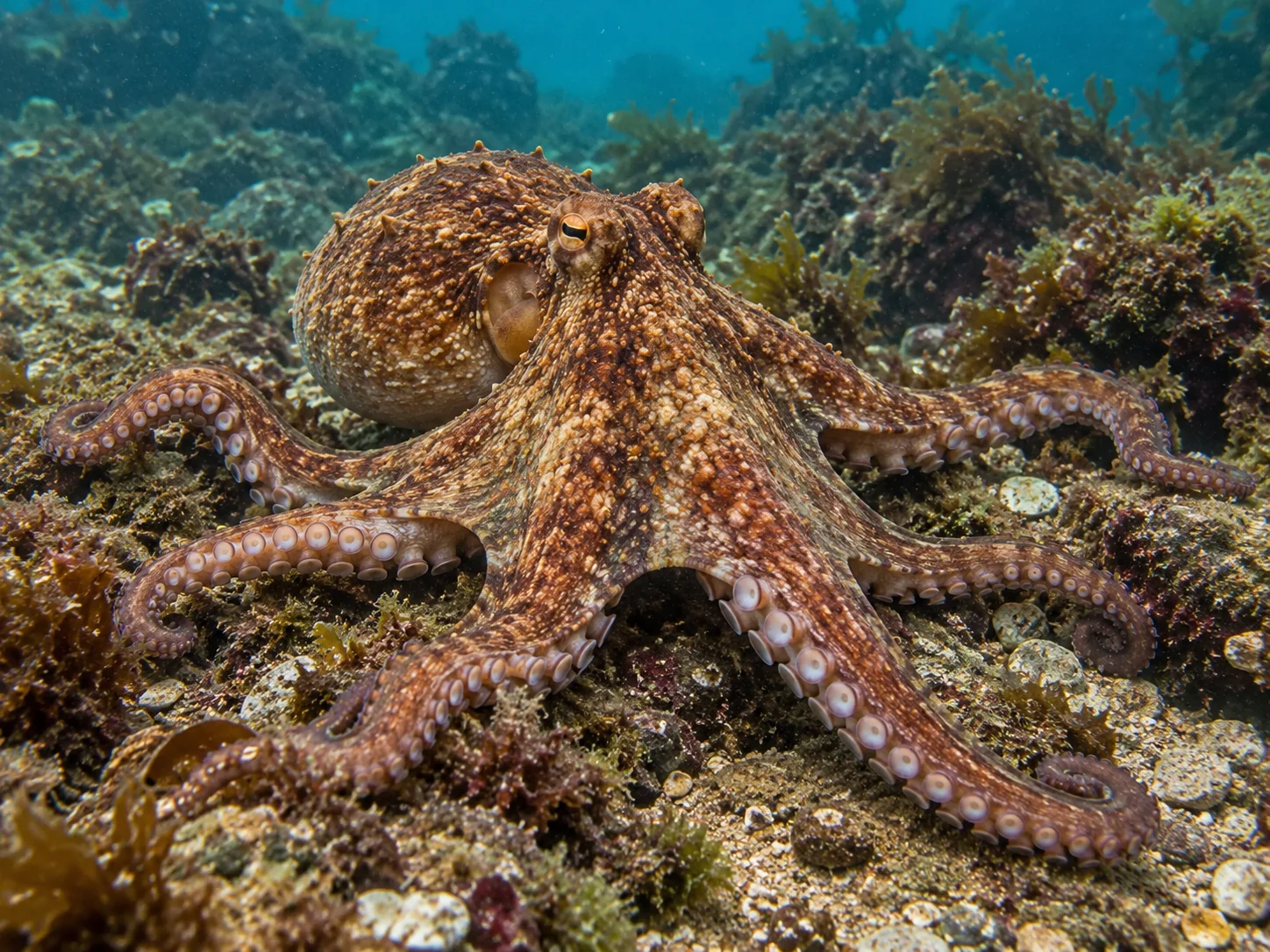
Meet the Octopus
An octopus has three hearts, blue blood, and nine brains of a sort. It can squeeze its whole body through a gap the size of its eyeball, change color and texture in under a second, and open a screw-top jar from the inside.
There are around 300 species, found in every ocean, from tide pools you can reach with your hand to the deep sea.
They are also the cleverest invertebrates known, and their intelligence evolved entirely separately from ours. The last common ancestor we share with an octopus was a simple worm-like creature over 500 million years ago. Whatever is going on in there, it is a solution to thinking that nature arrived at twice.
Scientific Name and Classification
Octopuses form the order Octopoda, so there is no single two-word name for them. Around 300 species sit inside it.
- Kingdom: Animalia
- Phylum: Mollusca
- Class: Cephalopoda
- Order: Octopoda
Being mollusks makes octopuses relatives of snails, clams and oysters, which takes some believing. Their closest kin are the other cephalopods: squid, cuttlefish and the nautilus.
Most mollusks carry a shell. Octopuses gave theirs up entirely, and everything interesting about them follows from that. No shell means no protection, so they had to become fast, flexible, well hidden and clever instead.
On the plural: octopuses is correct and octopodes is defensible. Octopi is not, because the word is Greek rather than Latin, though it is so widely used that nobody will mind.
Appearance and Anatomy
Octopuses range from the star-sucker pygmy octopus at under an inch to the giant Pacific octopus, which spans 14 feet or more and can weigh over 100 pounds.
- Three hearts. Two pump blood through the gills and one pushes it round the body. That third heart stops when the animal swims, which is tiring, and is why octopuses prefer to crawl.
- Blue blood. They use copper-based haemocyanin rather than iron-based hemoglobin. It carries oxygen better in cold, low-oxygen water, and poorly in warm water.
- Eight arms. Not tentacles. Squid have tentacles; an octopus has arms, lined with suckers.
- Suckers. A giant Pacific octopus has around 2,000 of them, each able to move independently, grip, and taste what it touches.
- No bones. The only hard part is the beak, like a parrot’s. If the beak fits through a gap, the whole animal can follow.
- Eyes. Large and sharp, with a rectangular pupil.
How Do Octopuses Change Color?
Here is the strangest fact about octopuses: as far as anyone can tell, they are colorblind. They have a single type of light receptor in their eyes, which should mean they see the world in shades of gray.
And yet they match the color of the seabed almost perfectly, in under a second.
The skin holds millions of tiny sacs of pigment called chromatophores, each pulled open or closed by its own muscles, with reflective layers beneath them. Together they produce color, pattern and brightness on demand.
How a colorblind animal matches colors is still being argued about. One leading idea is that octopus skin itself contains light-sensitive proteins, so the animal effectively senses light through its body rather than only its eyes.
They change texture too, raising bumps and flaps to imitate seaweed or rock. The mimic octopus of Indonesia goes further and impersonates other animals, flattening and coloring itself to pass as a flatfish, a sea snake or a lionfish depending on what is threatening it.
Habitat and Range
Octopuses live in every ocean on Earth, from tropical reefs to Antarctic waters and down to the deep sea floor.
Most are bottom-dwellers, living in dens among rocks, in crevices, in empty shells or in whatever people have dropped. Some deep-sea species swim instead, including the dumbo octopus, which flaps a pair of ear-like fins more than a mile down.
They are fussy about their homes and will pile stones at the entrance of a den, carry shells around as portable shelter, and keep the place tidy, leaving a telltale heap of empty crab shells outside.
Diet and Feeding
Octopuses are carnivores, eating crabs, shrimp, clams, snails, fish and sometimes other octopuses.
Hunting is mostly touch and stealth. An octopus flows over a patch of reef and reaches into every crevice at once, then pulls prey back to the beak at the center of its arms.
Shells are no defense. An octopus can pull a clam open, or drill a neat hole through the shell with its rasping tongue and inject a venom that loosens the muscle. All octopuses are venomous, though only the small blue-ringed octopus is dangerous to people.
They are also problem solvers. Captive octopuses open screw-top jars to reach a crab inside, and will work at the lid for several minutes without giving up.
Behavior and Lifestyle
Octopuses are mostly solitary and often active at dawn and dusk.
Their nervous system is arranged unlike ours. Of around 500 million neurons, roughly two thirds sit in the arms rather than the central brain. Each arm handles a great deal of its own decision-making, and a detached arm will keep reaching for food for a while on its own. The brain decides what to do; the arms largely work out how.
Escape is their specialty. Having no bones, an octopus squeezes through any opening its beak will pass, which is why aquarium tanks need weighted lids. They have been recorded leaving tanks at night, raiding a neighboring tank and returning before morning.
When threatened they jet away by firing water through a funnel, and release a cloud of ink that both hides them and dulls a predator’s sense of smell.
They recognize individual people, and in experiments have squirted water at keepers they apparently disliked while ignoring others.
Reproduction and Life Cycle
Octopus reproduction is extraordinary and rather sad.
They breed once and then die. A male passes a packet of sperm using a specially modified arm, and dies within months. The female lays tens of thousands of eggs in her den and then stops eating entirely, spending every hour guarding them, cleaning them and fanning fresh water over them.
That vigil lasts months, and in one deep-sea species it was recorded at four and a half years, the longest known brooding of any animal. She starves throughout. When the eggs hatch, she dies.
Hatchlings drift as plankton before settling to the bottom, and very few survive.
This is why octopuses live such short lives, mostly one to three years and five at most. An animal this intelligent gets almost no time, and no chance at all to learn from its parents.
Predators and Threats
Plenty of animals eat octopuses: sharks, dolphins, seals, large fish, moray eels, sea otters and seabirds.
Their defenses are camouflage first, then ink and jet propulsion, then squeezing into a crack too small to follow. As a last resort an octopus can shed an arm to escape, and grow it back.
Human pressures are fishing, warming seas and pollution. Warm water holds less oxygen, and because copper-based blue blood carries oxygen poorly when warm, octopuses are more exposed to ocean warming than many animals.
Conservation Status
There is no single status for octopuses, since the order holds around 300 species and most have never been assessed.
The common species caught for food are not currently considered at risk, and octopus fisheries have grown quickly as other fish stocks have fallen.
Proposals for commercial octopus farming have met real scientific opposition, on the grounds that an animal this intelligent and this solitary is poorly suited to being farmed at all.
Role in the Ecosystem
Octopuses sit in the middle of the food web, which makes them unusually important. They are serious predators of crabs, shellfish and small fish, and they are themselves prey for a long list of larger animals.
Their dens matter too. The heaps of discarded shells outside an octopus den, known as middens, create shelter that small creatures move into.
Scientifically they are valuable in another way. Because their intelligence evolved on a completely separate branch of life, studying octopuses is the nearest thing biologists have to examining a second, independent experiment in how to build a mind.