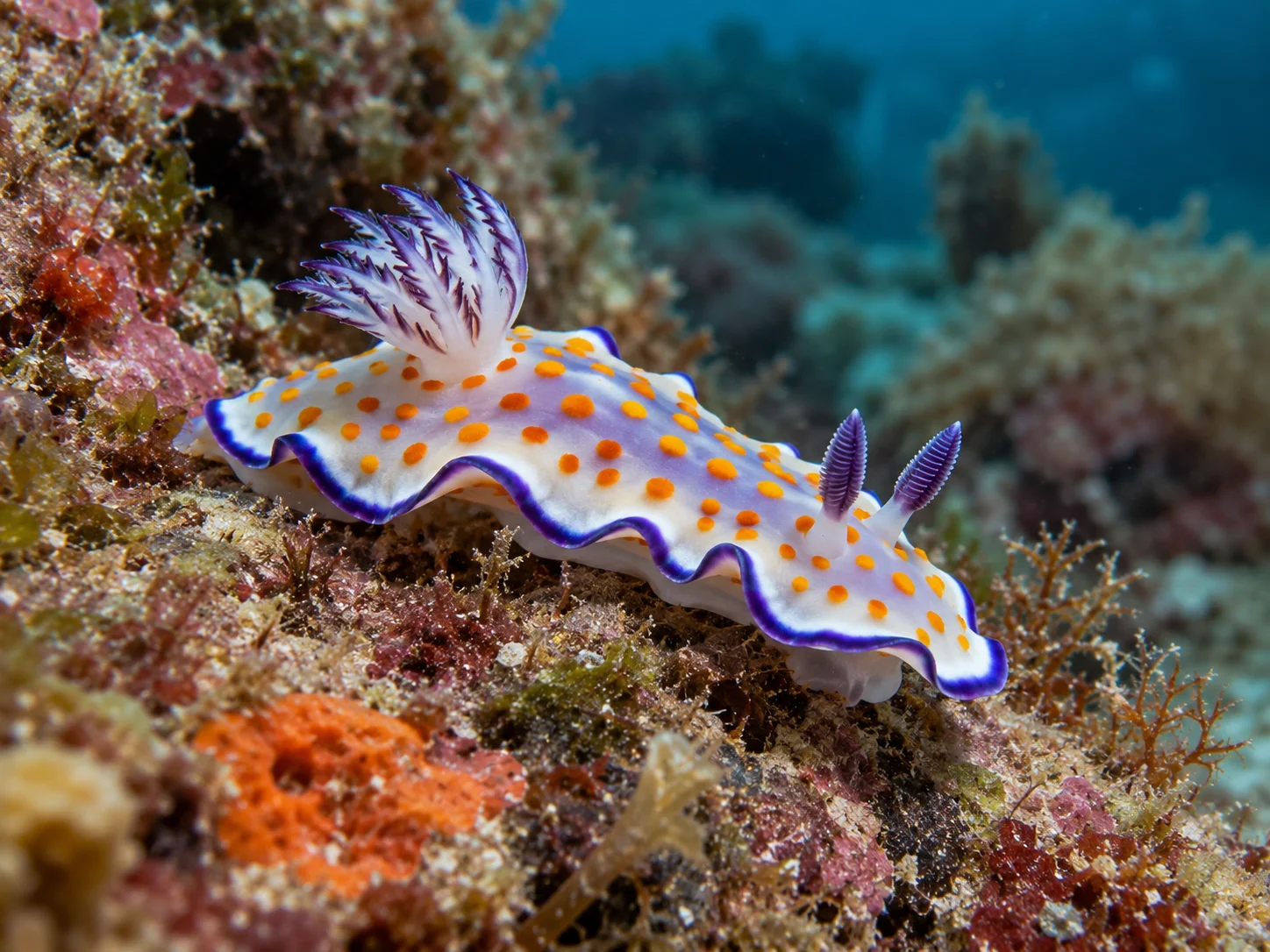
Meet the Nudibranch
A nudibranch is a sea slug that threw away its shell and replaced it with chemistry, theft and color.
Some of them eat animals armed with stinging cells, pass those cells through their own bodies undamaged, and install them in their skin to use as their own weapons. Others swallow living algae and keep it alive inside them, feeding off what it makes.
And they are spectacular. There are around 3,000 species, many of them patterned in colors that look invented (electric blue, orange, white and violet) on an animal with no bones and no shell, crawling slowly across a reef.
Scientific Name and Classification
Nudibranchs are the order Nudibranchia, a group of marine snails that have lost their shells.
- Kingdom: Animalia
- Phylum: Mollusca
- Class: Gastropoda
- Order: Nudibranchia
The name is literal: from Latin for naked and Greek for gills, because their gills are carried on the outside of the body rather than tucked under a shell.
Being gastropods makes them relatives of the garden snail and the octopus, the first closely, the second more distantly, since both are mollusks. The shell is not missing by accident. Nudibranchs gave it up over evolutionary time and built other defenses instead.
Appearance and Anatomy
The size range is enormous for one group: adults run from 0.16 inches to nearly 24 inches (4 to 600 mm). Most are a few inches at most.
- Soft body with no shell and no operculum in adults
- A pair of club-shaped rhinophores on the head
- Cerata, the finger-like projections along the back in many species
- Exposed gills
- Patterns from near-invisible camouflage to extreme contrast
The rhinophores are the two stalks that make a nudibranch look faintly like a rabbit. They are smell organs, reading chemicals in the water, which is how an animal that moves at this speed finds food that does not move either.
The cerata do several jobs at once. They increase the surface of the body, so they take over gas exchange in place of proper gills, and in some species they are venomous and work as a deterrent, which is where the stolen weapons end up.
Stealing Weapons
Several nudibranchs feed on hydroids and their relatives, which defend themselves with nematocysts, microscopic capsules that fire a sting on contact.
The nudibranch eats them without setting the stings off. The nematocysts travel through its gut unfired and undigested, and are then moved to the back of the body and stored in the cerata, where they stay functional and sting whatever touches the slug.
How the animal avoids triggering them on the way through is still not fully understood. What is clear is the result: an animal with no shell and no speed, carrying borrowed weapons it did not have to grow.
Borrowing Algae
A second kind of borrowing happens in some species. Certain nudibranchs take in living algae or plant cells from the soft corals they eat, and some host zooxanthellae, the same single-celled algae that live inside reef corals.
Those algae keep photosynthesizing inside the slug, and the slug feeds on what they produce. It is an animal getting part of its living from sunlight.
Worth being precise here, because this gets exaggerated. Nudibranchs take in whole algal cells; they do not strip out chloroplasts and keep those running, which is a trick belonging to a different group of sea slugs altogether.
Habitat and Range
Nudibranchs live in every sea on Earth, from the Arctic to the Southern Ocean, and almost never in fresh water.
They occur from the intertidal zone down past 2,300 feet (700 m), and one species has been found at around 8,200 feet (2,500 m). Variety peaks where you would expect: warm, shallow, well-lit reefs.
Most crawl along the bottom. A few swim in open water, and one, the blue dragon, spends its life floating upside down at the surface.
Diet and Feeding
Every known nudibranch is a carnivore. They eat sponges, hydroids, bryozoans, tunicates, barnacles, anemones and each other.
Most are specialists, working on one kind of prey, and that specialization is what produces the colors. An animal that lives on one sponge can match that sponge exactly and vanish; an animal that has taken on its prey’s toxins or stings can afford to advertise instead.
Both strategies appear across the group, and in some species the bright coloring is thought to be a warning. That reading is debated, since it is hard to prove what a fish understands by a pattern, but the pattern itself is not in doubt.
Reproduction and Life Cycle
Nudibranchs are hermaphrodites: every adult carries both male and female organs. They cannot fertilize themselves, so two animals still have to find each other, but when they do, either one can play either part, which doubles the chances for a slow animal in a big ocean.
The shell makes one brief appearance. Most species hatch as a swimming larva that does have a small coiled shell, and it is discarded at metamorphosis, a reminder in every individual life of what the group used to be.
Lives are short. Depending on species, a nudibranch lives from a few weeks to about a year.
Role in the Ecosystem
Because most nudibranchs specialize in one prey, they act as a check on particular sponges, hydroids and anemones, which keeps any one of them from overrunning a patch of reef. Remove the slugs and the balance shifts.
They are useful to people too, in an unexpected way. Their chemical defenses, borrowed and manufactured, have made them a hunting ground for pharmaceutical research, since an animal that handles potent compounds safely is worth understanding.
Mostly, though, the nudibranch is proof of a point about evolution. Giving up armor looks like a terrible idea, and this group did it anyway, then solved the resulting problem with poison, borrowed stings, camouflage and bluff, and ended up as some of the most extravagant animals in the sea.