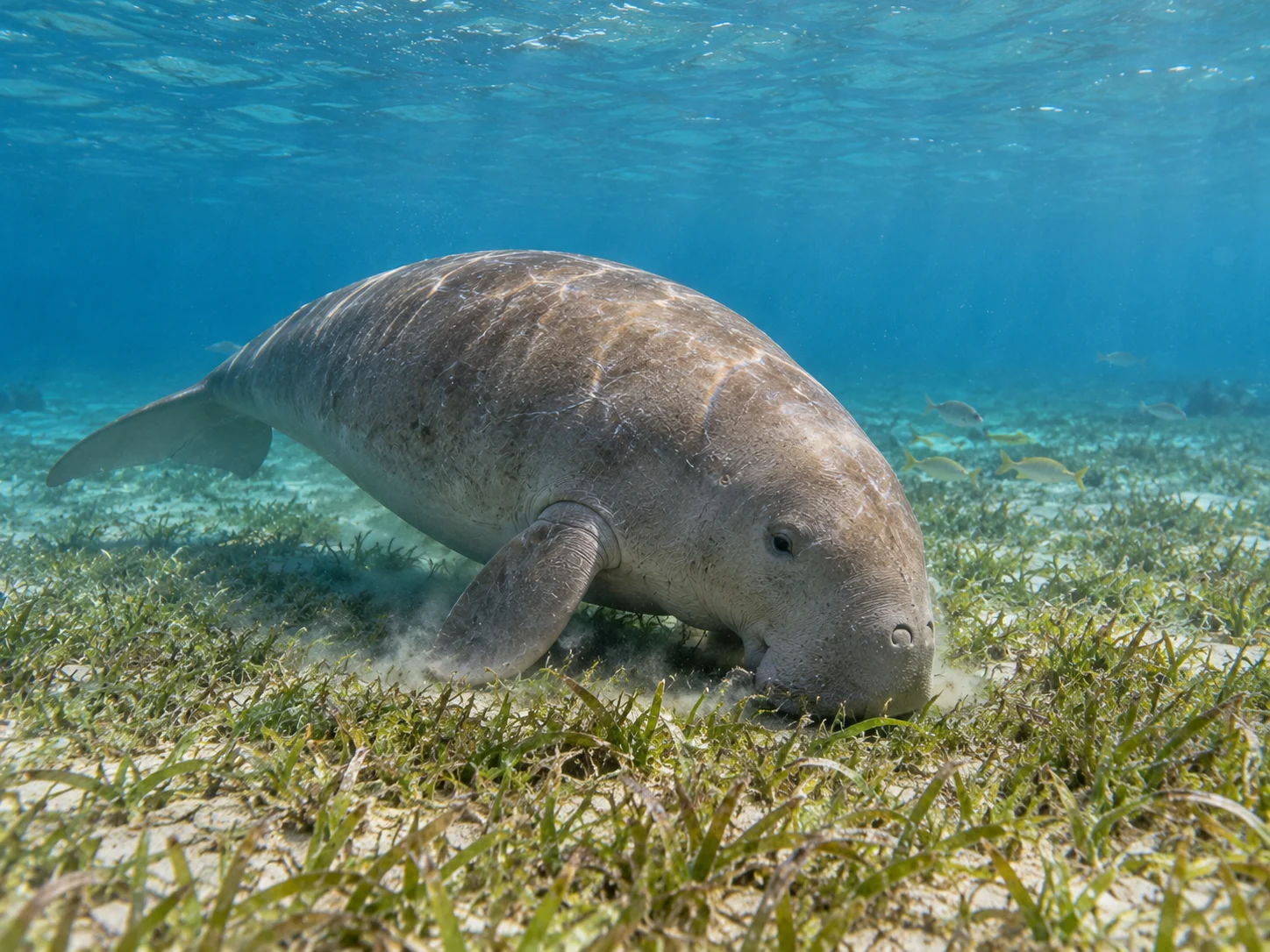
Meet the Dugong
The mermaid legend probably starts here. Sailors across the Indian Ocean and the Red Sea reported seeing creatures that held their young to the chest with a flipper and rose vertically out of the water to breathe, and the dugong does both of those things.
Its scientific order is named for the story. Sirenia, from the sirens of Greek myth. Columbus recorded manatees on his voyages and noted that they were nowhere near as beautiful as described, which is the most honest thing anyone has said about the legend.
The real animal is better than the myth: a 600-pound marine mammal that eats nothing but seagrass, lives for seventy years, and is the closest living relative of the elephant.
Scientific Name and Classification
The dugong is Dugong dugon, the only living member of its family and the only living species in its genus.
- Kingdom: Animalia
- Phylum: Chordata
- Class: Mammalia
- Order: Sirenia
- Family: Dugongidae
- Species: Dugong dugon
Sirenia contains just four living species: the dugong and three manatees. Its closest relatives outside the order are elephants and hyraxes, which share a land ancestor with them from about 50 million years ago.
The family used to have a second member, and its fate is worth recording. Steller’s sea cow was a 30-foot, 10-ton dugong relative discovered in the Bering Sea in 1741 by a shipwrecked expedition. Hunters followed. It was extinct by about 1768, roughly 27 years after Europeans first described it, which is one of the fastest documented extinctions of a large mammal.
Appearance and Anatomy
Dugongs are 8 to 11 feet long and weigh 500 to 925 pounds (230 to 420 kg), with exceptional animals heavier.
- Snout. A broad muscular upper lip covered in sensitive bristles, used to detect and uproot seagrass, working much like an elephant’s trunk tip.
- Tusks. Males grow a pair of incisor tusks that erupt at maturity and are used in competition. The growth layers in them can be counted to age an animal, like tree rings.
- Bones. Extremely dense and heavy, with no marrow cavity in the ribs, which acts as ballast and keeps a grazing animal down on the bottom.
- Skin. Thick, tough and smooth, with sparse short hairs.
- Lungs. Set along the back rather than beneath, which helps hold the body horizontal while feeding.
They have poor eyesight and excellent hearing, and they can hold their breath about six minutes while usually surfacing every few minutes at rest.
Habitat and Range
Dugongs live in warm shallow coastal waters across about 40 countries, from East Africa and the Red Sea through the Gulf, India and Southeast Asia to northern Australia and the western Pacific.
Their entire distribution is decided by one thing: seagrass. Dugongs eat almost nothing else, so they live where seagrass meadows grow, in shallow sheltered bays, mangrove channels and reef lagoons.
Australia holds the great majority of the world’s dugongs, with large populations in Shark Bay, Moreton Bay and the Great Barrier Reef region, and the Torres Strait holds one of the largest aggregations anywhere.
Elsewhere the picture is of fragments. Many of the 40 range countries now hold only a few dozen animals, and populations in parts of Southeast Asia and the western Indian Ocean are close to gone, with the species considered functionally lost from Chinese waters.
Diet and Feeding
Dugongs are herbivores and seagrass specialists, eating 60 to 90 pounds of it a day, and they are the only marine mammal that is a strict herbivore of this kind.
They are properly called grazers for a reason. A dugong uses its bristled upper lip to uproot whole plants, rhizomes and all, leaving distinctive feeding trails in the meadow that can be seen from the air and are used to survey them.
They prefer the low-fiber, nutrient-rich seagrass species, and there is evidence they return to the same patches repeatedly, cropping them in a way that favors the species they like best. That is cultivation grazing, and it means dugongs partly shape the meadows they depend on.
Because seagrass is poor food, they must eat enormous quantities, and they digest it slowly with gut microbes and an extremely long intestine.
Behavior and Lifestyle
Dugongs are usually seen alone or in pairs, typically a mother and calf, though they gather in large herds where seagrass is abundant, and herds of hundreds have been recorded in Australia.
They are slow and placid, cruising at about 6 miles an hour, and shy of boats and divers.
They communicate with chirps, whistles, barks and trills that carry well underwater, and mother and calf keep contact by sound.
They move in response to their food rather than on a fixed migration, and satellite tracking has recorded dugongs traveling hundreds of miles when a seagrass meadow is damaged, which is both a strength and a risk, since an animal crossing open coast is exposed to nets and boats the whole way.
Reproduction and Life Cycle
Dugong reproduction is slow enough that it governs everything about their conservation.
Females do not breed until 6 to 17 years old, gestation lasts 13 to 15 months, and a single calf is born. The mother then nurses it for about 18 months, and the calf stays with her for up to two years.
Between calves she waits three to seven years, and she may skip breeding entirely when seagrass is poor. Over a lifetime of seventy years a female may raise only a handful of calves.
Calves swim immediately and ride just above the mother’s back, and they begin eating seagrass within weeks while continuing to nurse.
Dugongs live 60 to 70 years, and the oldest recorded was 73, aged by counting growth layers in a tusk.
Predators and Threats
Tiger sharks, orcas and saltwater crocodiles take dugongs, mostly calves, and many adults in Shark Bay carry shark scars.
The real problems are all human, and gill nets lead the list. A dugong caught in a net drowns, and bycatch in gill nets and shark nets is the largest single cause of dugong deaths across their range.
Then comes the loss of the seagrass itself, to coastal development, dredging, agricultural runoff that clouds the water, and cyclones. The clearest case is Queensland in 2011, when floods and a cyclone destroyed large areas of seagrass and dugong deaths rose sharply the following year while breeding almost stopped. Starving dugongs simply do not reproduce.
Boat strikes, hunting, and oil and chemical pollution add to it. Dugongs are legally hunted by some Indigenous communities under traditional rights, which is a genuinely difficult issue that is best handled through co-management rather than prohibition, and several Australian and Torres Strait communities now run their own monitoring and catch limits.
Conservation Status
The dugong is listed as Vulnerable globally, and that global figure hides a much worse regional picture, which is the important thing to understand about it.
Australia’s populations are substantial and comparatively secure. Outside Australia, most are small, fragmented and declining, and in 2022 the dugong populations of East Africa and New Caledonia were assessed as Critically Endangered and Endangered respectively, the first time the species had been listed at that level anywhere.
Because females breed so rarely, a population losing even a small number of adult females each year will decline, and modeling suggests that a loss of just a few percent of adults annually is enough to push a dugong population down. There is almost no margin.
What works is net restrictions in seagrass areas, protecting seagrass from runoff and dredging, boat speed limits, and co-management with the communities that live alongside them.
Role in the Ecosystem
Dugongs are the main large grazer of tropical seagrass meadows, and their grazing keeps those meadows productive, recycles nutrients, and favors the faster-growing seagrass species.
That matters more than it sounds, because seagrass meadows are among the most valuable habitats in the ocean. They are nurseries for fish and prawns that coastal fisheries depend on, they stabilize sediment and protect shorelines, and they store carbon in their sediments at rates per acre comparable to or better than forest.
So protecting dugongs means protecting seagrass, which means protecting fisheries, coastlines and a carbon store at the same time. Few animals come with that much attached.
And the Steller’s sea cow should stay in mind. The dugong’s only close relative was found in 1741 and gone by 1768, hunted out in under thirty years by people who had no idea they were doing anything irreversible. The dugong is slower to breed than almost any marine mammal, and it is being lost in the same quiet, unremarkable way: a few animals in nets each year, and a little less seagrass each decade.