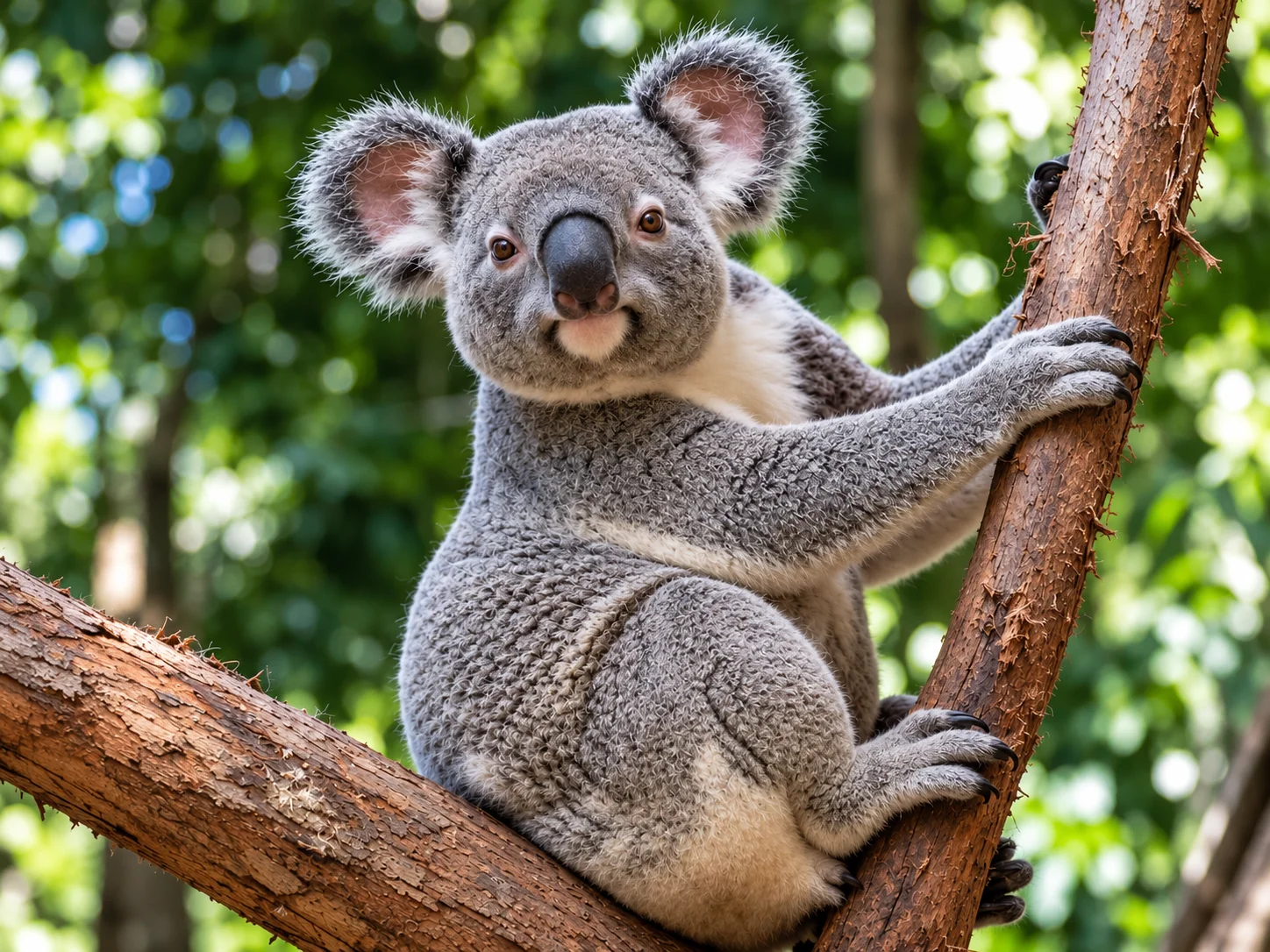
Meet the Koala
A koala sleeps 18 to 22 hours a day. That is not laziness, it is arithmetic: eucalyptus leaves contain so little energy and so much toxin that a koala can barely afford to move.
It is also not a bear. Koalas are marsupials, carrying their young in a pouch, and their nearest relative is the wombat.
They are one of the most specialized animals alive. A koala eats the leaves of a handful of eucalyptus species and nothing else, which worked beautifully until people started removing those trees.
Scientific Name and Classification
The koala’s scientific name is Phascolarctos cinereus. It is the only living species in its family, Phascolarctidae.
- Kingdom: Animalia
- Phylum: Chordata
- Class: Mammalia
- Infraclass: Marsupialia
- Order: Diprotodontia
- Family: Phascolarctidae
- Species: Phascolarctos cinereus
The name is a muddle of two languages: phascolarctos is Greek for “pouch bear” and cinereus is Latin for “ash-colored”. Even the scientists called it a bear.
It is not one. Koalas share the order Diprotodontia with wombats, kangaroos and possums, and the wombat is the closest relative of all.
Why Do Koalas Sleep So Much?
Because of what they eat.
Eucalyptus leaves are tough, fibrous, low in nutrition and poisonous to most animals. A koala has solved all three problems, but the solutions are expensive.
Its liver breaks down the toxins, which takes energy. Its gut holds a fermentation chamber called a caecum, around 6 feet long and proportionally the largest of any mammal, where bacteria slowly break the fiber down. Digesting a meal can take over 100 hours.
The result is an animal running on a very thin energy budget. Sleeping 18 to 22 hours a day is how the sums balance, and it is why koalas move slowly and look permanently drowsy.
They are not drugged or drunk, as the old story claims. They are simply conserving every calorie they have.
Appearance and Anatomy
Koalas stand about 2 to 2.8 feet tall and weigh 9 to 33 pounds. Southern koalas in Victoria are noticeably larger and furrier than northern ones in Queensland, which are smaller and lighter gray.
- Hands. Two thumbs on each front paw, opposing three fingers, for gripping branches. The back feet have two toes fused together, which make a comb for grooming.
- Fingerprints. Koalas have them, and they are so similar to human prints that they can confuse forensic examiners. We evolved them completely separately.
- Nose. Large, leathery and the koala’s main sense. It smells leaves to judge which are safe to eat.
- Fur. Dense and wool-like, waterproof on the back, and thickest on the rump, which doubles as a cushion for sitting in forks of trees.
- Teeth. Sharp front teeth to snip leaves, back teeth that grind them to paste.
The brain is unusually small for the body, smooth rather than folded, which is thought to be another energy saving.
Habitat and Range
Koalas live only in eastern and southeastern Australia, in eucalyptus woodland and forest across Queensland, New South Wales, Victoria and South Australia.
They need the right trees, not just any gum trees. Of more than 700 eucalyptus species, koalas feed on a few dozen and prefer a handful, and those preferences vary by region.
Each koala uses a home range of particular trees it returns to, which is why clearing even part of a woodland can push an animal out even though trees remain.
Diet and Feeding
Koalas are herbivores and eat almost nothing but eucalyptus leaves, around 1 to 1.5 pounds a day.
They are extremely particular. A koala sniffs leaves before eating and rejects most of them, choosing by species, by individual tree, by season and by the age of the leaf. Older leaves carry more toxin.
Despite the name, koalas do drink, especially in heat and drought, and have been seen licking rain off tree trunks. The old claim that they never need water is not quite right; most of the time they simply get enough from leaves.
Behavior and Lifestyle
Koalas are solitary and mostly nocturnal, spending the day wedged in a fork of a tree and feeding after dark.
Males hold overlapping territories and mark trees by rubbing a scent gland on the chest against the bark.
The sound surprises everyone. A male koala makes a deep bellowing growl, far lower than an animal that size should manage, using an extra pair of vocal folds found in almost no other land mammal. A rival hearing it judges the caller’s size from the pitch.
They also hug trees to keep cool. On hot days koalas press against the trunk of a tree, which can be several degrees cooler than the air, and lose heat straight into the wood.
Reproduction and Life Cycle
Pregnancy lasts only 33 to 35 days. The newborn joey is about the size of a jellybean, blind and hairless, and crawls unaided into the pouch, where it stays attached to a teat for around six months.
The koala pouch opens downward rather than upward, which seems alarming until you know it has a muscle at the opening that holds the joey in.
Then comes the part people find startling. Before a joey can eat eucalyptus it must acquire the gut bacteria that make the leaves digestible, and it gets them by eating a soft form of its mother’s droppings called pap. Without that step the leaves would simply poison it.
Joeys ride on their mother’s back until about a year old. Koalas live 10 to 15 years in the wild, less for males, who fight.
Predators and Threats
Dingoes, large owls and goannas take koalas, particularly young ones, but natural predation is not what is driving numbers down.
The real threats are these:
- Habitat loss. Clearing for farming, housing and roads removes the particular trees a koala depends on.
- Bushfire. Slow-moving animals in flammable trees fare badly. The 2019 to 2020 Australian fires killed or displaced tens of thousands.
- Disease. Chlamydia is widespread in wild koalas and causes blindness, urinary disease and infertility. A koala retrovirus weakens their immune systems further.
- Cars and dogs. Koalas crossing open ground between trees are killed in large numbers near towns.
- Drought and heat. Hotter, drier conditions reduce the water content of leaves, so koalas dehydrate.
Conservation Status
The koala is listed as Vulnerable on the IUCN Red List, and in 2022 Australia upgraded its own listing to Endangered for the populations in Queensland, New South Wales and the Australian Capital Territory.
Numbers have fallen sharply in the north while some southern populations, in parts of Victoria and South Australia, are stable or even overcrowded on islands where they were introduced.
Conservation work focuses on protecting and replanting the right eucalyptus species, building wildlife corridors and crossings, treating chlamydia, and running hospitals for injured animals. A vaccine for koala chlamydia has been trialled with promising results.
Role in the Ecosystem
Koalas prune the eucalyptus canopy as they feed, and their droppings return nutrients to the forest floor, feeding insects and fungi that break them down further.
Their larger value is as a flagship. Koalas are popular enough that protecting them attracts funding and public support, and the eucalyptus woodland saved for koalas shelters gliders, possums, owls, bats and a great many insects that would never raise a campaign of their own.
They are also an indicator. Because koalas need particular trees in connected patches, a landscape still holding healthy koalas is a landscape that has kept its woodland intact.