Meet the Anteater
A giant anteater has no teeth at all, and a mouth that opens barely wider than a pencil. It eats up to 30,000 ants and termites a day. Anteaters are toothless, ant-eating mammals of the suborder Vermilingua, native to Central and South America.
It does this with a tongue two feet long, anchored to its breastbone rather than inside its mouth, which it flicks in and out around 150 times a minute. Each flick is coated in sticky saliva, and the insects are swallowed whole and ground up by a stomach that does the work teeth would.
At a single nest it feeds for only about a minute before moving on, which turns out to be the key to the whole animal.
Scientific Name and Classification
There are four species of true anteater, in the suborder Vermilingua, which means worm tongue. The giant anteater is Myrmecophaga tridactyla; the silky anteater and two tamanduas make up the rest.
- Kingdom: Animalia
- Phylum: Chordata
- Class: Mammalia
- Order: Pilosa
- Suborder: Vermilingua
- Species: Myrmecophaga tridactyla and relatives
Their closest relatives are sloths, which share the order Pilosa with them, and more distantly armadillos. All belong to an ancient South American group called Xenarthra that evolved in isolation while the continent was separated from the rest of the world.
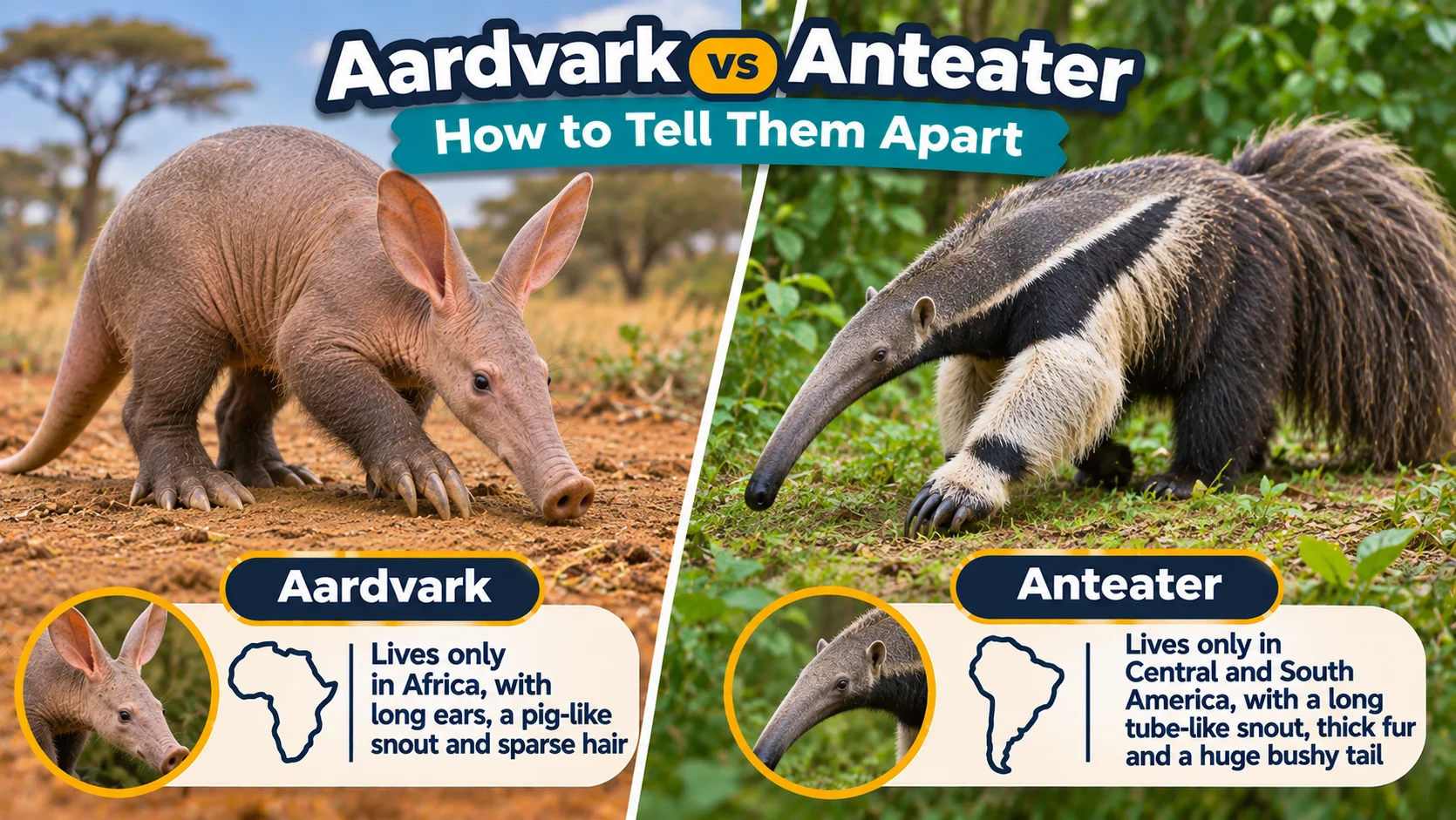
A naming point worth getting right: several unrelated animals eat ants and are not anteaters. The aardvark is African and unrelated. Pangolins are closer to carnivores. The echidna is an egg-laying mammal from Australia. Each of these evolved the same long snout, long tongue and no-teeth arrangement independently, which makes ant-eating one of the best examples of convergent evolution in mammals.
Why It Only Eats for a Minute
An anteater opening a termite mound is attacking an animal that fights back. Soldier ants and termites bite, and some ant species spray formic acid.
So the anteater’s strategy is speed and volume rather than persistence:
- It opens the nest with powerful forelimbs and claws up to four inches long.
- It feeds for around a minute, taking a few thousand insects, then leaves before the defenders mobilize fully.
- It visits up to 200 nests a day, which is why it covers so much ground.
- It rarely destroys a nest, so the colony recovers and can be visited again. The anteater is effectively farming rather than raiding.
Its tongue is built to match: covered in tiny backward-facing spines and coated in saliva from unusually large glands, and it moves fast enough that the anteater does not need to chew or even stop.
Its metabolic rate is among the lowest of any mammal, and its body temperature, around 32.7°C, is one of the lowest too. An animal living on insects cannot afford to run hot.
Appearance and Anatomy
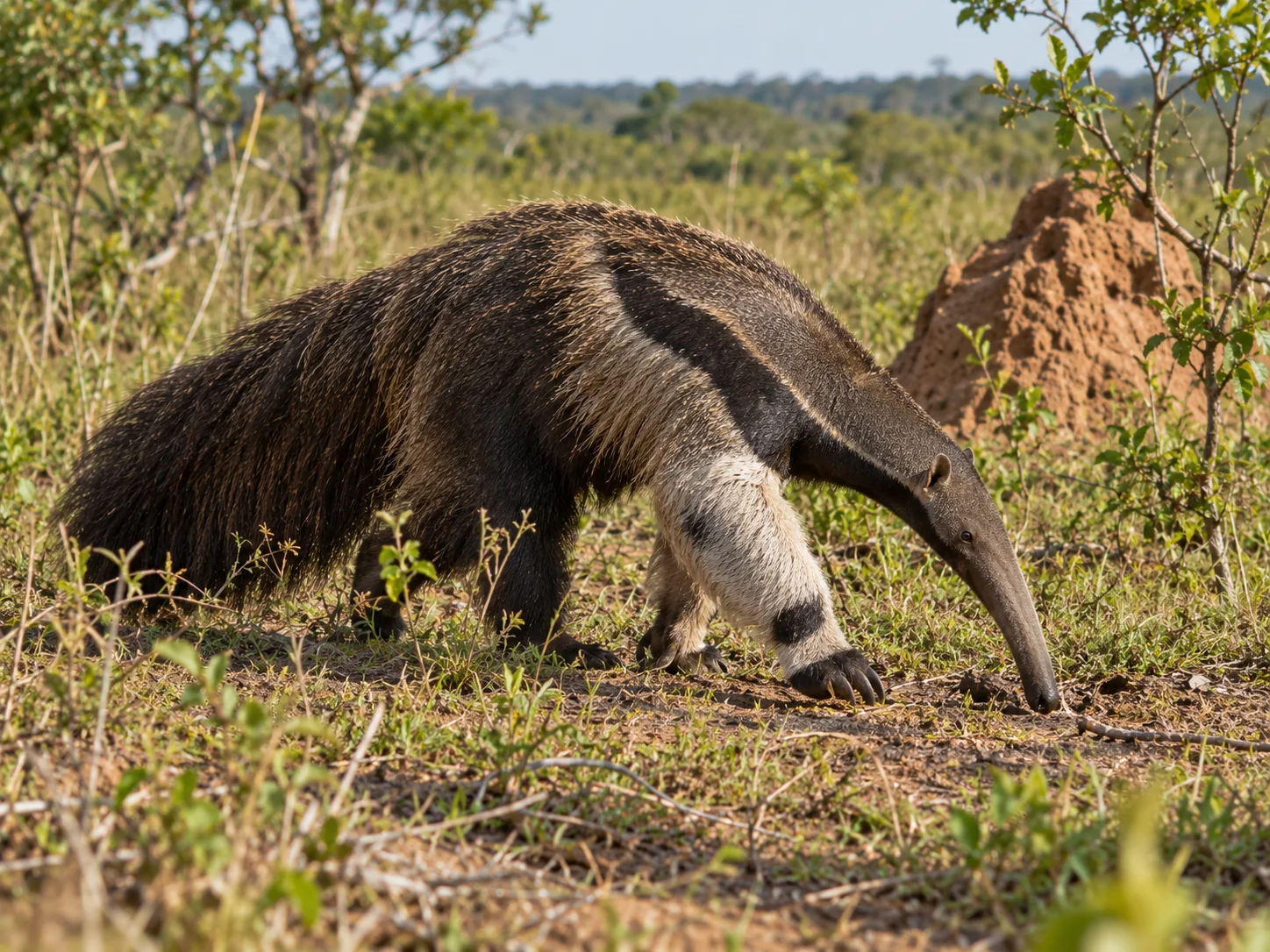
The giant anteater is 6 to 7 feet long including the tail and weighs 60 to 90 pounds (27 to 41 kg). The silky anteater is the other extreme, at about 14 inches and 14 ounces, roughly squirrel-sized.
- No teeth, and a mouth opening only about an inch wide. The stomach grinds food using swallowed grit and strong muscular walls.
- A two-foot tongue attached to the sternum, not the jaw.
- Front claws up to 4 inches, so long that the anteater walks on its knuckles with the claws curled inward, the way a gorilla does, to keep them sharp.
- A bushy tail that in the giant anteater works as a blanket, draped over the body while it sleeps.
- Smell roughly 40 times better than ours, which is how it locates nests. Its eyesight is poor and its hearing unremarkable.
Tamanduas and silky anteaters are tree-dwellers with prehensile tails; the giant anteater is entirely terrestrial.
Habitat and Range
Anteaters live in Central and South America, from Honduras down to northern Argentina, in rainforest, dry forest, savanna, grassland and wetland.
The giant anteater prefers open habitats: the grasslands and wetlands of the Cerrado, the Pantanal and the Llanos, where termite mounds are abundant and visible.
It has already disappeared from parts of its former range, including most of Central America, and is gone from Uruguay and much of southern Brazil.
They need large areas. A giant anteater may range over several square miles, because visiting a couple of hundred nests a day without exhausting any of them requires a lot of nests.
Diet and Feeding
Anteaters are insectivores, and specialized ones. Ants and termites make up almost the entire diet, with occasional fruit, soft eggs or larvae.
They are choosy in a way that reflects the risk. Anteaters avoid the most aggressive and chemically defended ant species, and tamanduas in particular select against ants with strong chemical defenses, so an anteater is not simply eating whatever it finds.
Because they do not drink much, they get most of their water from their food and from licking dew or rain.
This degree of specialization makes them very hard to keep. Captive anteaters cannot be fed ants in sufficient quantity and need carefully formulated substitutes, and getting it wrong causes serious health problems. They are not pets, and the pet trade in tamanduas does considerable harm.
Behavior and Lifestyle
Anteaters are solitary and largely silent, meeting mainly to mate, and they sleep up to 15 hours a day, curled in a shallow depression with that tail pulled over them.
They are mostly nocturnal where people are around and more active by day in undisturbed areas, which is a behavioral shift seen in a lot of hunted animals.
The one thing to know about them is their defense, because it is more serious than their placid appearance suggests. A threatened giant anteater rears onto its hind legs, balancing on its tail, and strikes with those four-inch claws. It is strong enough to injure or kill a jaguar, and there are documented human deaths from anteater attacks in Brazil, generally involving hunters or people who cornered one.
They swim well, using the long snout as a snorkel, and cross rivers readily.
Reproduction and Life Cycle
A single anteater pup is born after about 190 days, already furred and with claws, and it climbs straight onto its mother’s back.
It rides there for up to a year, and the camouflage is remarkable: the stripe on the pup’s flank lines up with the stripe on its mother’s, so from a distance the pair reads as one animal. A pup on its mother’s back is nearly invisible against her.
She nurses it for about six months and it stays with her until she is pregnant again, learning which nests to visit and which ants to avoid.
Anteaters mature at two to four years and live about 14 years in the wild, with captive animals reaching the mid-twenties. A female raises one pup at a time, roughly every year or two, which is slow enough that losses are not quickly replaced.
Predators and Threats
Jaguars and pumas are the main natural predators of adults, and pups are taken by birds of prey and smaller cats.
The human threats are specific, and road deaths are unusually prominent among them. Giant anteaters are poor-sighted, slow and range widely, and roads cut straight through the open country they live in, making vehicle strikes a leading cause of death in parts of Brazil.
Then there is fire. The grasslands they inhabit burn, and anteaters are too slow to escape fast-moving fires. Large numbers died in the Pantanal fires of 2020, and that combination of a slow animal in a fire-prone habitat is becoming more dangerous as fires get larger.
Add habitat conversion to cattle pasture and soy, hunting for meat and for claws, dog attacks, and collection of tamanduas for the pet trade.
Conservation Status
The giant anteater is listed as Vulnerable, with a declining population and local extinctions across its range.
The tamanduas and silky anteater are listed as Least Concern, though the silky anteater is so small, nocturnal and arboreal that very little is known about it, and its status rests on limited information.
What helps is practical and unglamorous: wildlife crossings and fencing on roads through anteater habitat, fire management in grassland reserves, keeping protected areas large enough for animals with multi-square-mile ranges, and working with ranchers, since anteaters do no harm to livestock and are sometimes killed simply for being unfamiliar.
Brazilian conservation groups have run roadkill-reduction and rehabilitation programs in the Cerrado with measurable results, which matters for a species where every breeding female counts.
Role in the Ecosystem
Anteaters are significant regulators of ant and termite populations, and because they take a small share from each of hundreds of nests, they suppress colonies without destroying them.
The nests they break open are then used by other animals, and the holes become shelter and feeding opportunities for lizards, birds and insects.
Their digging turns over soil in grasslands where few other animals excavate.
And the anteater is one of the best illustrations available of how far specialization can go. An animal that gave up its teeth, lowered its body temperature, moved its tongue’s anchor to its breastbone and learned to walk on its knuckles, all in order to eat one kind of food, is extraordinarily good at that food and has almost no fallback. It is also why four unrelated groups of mammals on four continents ended up looking so similar: when a food source is this abundant and this well defended, there turn out to be very few ways to exploit it.