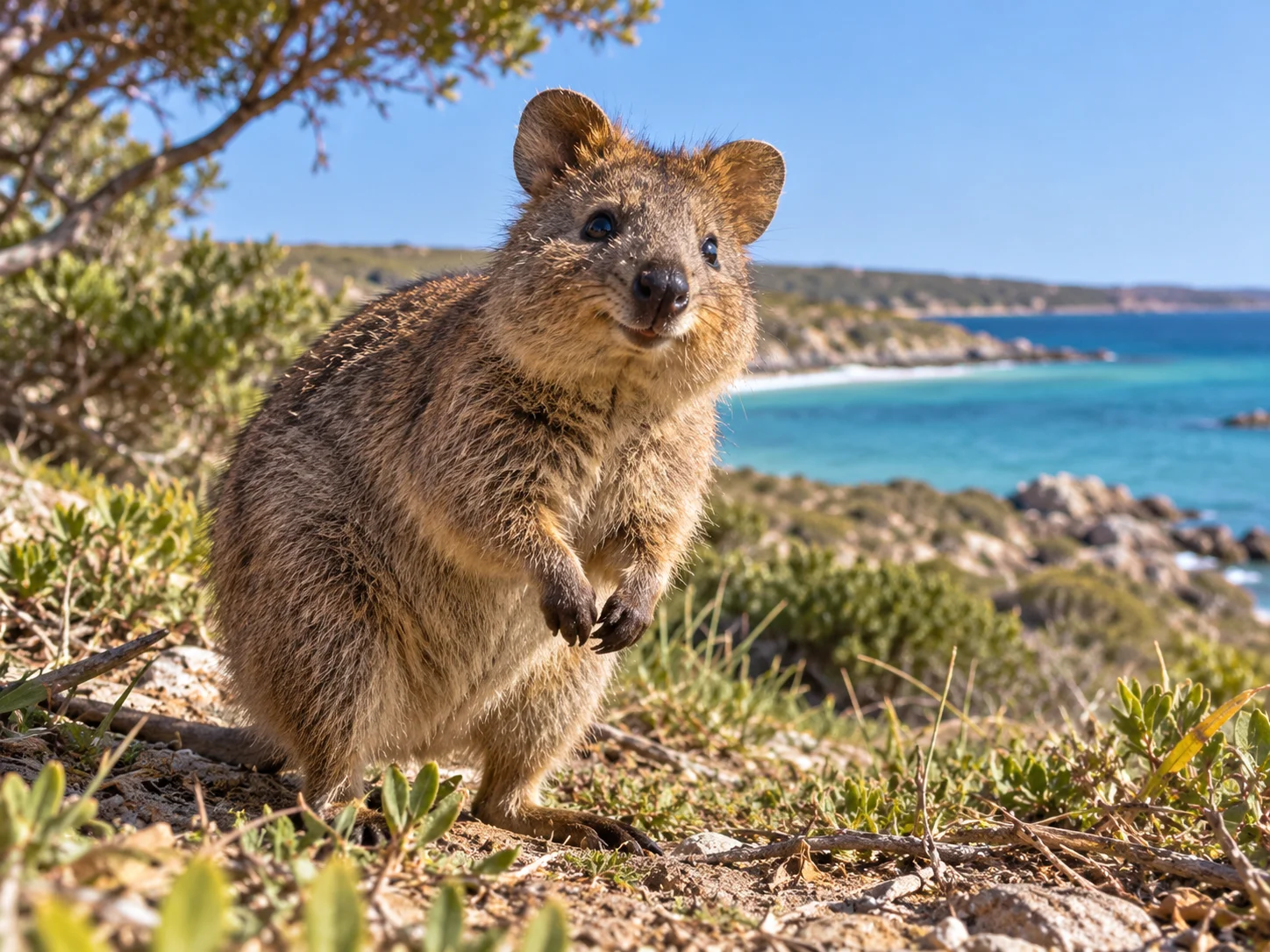
Meet the Quokka
The quokka is often called the happiest animal in the world, and it got the title by accident.
Its mouth curves upward at the corners and its cheeks are rounded, so a quokka photographed head-on looks like it is beaming at the camera. It is not. The face does that whether the animal is pleased, bored or asleep. The smile is the shape of its skull, not a mood.
Behind the famous face is a small marsupial in real trouble. Quokkas are listed as Vulnerable, there may be only around four thousand left on the Australian mainland, and almost everything people know about them comes from one island where they happen to be easy to meet.
Scientific Name and Classification
The quokka is Setonix brachyurus, the only species in its genus.
- Kingdom: Animalia
- Phylum: Chordata
- Class: Mammalia
- Order: Diprotodontia
- Family: Macropodidae
- Genus: Setonix
- Species: Setonix brachyurus
Macropodidae means big foot, and it is the family of the kangaroo and the wallabies. That makes a quokka a very small cousin of a very large animal: same family, same hopping gait, same pouch, about the size of a house cat.
The name quokka comes from the Noongar language of southwestern Australia, where the animal has always lived.
Appearance and Anatomy
A quokka measures 16 to 21 inches (40 to 54 cm) in the body with a tail of 10 to 12 inches (25 to 30 cm), and weighs between 5.5 and 11 pounds (2.5 and 5 kg).
- Thick, coarse brown-grizzled fur, paler underneath
- Short rounded ears and a blunt black nose
- Powerful hind legs for hopping
- Short tail, not used for balance the way a kangaroo uses its own
- Small front paws used to hold and pull down food
The short tail is what the scientific name records: brachyurus means short-tailed. A big kangaroo leans on its tail like a fifth limb, but a quokka is light enough not to need one, and the stub leaves it better suited to scrambling through low tangled scrub.
Habitat and Range
Quokkas live only in the southwestern corner of Western Australia, in three separate situations.
- Rottnest Island, off Perth, which holds the large and famous population
- Bald Island, near Albany, with a smaller one
- Scattered mainland pockets between Perth and Albany, totaling only about 4,000 animals
The two populations behave differently because their circumstances differ. Mainland quokkas need thick ground cover to hide in and will only live where at least 24 inches (600 mm) of rain falls a year. Island quokkas, with far less to fear, range through everything from dry scrub to the gardens of the settlement.
On Rottnest they sleep through the heat of the day in the shade of a spiky shrub called prickly moses, which works as a fence: a predator that wants the quokka has to get through the spines first.
Why Rottnest Island Is Named After Rats
In 1696 the Dutch explorer Willem de Vlamingh landed on the island and found it overrun with what he took to be enormous rats.
They were quokkas. He named the place after the mistake, and the name stuck: Rottnest, from a Dutch phrase he understood to mean rat nest island. One of Australia’s best-known tourist destinations is named after a European getting an animal wrong.
Diet and Feeding
Quokkas are herbivores. They eat grasses, sedges and leaves, pulling branches down with their front paws to reach what they want, and they have clear favorites among the local shrubs.
They digest the way cattle do. A quokka brings food back up and chews it a second time, which lets it pull nutrition out of tough dry plants that would otherwise pass straight through.
They also barely drink. Most of the water a quokka needs comes out of the plants it eats, which is how an animal survives a long dry summer on an island with very little fresh water.
Behavior and Lifestyle
Quokkas are mainly nocturnal, feeding through the night and resting in cover by day, though the island animals are easily tempted out by visitors.
They can climb, which surprises people who expect a hopping animal to stay on the ground. A quokka will go up a small tree or shrub to around 5 feet (1.5 m) to reach leaves out of easy reach.
Their famous tameness is not tameness at all. Rottnest quokkas have had no serious predators for thousands of years, so they never developed much fear of large animals, and a creature with no fear is not friendly, just unworried. That is exactly what makes them so easy to photograph, and so easy to harm.
Reproduction and Life Cycle
A quokka is pregnant for only about a month, and the newborn is tiny and barely formed when it arrives. It crawls into the pouch and attaches to a teat, and the real growing happens there.
The joey stays in the pouch for roughly six months, keeps drinking milk for two more, and is fully weaned at about eight months. Females can breed from around 18 months old and may raise two joeys a year, averaging about 17 over a lifetime.
Adults live about ten years, which is a long time for an animal this size and a reason populations recover slowly once they crash.
Predators and Threats
On Rottnest Island the only natural predator is a snake. On the mainland the picture is completely different: introduced red foxes, feral cats and dogs hunt quokkas, and those animals are the main reason the mainland population is so small.
Habitat loss does the rest. Logging, farming, housing and the draining and burning of swamps have taken away the dense cover mainland quokkas depend on, and bushfires can wipe out a small isolated group in a single season.
The IUCN lists the quokka as Vulnerable. It is an unusual case: a species that is genuinely at risk, while simultaneously being one of the most photographed animals on the internet.
Visiting Quokkas Responsibly
Because quokkas approach people, there are firm rules about what people may do back.
- Touching or handling a quokka is illegal for members of the public
- Feeding them is discouraged, and human food can make them ill
- Rottnest Island authorities can issue a 300-dollar fine for feeding or interfering with one
- Deliberate cruelty carries penalties up to a 50,000-dollar fine and five years in prison
The reasoning is simple. Bread and chips give a quokka nothing it needs and can damage its digestion, and an animal that learns to beg beside a road is an animal in the way of traffic. A photograph taken from a step back costs the quokka nothing.
Role in the Ecosystem
As a grazer, the quokka shapes the low vegetation around it, keeping some plants cropped and spreading seeds through its droppings as it moves between feeding areas.
It also stands for something larger. Quokkas survive in numbers only where foxes and cats do not, so a healthy quokka population is a direct readout on how well introduced predators are being controlled, the same test that applies to the koala and much of Australia’s small native wildlife.
Which is the useful thing to remember behind the smile. The quokka is not a cheerful animal having a lovely time; it is a vulnerable one that happens to look delighted, and the attention its face attracts is worth something only if it turns into care for the places it still lives.