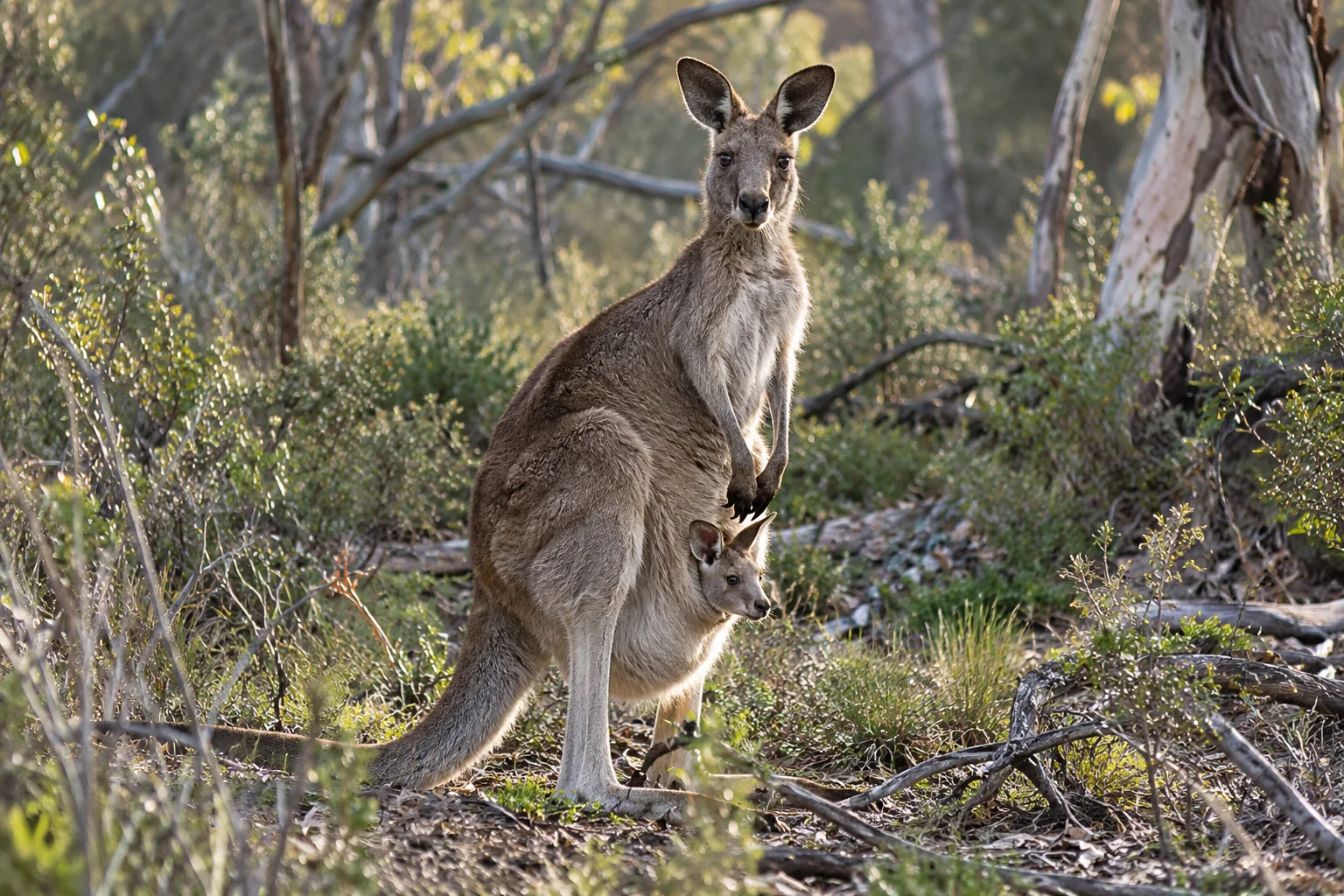
Meet the Kangaroo
A kangaroo is the only large animal on Earth that gets around by hopping. A big red kangaroo can clear 25 feet in one bound and travel at 35 miles an hour, and the strangest part is that going faster costs it almost no extra energy.
There are four species of true kangaroo, all native to Australia and New Guinea. They belong to a much larger family of hopping marsupials that also includes wallabies, wallaroos, tree-kangaroos and quokkas.
A newborn kangaroo is about the size of a jellybean, and it has to climb to the pouch by itself.
Scientific Name and Classification
The four kangaroo species sit in two genera, so there is no single two-word name for “kangaroo”. They belong to the family Macropodidae, meaning “big foot”.
- Kingdom: Animalia
- Phylum: Chordata
- Class: Mammalia
- Infraclass: Marsupialia
- Order: Diprotodontia
- Family: Macropodidae
The four species are the red kangaroo (Osphranter rufus), the eastern gray (Macropus giganteus), the western gray (Macropus fuliginosus) and the antilopine kangaroo (Osphranter antilopinus).
As marsupials they are only distantly related to the mammals most of us know. Their closest relatives are other Australian marsupials such as the koala and the wombat.
Difference Between Kangaroos, Wallabies and Wallaroos
All three are macropods, and the difference is mostly size.
| Size | Build | Where | |
|---|---|---|---|
| Kangaroo | Largest, up to 200 lb | Long legs, built for open country | Open plains and woodland |
| Wallaroo | In between | Stockier, shaggier | Rocky hills and escarpments |
| Wallaby | Smallest, often under 50 lb | Shorter legs, compact | Forest and dense scrub |
The pattern makes sense once you see it: longer legs suit long hops across open ground, shorter legs suit tight turns among trees.
Appearance and Anatomy
A large male red kangaroo stands over 6 feet tall and weighs up to about 200 pounds. Females are much smaller, often half the weight. Gray kangaroos are a little shorter but heavier-built.
- Hind legs. Huge, with tendons that work like springs. Each hop stores energy and gives it back on the next, which is why hopping faster barely costs more effort.
- Tail. Thick and muscular, used as a counterweight in the air and as a fifth limb on the ground. A kangaroo can rest its whole weight on its tail and kick with both feet.
- Feet. Very long, with a claw that can disembowel a dog.
- Forelimbs. Small but strong, used for grooming, feeding and grappling.
- Pouch. Females only, opening forward, with four teats inside.
Kangaroos cannot walk. The hind legs do not move independently, so at slow speeds the animal props on its tail and forelimbs and swings both back legs forward together. Swimming is the one exception: in water the legs kick alternately.
Habitat and Range
Kangaroos live across Australia, with each species taking a different part of it. Red kangaroos hold the arid interior, grays the wetter forests and woodlands of the east and south-west, and antilopine kangaroos the tropical north.
They handle heat and drought extremely well. Red kangaroos can go long stretches without drinking, taking most of their water from plants, and they lick their forearms so evaporation cools the blood running close to the skin.
There are more kangaroos in Australia than people, and in good seasons the population runs into the tens of millions.
Diet and Feeding
Kangaroos are herbivores, grazing on grass, leaves, shrubs and ferns.
Like cattle they ferment tough plant food in a chambered stomach and bring it back up to chew again, though the system evolved quite separately. Their gut microbes produce far less methane than a cow’s, which has interested researchers looking at livestock emissions.
They feed mostly in the cool of early morning and evening, resting in shade through the day, and in dry country will dig down into creek beds to reach water below the surface.
Behavior and Lifestyle
Kangaroos live in groups called mobs, loose gatherings of a few animals up to a hundred. There is safety in numbers: more eyes watching means more warning.
An alarmed kangaroo thumps the ground hard with its hind feet, and the whole mob reacts.
Males box over females and rank. They grapple with the forelimbs, lean back on the tail, and kick forward with both hind feet, which is the part that does the damage. Fights are usually brief and settled on size.
Their hopping is startlingly efficient. The spring-loaded tendons mean a kangaroo uses little more energy at 25 miles an hour than at 12, which is why they cover enormous distances looking for food in dry country.
Reproduction and Life Cycle
Kangaroo reproduction is one of the strangest stories in mammals.
Pregnancy lasts only about 33 days. The newborn, called a joey, is roughly the size of a jellybean, blind, hairless and with barely formed hind legs. It then does something remarkable: using its forelimbs alone, it crawls unaided up through its mother’s fur to the pouch, finds a teat and latches on.
It stays attached for months, leaves the pouch at around six months, and keeps returning for several more.
Then it gets stranger. A female can support three young at once: an embryo on hold, a tiny joey in the pouch, and an older joey outside it. She produces two different kinds of milk from different teats at the same time, each matched to its stage.
She can also pause a pregnancy. In drought the embryo simply stops developing until conditions improve, which lets kangaroos rebuild numbers fast after hard years. They live 8 to 25 years depending on species.
Predators and Threats
Dingoes are the main natural predator of adults. Eagles, foxes and feral cats take joeys. Australia’s largest predators, including a marsupial lion, died out long ago, which is part of why kangaroo numbers are now so high.
A cornered kangaroo fights, and the two-footed kick is dangerous. One documented defense is leading a pursuer into water and holding it under.
Today the biggest killers are vehicles, drought and bushfire. Kangaroos are also culled commercially, which remains contentious.
Conservation Status
All four kangaroo species are listed as Least Concern and none is at risk. Numbers swing enormously with rainfall, falling in drought and recovering quickly afterward.
The debate in Australia is about abundance rather than scarcity. Farming has added water points and pasture across the interior, kangaroo numbers have risen, and they compete with livestock for grass, which is the basis for commercial culling.
Their smaller relatives are a different story. Several wallaby species are threatened or already extinct, mostly because foxes and feral cats hit small macropods far harder than large ones.
Role in the Ecosystem
Kangaroos are Australia’s main large grazers, filling the role that deer and antelope play elsewhere. Their grazing shapes which grasses grow and keeps fuel loads down, which matters in a country that burns.
Their soft feet do far less damage to fragile soil than hooves do, and in dry country that difference is significant.
They spread seeds in their droppings, feed dingoes and eagles, and the holes they dig for water are used by other animals too.