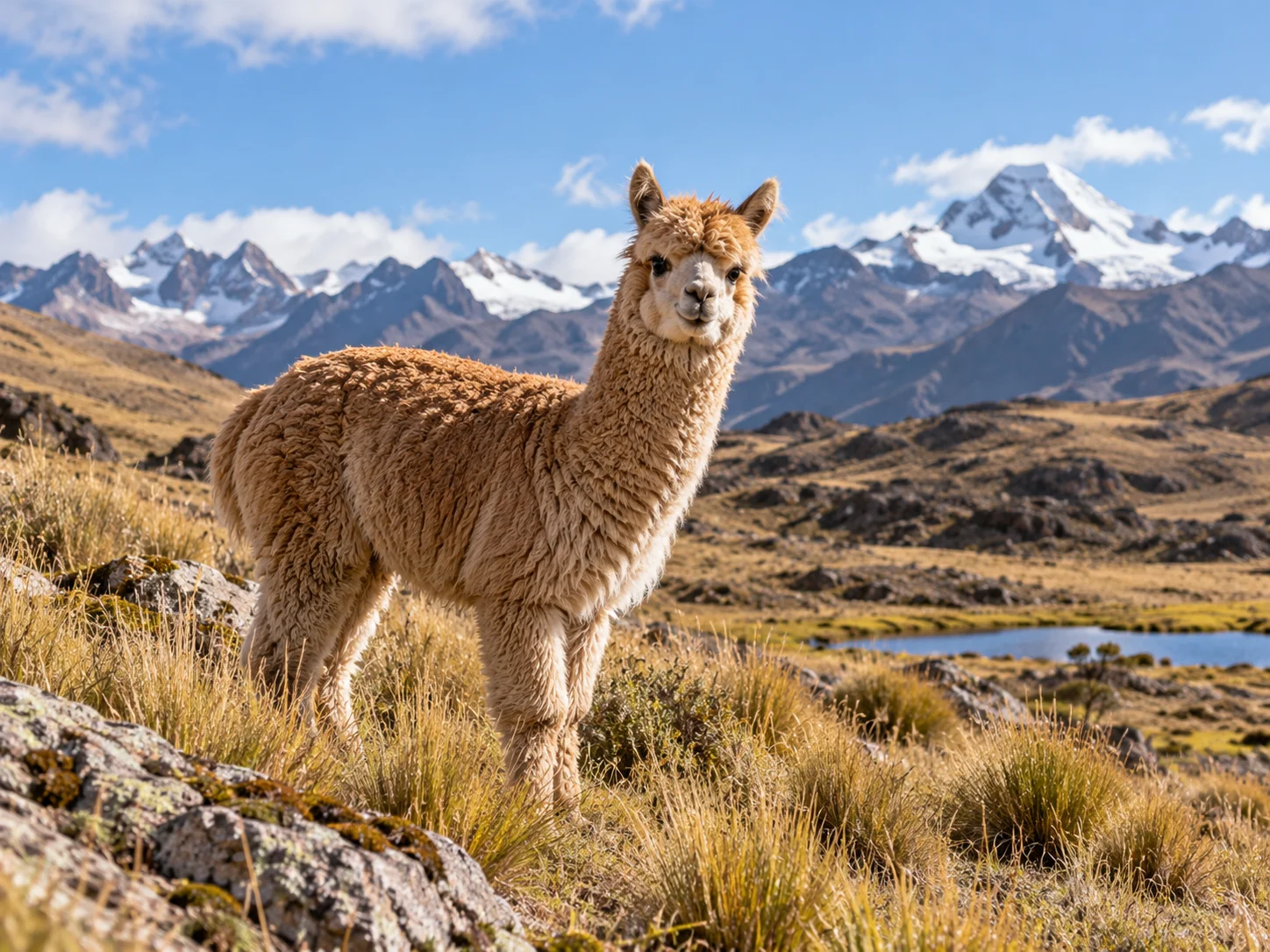
Meet the Alpaca
Alpaca fleece from Inca-era graves is finer than almost anything produced today. Textiles recovered from pre-Columbian burials in Peru contain fiber so thin and so uniform that modern breeders have spent decades trying to get back to it.
What happened in between is the Spanish conquest. The Inca had run a careful breeding system for centuries, with the finest animals reserved for royal cloth, and when the empire fell an estimated 90 percent of the alpacas and llamas were destroyed, along with the records and the breeding program. Survivors were driven into the high Andes, where herds mixed.
Five hundred years later the fleece has still not recovered to Inca standards, which makes the alpaca a rare case of a domestic animal that was measurably better bred a thousand years ago than it is now.
Scientific Name and Classification
The alpaca is Vicugna pacos, and that genus name is the result of a reclassification. Alpacas were long assumed to be domesticated guanacos and placed in Lama, but DNA work published in 2001 showed they descend mainly from the vicuna, so they were moved into Vicugna.
- Kingdom: Animalia
- Phylum: Chordata
- Class: Mammalia
- Order: Artiodactyla
- Family: Camelidae
- Species: Vicugna pacos
Alpacas are camelids, so camels are their relatives, along with the llama, the guanaco and the vicuna. The family evolved in North America and spread south, which is why the South American camelids and the Old World camels are so far apart.
There are two breeds, and the difference is the fleece: the huacaya has dense crimped fiber that gives it a fluffy, teddy-bear look, and the suri has long silky locks that hang in ropes. Huacayas are the great majority.
Alpaca or Llama?
They are different species, and telling them apart is easy once you know what to look at:
- Size. A llama is roughly twice the weight of an alpaca, at 250 to 450 pounds against 100 to 200.
- Ears. Alpaca ears are short and spear-shaped. Llama ears are long and curved, often described as banana-shaped.
- Face. Alpacas have a blunt, woolly face. Llamas have a longer face with much less fleece on it.
- Purpose. Alpacas were bred for fiber. Llamas were bred as pack animals and are still used to carry loads.
- Temperament. Alpacas are timid herd animals. Llamas are bolder and are used as livestock guardians, including for alpacas.
They can interbreed, producing a huarizo, which is usually sterile and is not deliberately bred by anyone serious about fleece.
On spitting: both do it, and it is mostly aimed at each other over food or rank rather than at people. An alpaca that spits at a human has usually been mishandled or bottle-raised into having no fear of people.
Appearance and Anatomy
Alpacas stand 2.8 to 3.4 feet at the shoulder, measure about 4 to 7 feet in body length, and weigh 100 to 200 pounds (45 to 90 kg).
Their anatomy is built for thin air and rough ground at 12,000 feet and above:
- Blood. Oval red blood cells, unlike the round cells of most mammals, and far more of them, which carries oxygen efficiently at altitude.
- Feet. Two toes with a soft pad underneath and a toenail on top, rather than a hoof, so they do not cut up pasture the way sheep and cattle do.
- Teeth. No upper front teeth, just a hard dental pad, so they nip grass off rather than tearing it out by the roots.
- Stomach. Three chambers rather than a cow’s four, and unusually efficient, so an alpaca eats less than a sheep of equivalent size.
The fleece comes in 22 recognized natural colors, more than any other fiber animal, from white through fawn, brown, gray, rose gray and true black. It contains no lanolin, which is why alpaca is wearable by many people who react to sheep’s wool, and the fiber is hollow, making it warmer than wool of the same weight.
Habitat and Range
Alpacas come from the high Andes of Peru, Bolivia, Chile and Ecuador, and are kept worldwide today.
Peru holds the great majority of the world’s alpacas, around three quarters of them, mostly on the altiplano between 11,000 and 16,000 feet, where temperatures swing from well below freezing at night to warm sun by day and the vegetation is sparse tough grass.
They have been exported to the United States, Australia, New Zealand, Britain and Europe since the 1980s, where they are kept for fiber, for breeding stock and increasingly as smallholding animals.
They were domesticated 6,000 to 7,000 years ago from wild vicunas in the Peruvian highlands, which makes them one of the older domestic animals and one of very few domesticated in the Americas at all.
Diet and Feeding
Alpacas are herbivores that live on grass and hay, with mineral supplements where the pasture is poor.
They are extremely efficient grazers, eating roughly 1.5 percent of their body weight in dry matter daily, which is less than a sheep needs, and they chew cud like cattle.
They are also gentler on land than most livestock. Soft padded feet instead of hooves and a habit of nipping rather than pulling grass means an alpaca pasture recovers where a sheep pasture would be worn down, and this is one of the main practical arguments for keeping them.
They need very little grain, and overfeeding is a common mistake with alpacas in wealthy countries, where obesity and the problems that follow are far more common than malnutrition.
Behavior and Lifestyle
Alpacas are herd animals, and this is not a preference but a requirement. An alpaca kept alone becomes chronically stressed and can decline physically, and most countries’ welfare guidance says they should never be kept singly. Three is usually given as the minimum.
They communicate by humming, a soft sound used constantly between herd members and between mothers and young, and by ear and tail posture. The alarm call is a startling high shriek that puts the whole herd on alert.
They use communal dung piles rather than scattering droppings, which is unusually tidy, makes parasite control easier and gives gardeners a famously good fertilizer that can be used without composting.
They are curious but not affectionate, and it is worth saying plainly: alpacas are not cuddly. Most dislike being held or stroked, particularly on the head, and a well-treated alpaca will stand near you and investigate you without wanting to be touched.
Reproduction and Life Cycle
Females have no regular heat cycle and can conceive at almost any time, which is unusual among farm animals and makes breeding easy to schedule.
Gestation is long, 11 to 12 months, and a single cria is born, almost always during daylight hours in the morning. That timing is an Andean adaptation: a cria born in the morning is dry and on its feet before the freezing night.
Crias weigh 12 to 20 pounds, stand within an hour, and are weaned at six to eight months.
Females can breed at around 18 months to two years and produce one cria a year at most. Twins are extremely rare and usually do not survive.
Alpacas live 15 to 20 years, with some reaching 25.
Predators and Threats
Pumas, Andean foxes and feral dogs take alpacas in South America, and domestic dogs, coyotes and foxes are the main problem elsewhere. Crias are the usual victims.
Their defense is the herd and the alarm shriek, and farmers often keep a llama or a guardian dog with the herd, since alpacas themselves will not fight off a predator.
The main threats are economic rather than predatory. Andean herders are among the poorest rural populations in South America, fiber prices are volatile, and much of the value in alpaca products is captured well downstream of the people keeping the animals.
Climate is becoming serious. The high Andean grasslands depend on glacial meltwater and seasonal rain, and changing patterns plus retreating glaciers are reducing grazing in exactly the places where alpacas are the only viable livestock.
Shearing is also worth being clear about. Alpacas must be shorn annually, because the fleece does not stop growing and an unshorn alpaca in a warm climate can die of heat stress. Done properly it takes a few minutes and is essential, not exploitative.
Conservation Status
The alpaca is a domestic animal and is not assessed for conservation. There are around 4 to 5 million worldwide, the great majority in Peru.
Its wild ancestor is a better story. The vicuna was hunted for its exceptionally fine fleece and fell to around 6,000 animals by the 1960s. Protection, community management and a system in which Andean communities round up wild vicunas, shear them and release them, keeping the proceeds, has brought the species back to several hundred thousand. It is one of the most successful wildlife recoveries anywhere, and it works because the animal is worth more alive and shorn than dead.
The genetic concern for alpacas is fiber quality rather than numbers. Centuries of uncontrolled crossing after the conquest left the fleece coarser than it was, and Peruvian breeding programs are now working to recover fineness, in part by studying the textiles in those graves.
Role in the Ecosystem
Alpacas are the reason people can live on the Andean altiplano at all. At 13,000 feet, where almost no crops grow and cattle and sheep cannot thrive, alpacas convert tough grass into fiber, meat and manure, and they have supported human communities there for 6,000 years.
Their padded feet and grazing habits make them the least damaging livestock for fragile high-altitude grassland, which matters because that grassland stores carbon and regulates water supply for everything below it.
Alpaca fiber is also a genuinely good environmental proposition compared with most textiles: no lanolin so less processing, naturally colored so less dye, warm so less of it needed, and produced by an animal that needs no grain and damages no pasture.
And the Inca comparison is worth sitting with. A pre-industrial civilization, with no microscopes and no genetics, bred a fiber animal to a standard that modern breeders with laboratories are still working to match. Whatever they knew about selecting animals, they knew it very well, and most of it was lost in a single century.