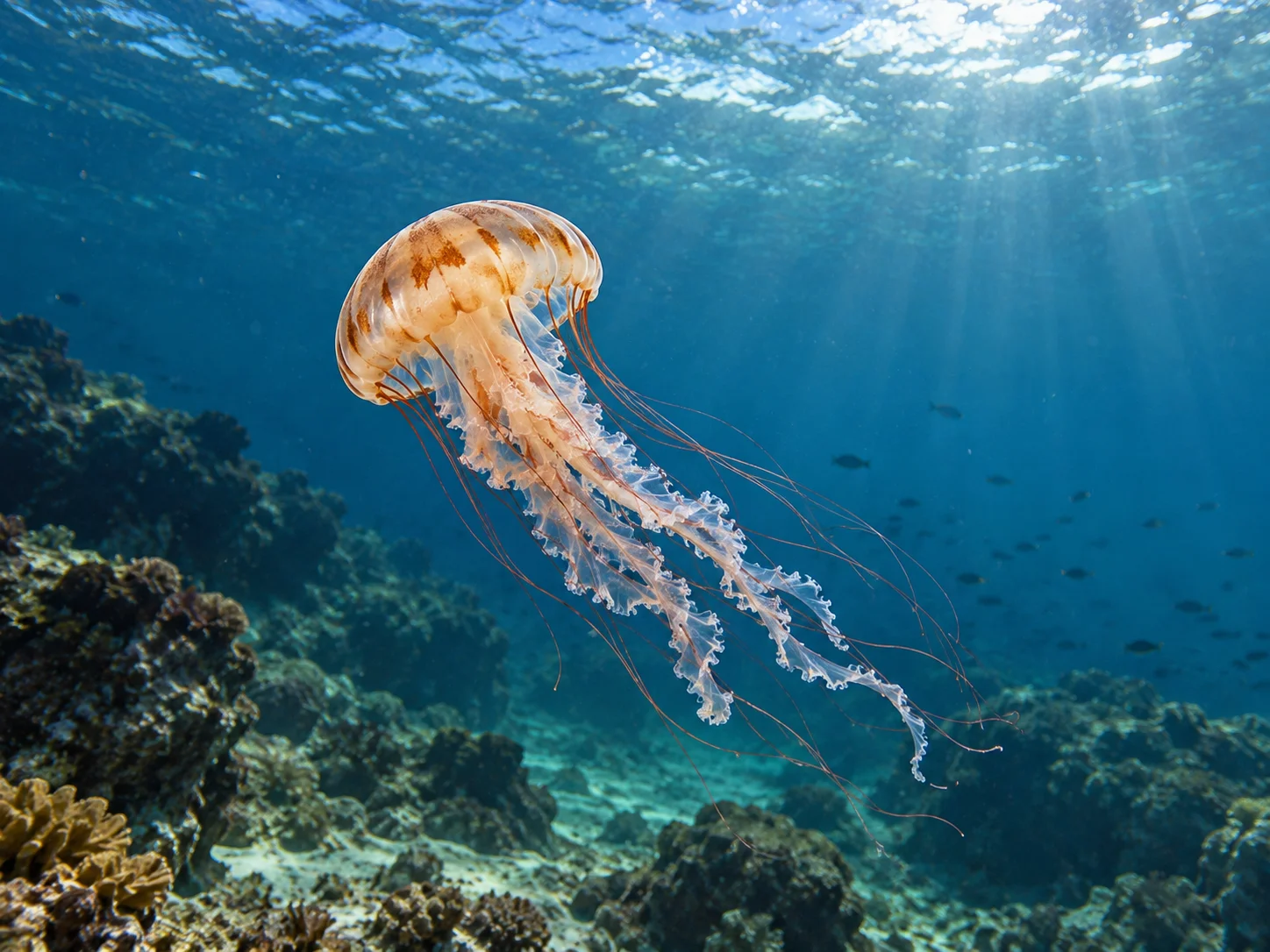
Meet the Jellyfish
A jellyfish has no brain, no heart, no bones, no blood and no lungs. It is about 95 percent water. Jellyfish are soft-bodied ocean drifters of the class Scyphozoa, around 200 species of them, and they are among the oldest animals in the sea.
With none of that equipment it has survived in the oceans for more than 500 million years, which makes jellyfish older than dinosaurs, older than sharks, and older than trees.
One of them does something no other animal can do: it can grow backwards into a younger version of itself, apparently indefinitely.
Scientific Name and Classification
True jellyfish form the class Scyphozoa, with around 200 species, so there is no single two-word name.
- Kingdom: Animalia
- Phylum: Cnidaria
- Class: Scyphozoa (true jellyfish)
The phylum Cnidaria also holds corals, sea anemones and the box jellyfish, which belong to a separate class, Cubozoa. So the most dangerous jellyfish in the sea is, strictly speaking, not a true jellyfish.
And despite the name, a jellyfish is not a fish. It has no backbone, no gills and no fins. Marine biologists increasingly call them sea jellies for exactly that reason.
How Does a Jellyfish Sting?
With thousands of microscopic harpoons, and they are not under the animal’s control.
A jellyfish tentacle is covered in cells called cnidocytes, each containing a coiled, venom-filled thread called a nematocyst. Touch triggers it mechanically, and the thread fires out and injects venom in a few millionths of a second. It is one of the fastest movements in all of biology.
Because the trigger is mechanical rather than a decision, a dead jellyfish on the beach can still sting you, and so can a detached piece of tentacle floating in the water. That is why you should never pick one up, however lifeless it looks.
If you are stung: leave the water, rinse the area with seawater rather than fresh water, remove tentacles with tweezers or a gloved hand rather than bare fingers, and seek medical help for a severe sting or any sting from a box jellyfish. Vinegar helps with some species, including box jellyfish, but can make others worse, so follow local beach advice.
And despite a famous television episode, do not use urine. It does not help and may fire more nematocysts.
Appearance and Anatomy
Jellyfish range from a few millimeters to the lion’s mane jellyfish, whose bell can reach 7 feet across with tentacles trailing over 100 feet, longer than a blue whale.
- Bell. The umbrella-shaped body, made of a jelly-like layer called mesoglea sandwiched between two thin sheets of cells.
- No brain. Instead a nerve net spread through the body, which coordinates swimming and responses without any central control.
- No heart or blood. Oxygen diffuses straight in through the thin body wall.
- One opening. The mouth is also the exit. Food goes in and waste comes out the same way.
- Statocysts. Tiny balance organs around the bell rim that tell the animal which way is up.
Box jellyfish go further and have real eyes, 24 of them, including some with lenses and retinas. What an animal with no brain does with image-forming eyes is a question researchers are still working on.
Habitat and Range
Jellyfish live in every ocean on Earth, from warm shallow bays to polar seas and down into the deep ocean trenches.
A few live in fresh water, and one lake in Palau holds millions of golden jellyfish that have lost most of their sting, having been isolated with no predators for thousands of years.
They are poor swimmers and drift with currents, pulsing the bell mainly to stay at the right depth rather than to travel. That is why they wash up in such numbers after storms.
Diet and Feeding
Jellyfish are carnivores, eating plankton, fish eggs, fish larvae, small fish, crustaceans and other jellyfish.
They do not hunt. They drift with tentacles trailing and wait for something to swim into them, then the nematocysts fire, the prey is paralyzed, and the tentacles move it to the mouth.
It is a strategy that costs almost nothing in energy, which is a large part of why such a fragile animal has lasted half a billion years.
Some species take a shortcut. The upside-down jellyfish lies on the seabed with its tentacles pointing up, farming algae in its own tissues and living partly on the sugars they produce, much as coral does.
Behavior and Lifestyle
With no brain, almost everything a jellyfish does is a direct response to its surroundings rather than a decision.
They gather in enormous groups called blooms or smacks, sometimes millions of animals, usually where currents concentrate them and food is plentiful.
Many glow. Bioluminescence is common among jellyfish, used to startle predators or attract prey, and a green fluorescent protein first isolated from a jellyfish is now one of the most important tools in biology, used to make living cells light up under a microscope. It won a Nobel Prize.
Research has found that jellyfish rest at night with reduced activity, meeting the scientific definition of sleep. An animal with no brain still sleeps.
Reproduction and Life Cycle
A jellyfish lives two completely different lives.
Eggs and sperm are released into the water, and the larva that results settles on the seabed and becomes a polyp, a small anemone-like stalk fixed in place. The polyp can live for years, and buds off tiny jellyfish that float away and grow into the familiar drifting adult, the medusa.
Most adult jellyfish live only a few months to a year.
Then there is Turritopsis dohrnii, the immortal jellyfish. Under stress or injury, instead of dying it can reverse its development, its cells transforming back into a polyp, which then buds new adults. It is the only animal known to reliably run its life cycle backwards, and in principle it can do so indefinitely. In practice they are still eaten and still get sick, so they do die; they just do not have to die of being old.
Predators and Threats
Sea turtles eat them in quantity, particularly leatherbacks, along with sunfish, some seabirds and other jellyfish. Several of those predators are declining.
Jellyfish themselves face few threats, and that is the problem. Human activity tends to suit them: overfishing removes the fish that compete with them for plankton and the fish that eat their young, warming water speeds up their breeding, fertilizer runoff creates low-oxygen zones that jellyfish tolerate better than fish, and harbor walls and oil platforms give polyps new surfaces to settle on.
Plastic bags in the sea look exactly like jellyfish to a turtle, which kills the predator rather than the prey.
Conservation Status
Jellyfish are not generally threatened, and the concern runs the other way: in several seas they are increasing.
Large blooms have clogged fishing nets, blocked the cooling water intakes of power stations and forced beaches to close. In 2007 a bloom wiped out an entire salmon farm in Northern Ireland.
Scientists are careful here, because jellyfish numbers have always risen and fallen in cycles and long-term records are patchy. The honest position is that some regions are clearly seeing more jellyfish, and whether that is a global trend is still being argued.
Either way, a sea with many jellyfish and few fish is usually a sea that has been overfished.
Role in the Ecosystem
Jellyfish are both predator and prey in the open ocean, eating plankton and fish larvae and feeding turtles, sunfish and seabirds.
They provide shelter too. Juvenile fish and small crustaceans ride beneath the bell, protected by the stinging tentacles from animals that would otherwise eat them, which is a safe place to grow up in an ocean with nowhere to hide.
When they die and sink they carry carbon to the seafloor, and those falls feed deep-sea scavengers.
Their contribution to human knowledge is larger than most animals’. The glowing protein taken from one jellyfish let scientists watch processes inside living cells for the first time, and that single discovery has shaped modern medicine and biology.